

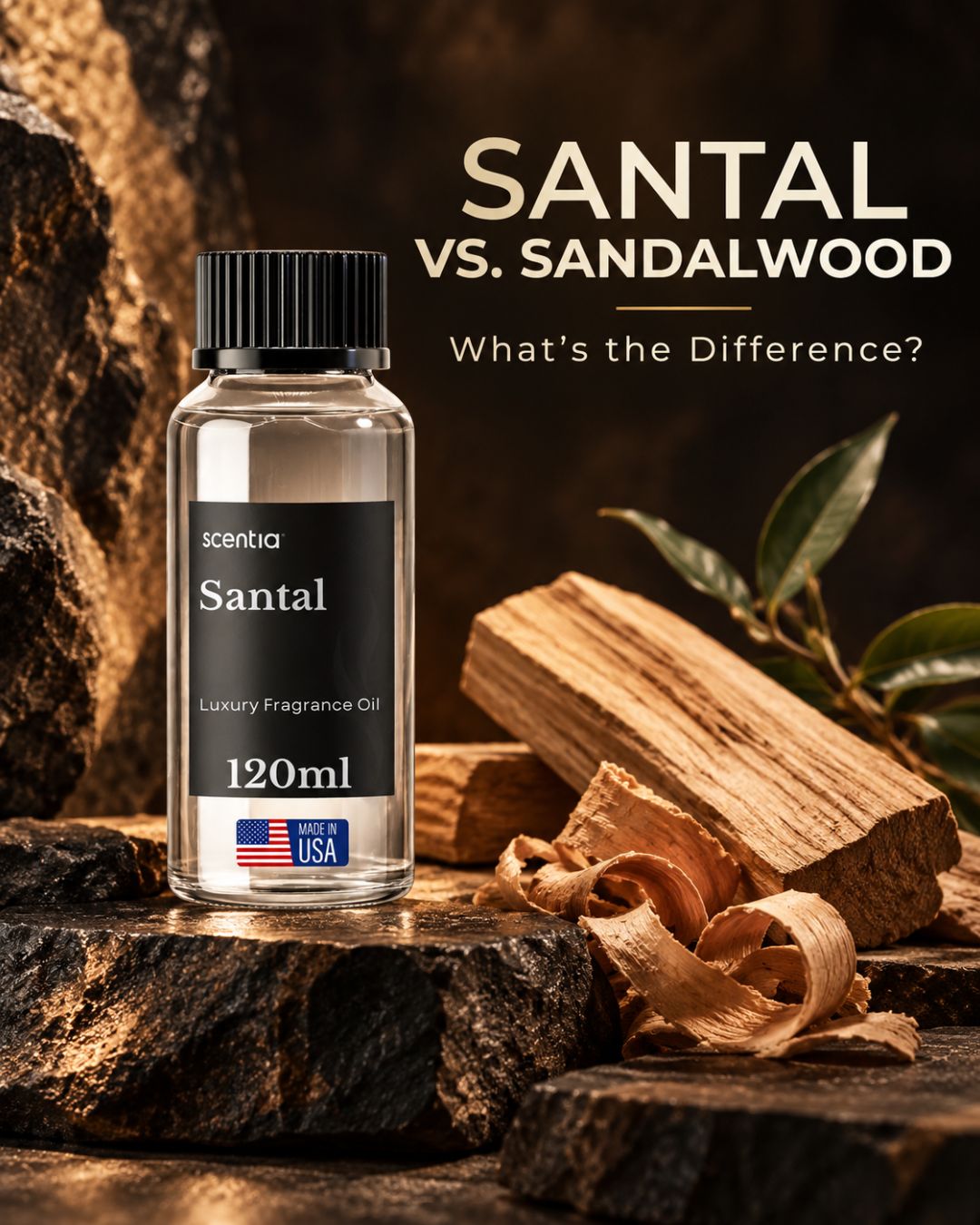
Quick answer: Sandalwood is a raw material: the fragrant heartwood of the Santalum tree, with a soft, creamy, milky-woody scent. Santal is a fragrance style built around sandalwood but layered with other notes, most often cardamom, iris, leather, violet, or musk, giving it a drier, spicier, more modern character. All santal fragrances contain a sandalwood accord; not all sandalwood fragrances are santal.
What is sandalwood?
Sandalwood is the wood (and the oil distilled from it) of trees in the Santalum genus, most famously Indian sandalwood (Santalum album) and Australian sandalwood (Santalum spicatum). On its own it smells smooth, warm, slightly sweet, and milky, with a soft woodiness that sits close to the skin rather than projecting. It has been used in incense and perfumery for centuries and is one of the most common base notes in fragrance.
Because true sandalwood oil is scarce and expensive, most modern home and personal fragrances use a sandalwood accord: a blend of natural and synthetic materials that recreate the creamy-wood profile. For a deeper look at the note itself, read our sandalwood fragrance note guide.
What is santal?
"Santal" is simply the French word for sandalwood. In fragrance, though, it has come to describe a specific style rather than the raw material. A santal fragrance takes the sandalwood base and pairs it with contrasting notes to make it feel drier, cooler, and more contemporary. The classic santal structure is:
- Top: cardamom, pink pepper, or a hint of citrus
- Heart: iris, violet, or papyrus
- Base: sandalwood accord, cedar, leather, ambrox, musk
The result reads as "sandalwood, but sharper." It is the profile behind many of the best-known modern niche fragrances and the reason "santal" became a search term in its own right. Our santal fragrance note guide covers what it smells like in detail.
Santal vs. sandalwood: side by side
| Sandalwood | Santal | |
|---|---|---|
| What it is | A raw material (wood / oil / accord) | A fragrance style built on sandalwood |
| Smell | Creamy, milky, soft, warm, slightly sweet | Dry, spicy, leathery, cool, modern |
| Typical companions | Vanilla, rose, amber, oud | Cardamom, iris, leather, violet, musk |
| Feels | Comforting, meditative, traditional | Sophisticated, urban, unisex-leaning masculine |
| Best rooms | Bedroom, meditation space, bathroom | Living room, home office, entryway |
Is santal the same as sandalwood?
No. The words are linguistically the same, but in practice they describe different things. If a product is labeled "sandalwood," expect the soft creamy wood front and center. If it is labeled "santal," expect sandalwood as the foundation with a drier, spicier overlay. Someone who loves one will not automatically love the other: sandalwood fans sometimes find santal too sharp, and santal fans sometimes find pure sandalwood too sweet.
Which one should you choose for your home?
Choose sandalwood if you want warmth and calm: a bedroom scent, something for winding down, a backdrop for a bath or a yoga corner. It pairs naturally with vanilla and amber. See best scents for sleep for how sandalwood fits into an evening routine.
Choose santal if you want the room to feel considered: a living room, an entryway, a home office. It is the scent profile most people mean when they say a space smells "expensive" without smelling sweet. Scentia's Santal fragrance oil is built on this structure, a sandalwood base with cardamom and iris, and is part of the Designer Collection.
If you cannot decide, the answer is usually to try santal in a cold-air diffuser at a low intensity. In a cold-air diffuser the dry-woody character comes through cleanly, without the heavy sweetness that a candle or warmer can add.
Where do these notes sit in the bigger picture?
Both belong to the woody fragrance family. Sandalwood is a soft wood; santal leans toward the dry, spicy end of woody alongside cedar and vetiver. For how woody fits against fresh, floral, oriental, and the other families, see fragrance families explained, or browse the full fragrance notes hub.
Frequently asked questions
Is santal a type of sandalwood?
Santal is the French word for sandalwood, but in fragrance it names a style: a sandalwood base layered with spicy, dry, or leathery notes. It is built on sandalwood rather than being a type of it.
What does santal smell like compared to sandalwood?
Sandalwood smells creamy, soft, and slightly sweet. Santal smells drier and spicier, often with cardamom, iris, or leather on top of the sandalwood base.
Is santal masculine or feminine?
Santal is generally treated as unisex with a lean toward masculine, because of its dry, spicy character. Pure sandalwood reads as softer and more neutral.
Can I diffuse santal and sandalwood together?
Yes. They share a base, so they layer naturally: sandalwood softens santal's sharpness and santal gives sandalwood more lift. Start with more sandalwood than santal and adjust.
Why is santal so popular right now?
A handful of widely worn niche fragrances made the dry, spicy sandalwood profile the signature "modern luxury" scent of the last decade. Home fragrance followed, and santal became a search term in its own right.



Leave a comment
All comments are moderated before being published.
This site is protected by hCaptcha and the hCaptcha Privacy Policy and Terms of Service apply.