

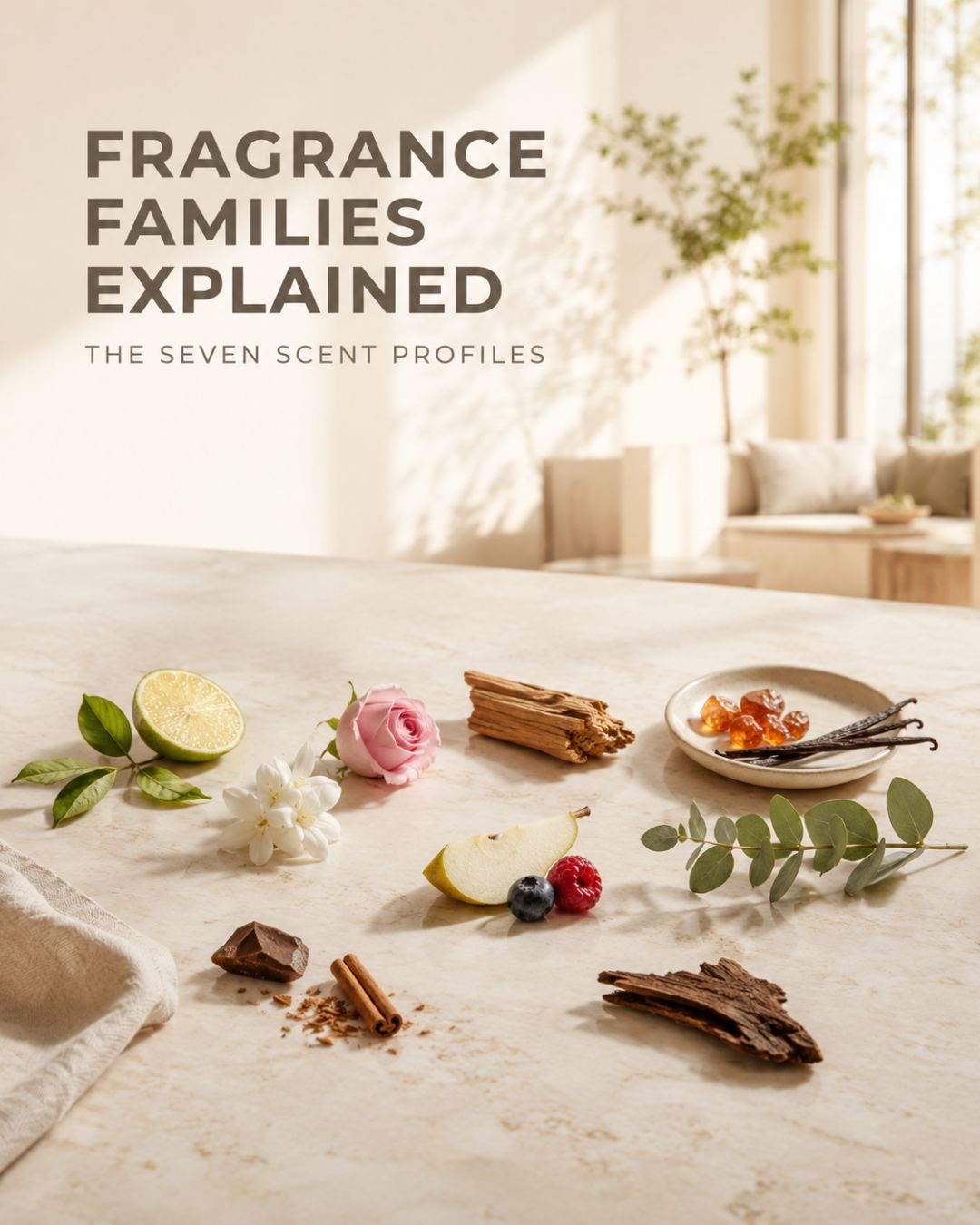
Most people buying home fragrance are choosing by product name and photograph, which is roughly like choosing wine by label. Fragrance families are the shortcut. Learn the seven and you can predict whether you will like something before you smell it.
A family describes the dominant character of a blend. Almost nothing sits purely in one, and the interesting scents usually sit across two. But the family tells you the shape of the thing.
Woody
Dry, warm, grounded. This is the family that reads as expensive without trying, which is why so much hotel and spa scenting leans on it.
Key notes: sandalwood, cedar, vetiver, oud. Sandalwood is creamy and soft. Cedar is sharper and drier. Oud is dense and slightly animalic, and it is the one people either love immediately or find far too much.
Best in: living rooms, offices, entryways. Woody scents fill a space without demanding anything.
Floral
The largest family and the most misunderstood, because most people picturing "floral" are picturing an old-fashioned soliflore. Modern florals are usually built around one flower with something dry underneath to keep them from turning sweet.
Key notes: jasmine, rose, freesia, tuberose, orange blossom. Jasmine is rich and slightly indolic. Freesia is light and clean.
Best in: bedrooms, bathrooms, dining rooms. Be careful with intensity. Florals go from lovely to overwhelming in a very short distance.
Citrus
Bright, sharp, immediate. Citrus is the fastest family to register and the fastest to fade, which is why it is almost always a top note rather than the whole composition.
Key notes: bergamot, lemon, grapefruit, neroli. Bergamot is the sophisticated one, more bitter and floral than lemon.
Best in: kitchens, entryways, mornings. Citrus reads as clean in a way no other family manages.
Fresh
Overlaps with citrus and aquatic and is distinct from both. Fresh is green, airy, slightly cool. Think cut stems, linen, tea.
Key notes: white tea, green tea, cucumber, bamboo, aloe. White tea is the quiet centre of a lot of spa scenting.
Best in: anywhere you want the room to feel clean rather than scented. The safest family for guests and shared spaces.
Gourmand
Edible. Vanilla, caramel, tonka, coffee, chocolate, spice. Gourmands are the most immediately comforting family and the easiest to overdo.
Key notes: vanilla, tonka bean, cinnamon, cardamom.
Best in: living rooms in winter, and almost nowhere in July. Keep gourmands away from kitchens, where they compete with actual food, and out of small enclosed spaces.
Amber and oriental
Warm, resinous, slightly smoky. This is the family behind most "luxury hotel" scenting, usually blended with wood.
Key notes: amber, leather, incense, myrrh, patchouli. Amber is soft and enveloping. Leather is drier and more architectural.
Best in: evening spaces. Studies, dining rooms, anywhere you want the room to feel like it has weight. Noir Mystique lives here.
Aquatic and marine
Salt, air, mineral coolness. The newest family of the seven and the one closest to what people mean when they say a place smells like a resort.
Key notes: sea salt, driftwood, ozonic accords, marine mineral notes.
Best in: open-plan spaces, bathrooms, anywhere with light. Coastal and Miami One both draw on this.
How to use this
Two practical rules.
First, adjacent families layer well and distant ones fight. Woody and amber sit beside each other and blend easily. Gourmand and aquatic do not, and a home running both in adjoining rooms smells confused rather than layered.
Second, match the family to what the room is for. Fresh and citrus in working spaces. Woody and amber where people sit in the evening. Floral where you want softness. It sounds obvious written down and almost nobody does it.
If you only remember one thing: fresh and woody are the two families that are hardest to get wrong.
The fastest way to find your family is to smell several side by side rather than reading about them. A sample set costs less than a single full bottle and settles the question in an afternoon. Once you know, browse by scent and buy properly.
Frequently Asked Questions
What are the main fragrance families?
Woody, floral, citrus, fresh, gourmand, amber and oriental, and aquatic. Most blends sit across two of them rather than purely in one.
Which fragrance family is best for a home?
Fresh and woody are the most forgiving. They fill a space without dominating it and are the least likely to bother guests.
What is the difference between fresh and aquatic?
Fresh is green and airy, built on notes like tea, cucumber and bamboo. Aquatic is cooler and more mineral, built on salt, ozonic accords and driftwood.
Can I mix fragrance families?
Adjacent families layer well, such as woody with amber or fresh with citrus. Distant pairings like gourmand with aquatic tend to clash.
How do I work out which family I like?
Smell several side by side rather than reading descriptions. A sample set is the cheapest way to test a range before committing to a full bottle.
Find your family in an afternoon
Sample sets let you smell across the range side by side before committing to a full bottle.
Not sure which fragrance fits your home? See how to choose a home fragrance by mood, fragrance family and room →
Turn fragrance families into a home scent: use our Signature Scent Guide or try the Scent Finder.



Leave a comment
All comments are moderated before being published.
This site is protected by hCaptcha and the hCaptcha Privacy Policy and Terms of Service apply.