

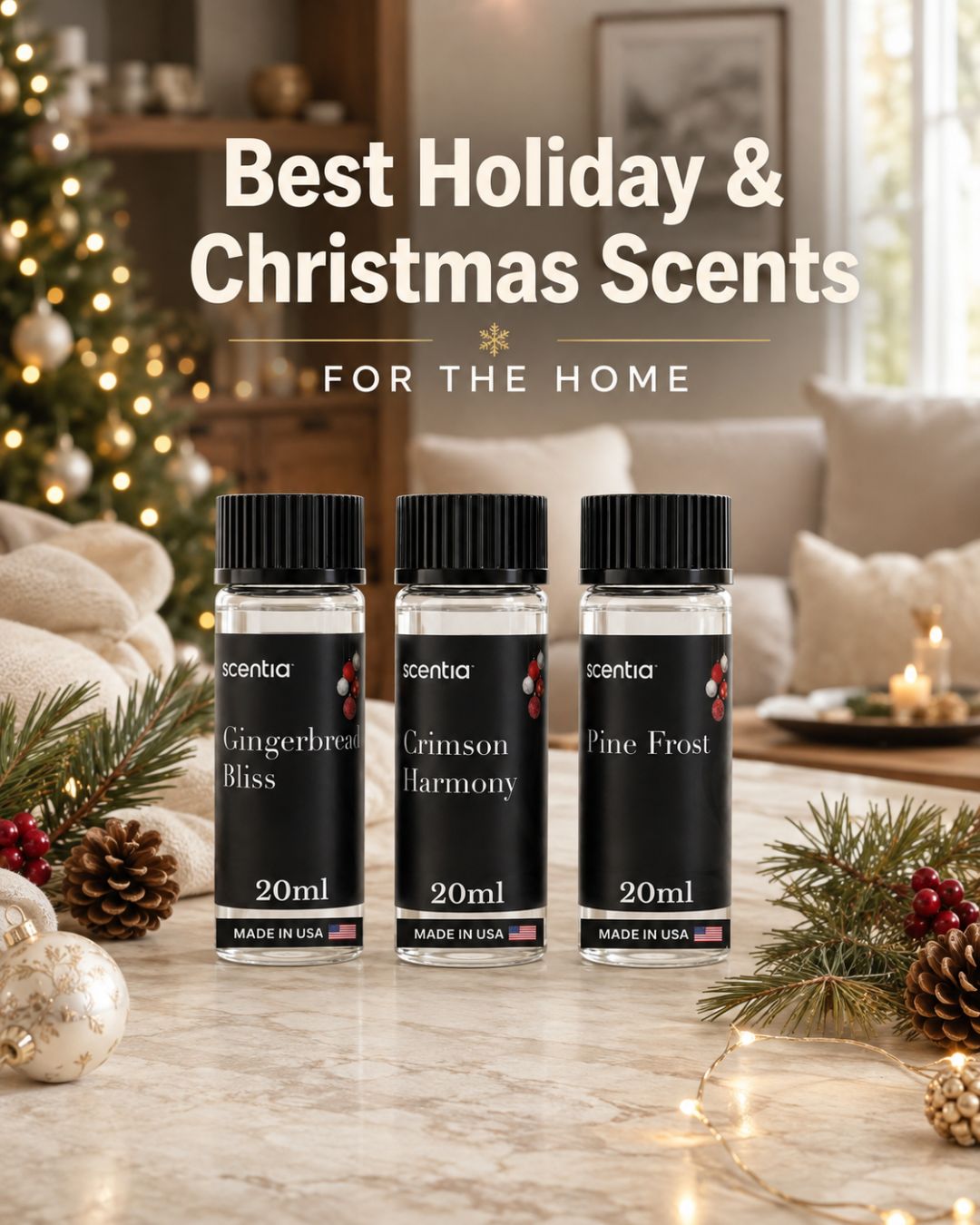
Holiday scenting has a specific difficulty that no other season has. You are scenting a house that is simultaneously hosting more people, cooking more food, and running with every window shut. Get the intensity wrong and it is the only thing anyone notices.
The four notes that actually say holiday
Frankincense. Resinous, dry, faintly smoky. It is the note doing most of the work in scents that feel ceremonial rather than seasonal, and it is badly underused in home fragrance. If you want a house that feels like the holidays without feeling like a gift shop, start here.
Fir and pine. The obvious one, and worth being careful with. Real fir is green, sappy and slightly bitter. Most commercial pine fragrance is sharp and reads as cleaning product. The difference is whether the blend has anything warm underneath it.
Warm spice. Cinnamon, clove, nutmeg, star anise. Used at the base of a blend it is lovely. Used at the top it is a scented candle from a mall kiosk.
Vanilla. The rounding agent. Vanilla underneath resin and spice softens the whole thing and makes it feel domestic instead of formal. On its own it is a dessert.
The dinner table problem
This is where most holiday scenting goes wrong, and it is worth taking seriously because the failure is social rather than aesthetic.
You are cooking a large meal. The kitchen is producing an enormous amount of its own smell, most of it good. Meanwhile a diffuser is running a spiced blend in the next room. Those two things do not layer. They compete, and what people experience is a muddle neither you nor the food deserves.
The fix is simple and almost nobody does it. Turn the fragrance off in and around the eating area before you cook. Not down. Off. Let the food be the smell in that part of the house, and let fragrance handle the rooms people arrive in and sit in afterwards.
A working plan for a house full of people
| Space | Approach |
|---|---|
| Entryway | Run it, and run it a little stronger than elsewhere. This is the only room where a first impression matters more than comfort. |
| Living room | Resin and warm spice, moderate. This is where people will spend hours, so err low. |
| Dining room | Off during and before the meal. Back on afterwards if you like. |
| Kitchen | Off entirely. |
| Guest room | Something neutral and light. A strong scent in a room someone is sleeping in is an imposition. |
| Bathroom | Fresh or citrus, not holiday. It should read as clean. |
The guest room row matters more than it looks. Your favourite scent at your favourite intensity is a lot to inflict on someone who has no way to turn it off at two in the morning. Light, or nothing.
Timing
Fragrance needs a week in a space before it settles and stops announcing itself. Switch over in the first half of November if you want the house to feel right by the time people arrive, rather than smelling like you scented it that morning, which is a real and detectable thing.
Hold the heaviest blends for the last two weeks of December. Running full resin and spice from early November means you will be tired of it before the actual holiday.
Scenting for guests, not for yourself
Two rules that apply all year and matter most now.
First, you have gone nose blind to your own home and your guests have not. Whatever level feels right to you is very likely too strong for someone walking in from outside. Turn it down and trust the arithmetic rather than your nose.
Second, closed windows change everything. A house sealed against winter has far less air exchange than the same house in June, so the setting that was subtle in summer is heavy now. This is the single most common holiday scenting mistake and it is entirely fixable by turning a dial. We go through it properly in scenting without overdoing it.
As a gift
Home fragrance is one of the few gifts that is genuinely used rather than stored, provided you do not pick something aggressively personal. Fresh, woody and light amber blends are the safe range. Heavy gourmands and dense florals are not, however much you like them.
A sample set is the better gift for someone whose taste you do not know, because it hands the choice back to them. The gifting guide breaks it down by recipient.
The Holiday Collection is built around resin, fir and warm spice, and the starter kits pair a diffuser with oils if you are giving the whole thing.
Frequently Asked Questions
What scents make a home feel like Christmas?
Frankincense, fir, warm spice such as cinnamon and clove, and vanilla underneath to round it out. Resin-led blends feel more like the season than sweet ones.
Should I diffuse fragrance while cooking a holiday meal?
No. Turn it off in the kitchen and dining area before you start cooking. Fragrance and food smells compete rather than layer, and the food should win.
When should I start using holiday scents?
Early to mid November for lighter blends, with the heaviest resin and spice held for the final two weeks of December. Fragrance takes about a week to settle into a space.
Why does my house smell too strong in winter?
Closed windows mean far less air exchange than in summer, so the same diffuser setting produces a much stronger result. Turn it down when the house gets sealed up.
Is home fragrance a good gift?
Yes, if you avoid anything aggressively personal. Fresh, woody and light amber blends suit most people. A sample set is safer than a full bottle when you do not know their taste.
Resin, fir and warm spice
The Holiday Collection, built for a house full of people rather than a candle aisle.

Leave a comment
All comments are moderated before being published.
This site is protected by hCaptcha and the hCaptcha Privacy Policy and Terms of Service apply.