

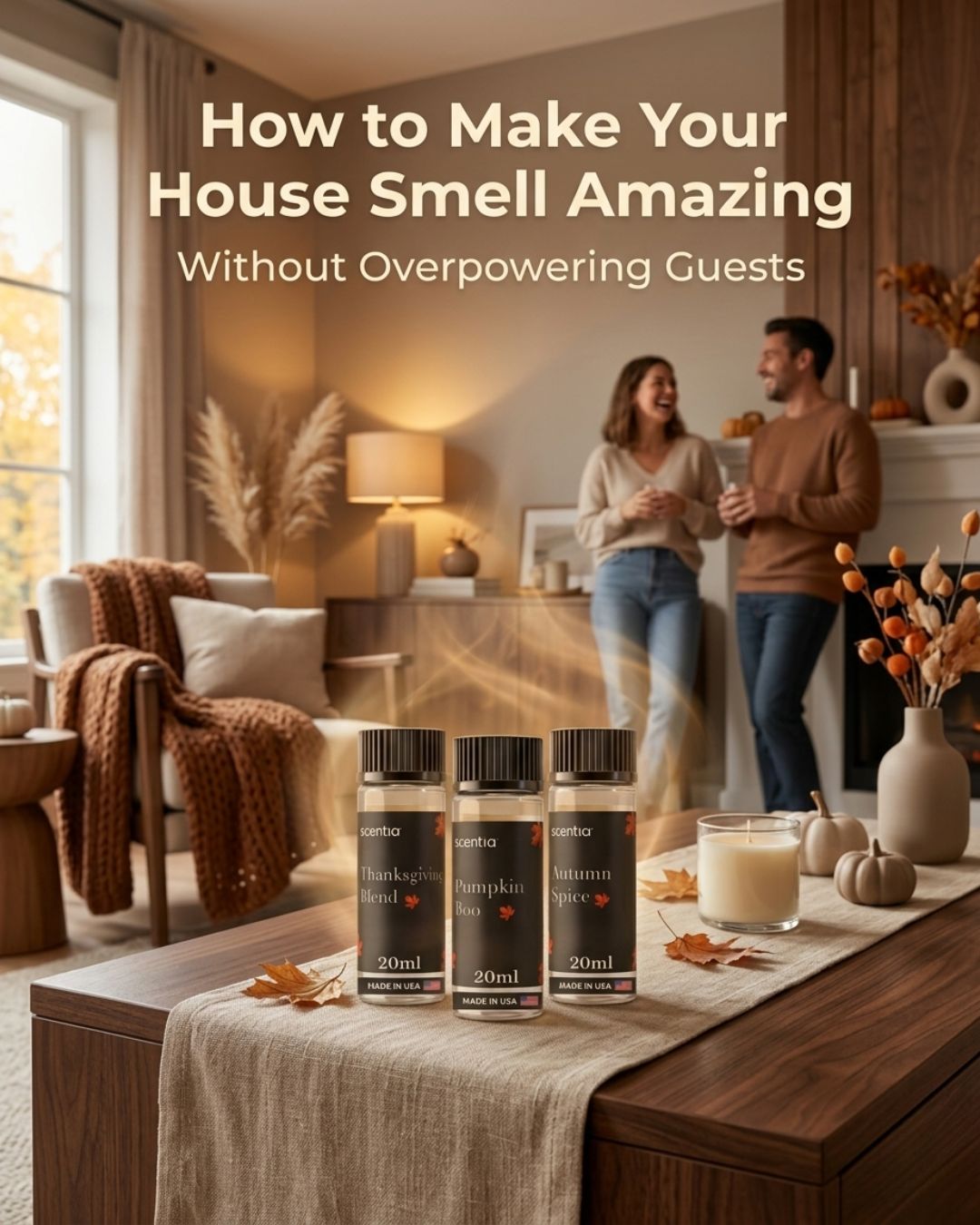
You know the house. You walk in and there's a wall of vanilla-cinnamon-apple-whatever. Someone's plug-in has been working overtime since October. Your eyes water. You smile politely. You plan your exit.
Nobody wants their house to be that house. But plenty of us overcorrect and end up with a home that smells like nothing, which is its own kind of sad. There's a middle version that's actually achievable, and most of it comes down to three decisions: the type of fragrance, how much of it is in the air, and where it's coming from.
The problem with most scented homes
Most scented homes fall into one of two traps.
Trap one is the grocery store trap. Plug-ins, trigger sprays, wax melts, scented candles. These are engineered to be cheap, which means they're usually heavy on synthetic fragrance oils that hit you hard on the top note and then turn stale fast. They also tend to be layered on top of each other — the plug-in in the hallway plus the candle in the kitchen plus the spray someone used in the bathroom an hour ago. It's a scent traffic jam.
Trap two is the overcompensation trap. Someone invests in a nice diffuser, picks a strong oil, and runs it on maximum intensity because they want to make sure it's working. After a week, their guests start inventing reasons not to come over.
What subtle actually means
Subtle does not mean faint. Subtle means the fragrance is the background, not the foreground. You notice it when you walk in, and then you forget about it, and then forty minutes later someone says "your house smells amazing" and you realize the diffuser is still going.
That effect comes from a few things working together.
Pick a fragrance family that doesn't hit people in the face
Some fragrance families are naturally more welcoming than others in a home setting. Clean whites (white tea, cotton, linen), soft citrus (bergamot, grapefruit, yuzu), light florals (jasmine, neroli), and airy marine notes tend to read as "this house is clean and nice" rather than "someone is burning incense in here."
The families that overwhelm are heavy gourmands (cinnamon bun, pumpkin spice, vanilla frosting), dense musks, loud ouds, and anything with strong anise or clove. That doesn't mean never use them — it means they're seasonal accents, not everyday base scents.
Our W Bliss oil is a good example of a fragrance that does welcoming well. It's a citrus-floral with lemon, jasmine, and koa wood, inspired by the energy of W Hotel lobbies. It reads bright and spa-like without being sweet or heavy.
If you want something a little warmer but still not overpowering, Coastal leans into bergamot, jasmine, and marine notes — the Ritz-Carlton kind of fragrance. Dream Walk is softer, more neutral, closer to a clean hotel suite.
Use a diffuser that lets you dial the intensity down
This is where the machine matters. A plug-in has one setting: on. A candle has one setting: whatever the wick decides. You can't calibrate them to your room or your tolerance.
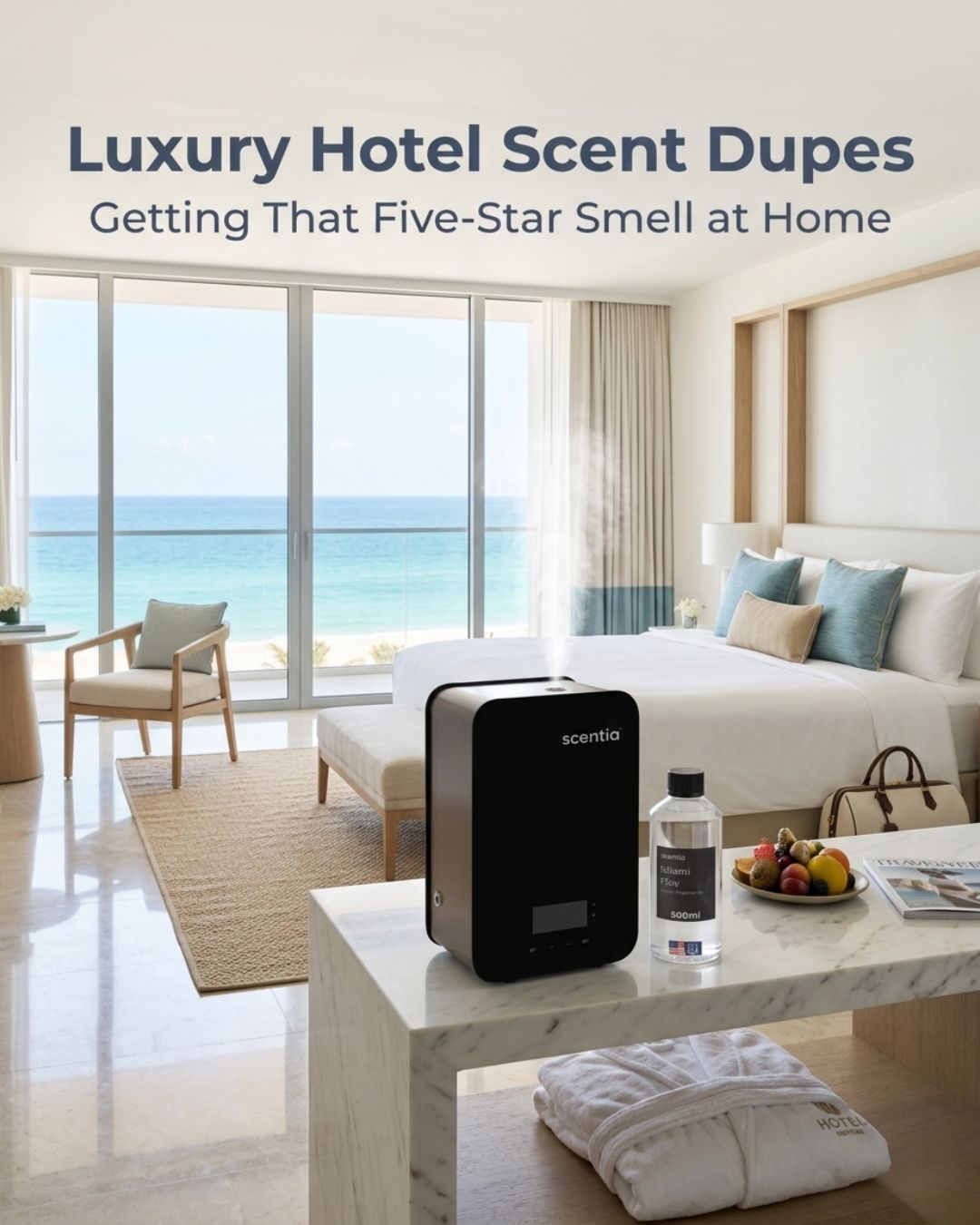
A good cold-air diffuser has intensity controls and usually a scheduler. Our Scentia Max runs on an app where you can set it to, say, 30% intensity for 10 minutes on, 20 minutes off. That's plenty for most homes. On max intensity running 24/7, yes, you'd overwhelm your guests. But that's not how the device is meant to be used.
Start lower than you think you need to. Your nose adapts to the fragrance in your own home within about fifteen minutes — that's called olfactory fatigue — so your baseline is unreliable. If you can smell it clearly in your own house after two hours, your guests are going to feel punched in the face.
One primary source, not five
Pick one diffuser in your main living area and let it do the work. Don't stack a diffuser plus a candle plus a plug-in plus a reed diffuser in the same room. They'll fight each other, and the resulting mix is never what any of them smells like individually.
If you have a big house, use different diffusers in different zones — Max in the living room, MiniPod in the bedroom — but keep the scents either the same or deliberately related. You want the transitions between rooms to feel like one home, not like walking through a Yankee Candle.
Run it before guests arrive, not while they're there
The trick most people miss: turn the diffuser on an hour before people show up, then turn it off or knock it down to minimum when they arrive. The scent will linger at exactly the right level for the first hour, which is when it matters most. After that, your guests are smelling the food, the drinks, and each other anyway.
If you run it full blast the entire evening, by hour three nobody can smell anything because everyone's noses have adjusted, except the one friend who walked in late — and she's having a rough time.
Quick rules of thumb
Low-to-medium intensity, always. You can always turn it up. It's harder to turn it down after your friend has already developed a headache.
Light, clean, or citrus-forward scents for everyday. Save the heavier stuff for winter evenings or specific moods.
One primary source per room. Stop stacking.
Scheduled, not continuous. Morning boost, evening boost, off in between.
Test it on yourself after you've been out for two hours. If when you walk back in it smells like "wow, a lot," your guests are in for a rough time.
Starting point
If you want to try this without overcommitting, the Sample Kit gives you three of our most approachable oils in 20ml sizes, and the Home Scenting collection has the full diffuser lineup. Pair a moderate cold-air diffuser with a clean fragrance family and run it at 30–40% intensity, and your house will smell like the nicest hotel you've ever stayed at, not a 90s department store.

Leave a comment
All comments are moderated before being published.
This site is protected by hCaptcha and the hCaptcha Privacy Policy and Terms of Service apply.