

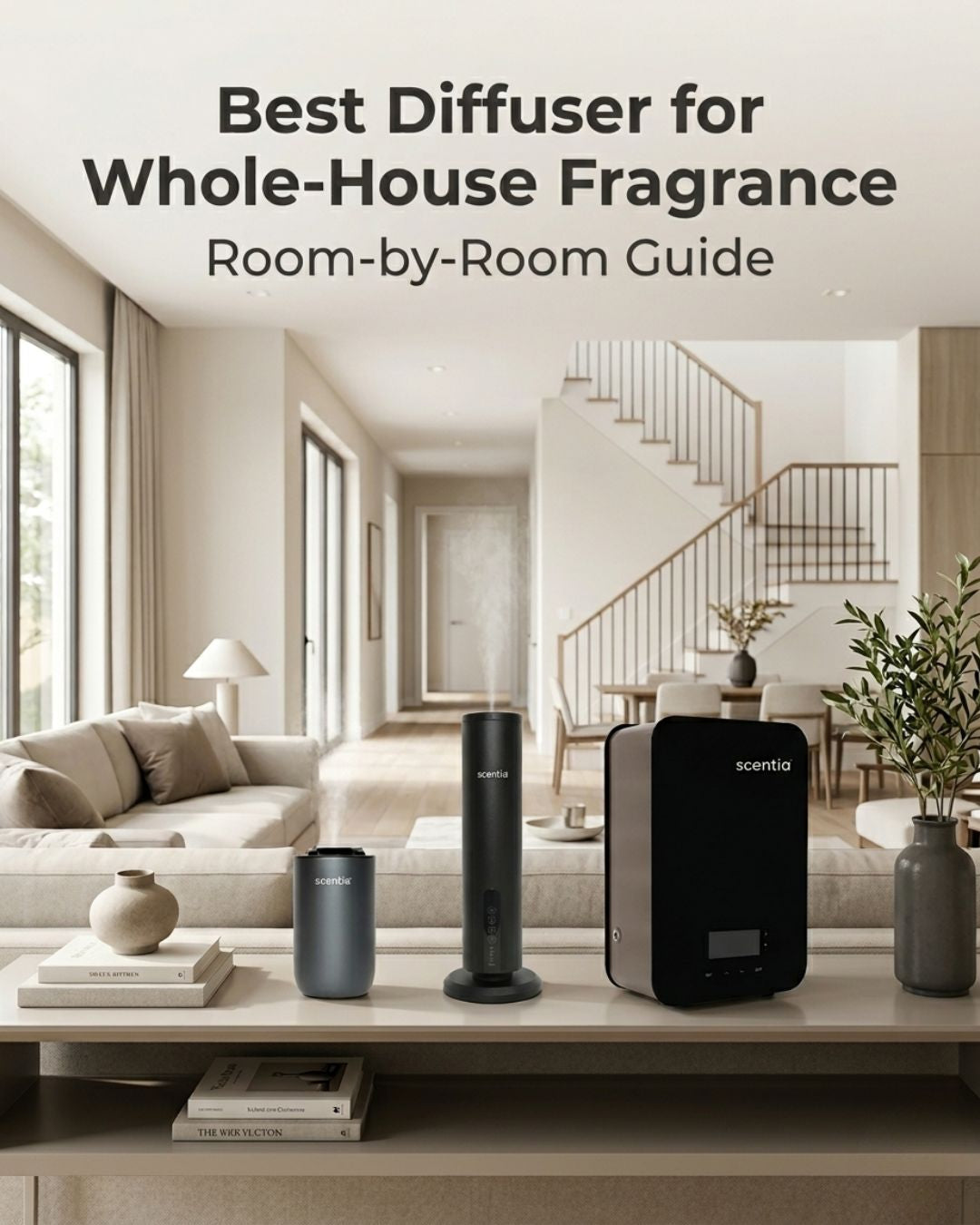
Quick answer: Whole-house scenting can use one high-coverage standalone diffuser, multiple zoned diffusers, or an HVAC-compatible scent diffuser. The right setup depends on the home's size, layout, airflow and whether rooms are open or separated. Scentia Casa can operate standalone or with compatible HVAC integration and covers up to 5,500 sq ft.
For current Scentia specifications, compare the Scentia Casa with the Scentia Max, or see the full diffuser comparison.
"Whole-house fragrance" means different things depending on the house.
If you're in a 900 sq ft apartment with an open layout and one wall separating the bedroom, one diffuser in the living area is your whole house. Done.
If you're in a 3500 sq ft two-story with closed doors, multiple bedrooms, a basement, and an attached garage, whole-house means something much bigger — and one diffuser is not going to do it, no matter what the product page says.
Here's the honest breakdown of what works for what size home.
The three realistic options
There are really only three categories of whole-house scenting that work. Everything else is either a portable unit for one room or a gimmick.
1. HVAC-integrated diffuser
This is the hotel approach. A commercial-grade cold-air diffuser connects to your HVAC ductwork. When your air conditioning or heat is running, the diffuser releases fragrance into the airstream and your existing ducts distribute it through the house.
Pros: Genuinely fills an entire multi-room home evenly. No machine visible in any room. Controllable via app or on-unit timer. Uses a single oil reservoir for the whole house.
Cons: Requires HVAC access and usually a small install (usually 30 minutes by a handy homeowner or an HVAC tech). Higher upfront cost. Only distributes when the HVAC is running, so you need the system set to circulate air even when not heating/cooling.
This is what Scentia Casa does. It's the same category of system used in boutique hotels and upscale spas, sized for residential use.
2. One high-coverage cold-air diffuser in the main living area
For homes under ~1500 sq ft, or larger homes with an open-plan main floor where most of the scent should live, a single powerful cold-air diffuser in the living area can feel like whole-house scenting. The air moves between rooms through doorways and return vents naturally. You get a dominant scent in the main area and a softer version in adjacent rooms.
Pros: One device. No install. Full control over intensity and schedule. Portable if you move.
Cons: Doesn't reach rooms with closed doors. Second floors get much less. Basements get none.
Scentia Max is rated for up to 1500 sq ft. In an open floor plan that's usually enough for the main living space plus light carry into adjacent rooms.
3. Multiple zoned diffusers
The middle-ground option. You put a Max or similar in the main living area, add a MiniPod in each bedroom or office you care about, and let each one run on its own schedule. If you use the same oil across devices (or deliberately coordinated oils), the house smells cohesive without requiring an HVAC install.
Pros: No install. Works in homes with closed-door floor plans. Each room can run on its own schedule (so the bedroom only scents in the evening, the office only during work hours, etc.).
Cons: Multiple devices means more maintenance and more oil consumption. Larger upfront device cost than a single unit.
Room-by-room recommendations
Here's what actually tends to work in each space.
Main living room / great room
The priority space. Most of your waking hours happen here and guests are here. You want meaningful, sustained fragrance.
Best choice: Scentia Max on the side of the room with good airflow (near a vent, not in a dead corner). Medium intensity, scheduled in two blocks — morning and evening.
Oil: Your signature scent. Coastal, Dream Walk, W Bliss, or Miami One if you want something more distinctive.
Entryway / foyer
This is the "first impression" room. The scent here sets the tone for the whole house. It's also a transit zone, so you don't need a huge coverage machine.
Best choice: A MiniPod on a console table or small unit near the door. Or, if you have a diffuser in the adjacent living room, often the carry from there is enough.
Oil: Clean and welcoming. Citrus-forward works well. W Bliss is a good default — bright lemon-jasmine that reads as "this home is well-cared-for."
Primary bedroom
Bedrooms are small enough that you don't need much, and you want the scent lighter than in living areas. Strong scents in a bedroom interfere with sleep.
Best choice: MiniPod on the dresser or bedside table. Low intensity. Scheduled to run for 30 minutes in the evening and then shut off overnight.
Oil: Go calmer. Dream Walk, Coastal, or any of the softer resort oils. Avoid anything sharply citrus or anything gourmand-heavy.
Home office
Depends on the kind of work. For focus and energy, clean citrus or green-forward scents tend to outperform. For calm and reduced stress, softer whites and light florals.
Best choice: MiniPod on the desk or bookshelf. Schedule it to match your work hours.
Oil: W Bliss during work hours (citrus-floral, energizing). Coastal for calmer focus.
Bathrooms
You don't need much, and you don't want strong diffusion during or immediately after showers (the humidity affects how scent behaves). A reed diffuser actually works fine in a bathroom, or a MiniPod on a low setting.
Oil: Clean, fresh — citrus or light aquatic. Avoid heavy floral or gourmand, which get cloying in small humid spaces.
Kitchen
Tricky. Kitchens have their own dominant smell (food, cooking, trash), and adding fragrance often creates a clash. Most people either skip the kitchen entirely or run a small diffuser only when not cooking.
Best approach: Let the adjacent living room handle it. Don't diffuse in the kitchen during cooking. If you want something, a MiniPod on a shelf well away from the stove on low intensity.
Guest bathroom / powder room
This is where you want to invest a little. Guests are going to go in there during every visit and your house's "cleanliness reputation" is partly built in that room.
Best choice: A small MiniPod, or a reed diffuser with a quality oil. Low intensity but always on.
Oil: Clean whites or light citrus.
Garage / laundry / basement
Not worth scenting for most people. The air doesn't circulate back into the main house through any useful path, and these rooms have their own chemistry (detergent, concrete, gasoline). Skip.
Whole house via HVAC
If you're doing this at scale — a 2000+ sq ft two-story, or you genuinely want the hotel-lobby feel in every room — HVAC integration is the only thing that actually delivers it evenly. Everything else leaves you with loud zones and dead zones.
Scentia Casa is the Scentia option for this. It's designed for residential HVAC integration, uses the same oil line as our Max and MiniPod, and gives you a single control point for the whole house.
Which should you actually pick
• Apartment under 1200 sq ft, open layout: One Max in the living area. Done.
• Single-story home, 1200–2000 sq ft, some closed doors: Max in the living area, MiniPod in the primary bedroom. Maybe one in the office.
• Two-story home, 2000+ sq ft, closed-door layout: Either zoned diffusers (Max downstairs, multiple MiniPods upstairs) or HVAC (Scentia Casa) depending on whether you want convenience or coverage.
• Large home, 3500+ sq ft, or you want the actual hotel effect: HVAC integration. Nothing else produces that even, always-on, no-hot-spots feeling.
A common mistake
People with large houses often buy one big expensive portable diffuser expecting it to cover everything, and then they're disappointed. It's not the diffuser's fault. No portable, non-ducted device is going to fill a whole multi-room home evenly. Past a certain size, you either need multiple devices or you need HVAC integration. The physics doesn't budge.
Start with the layout, not the product. Figure out what size and shape your home actually is, then pick the right category of device. Once you're in the right category, Scentia diffuser comparison has all three tiers covered.
New to waterless scenting? Read how waterless cold-air diffusion works. For smaller spaces, compare the full lineup in our home diffuser guide.

Leave a comment
All comments are moderated before being published.
This site is protected by hCaptcha and the hCaptcha Privacy Policy and Terms of Service apply.