

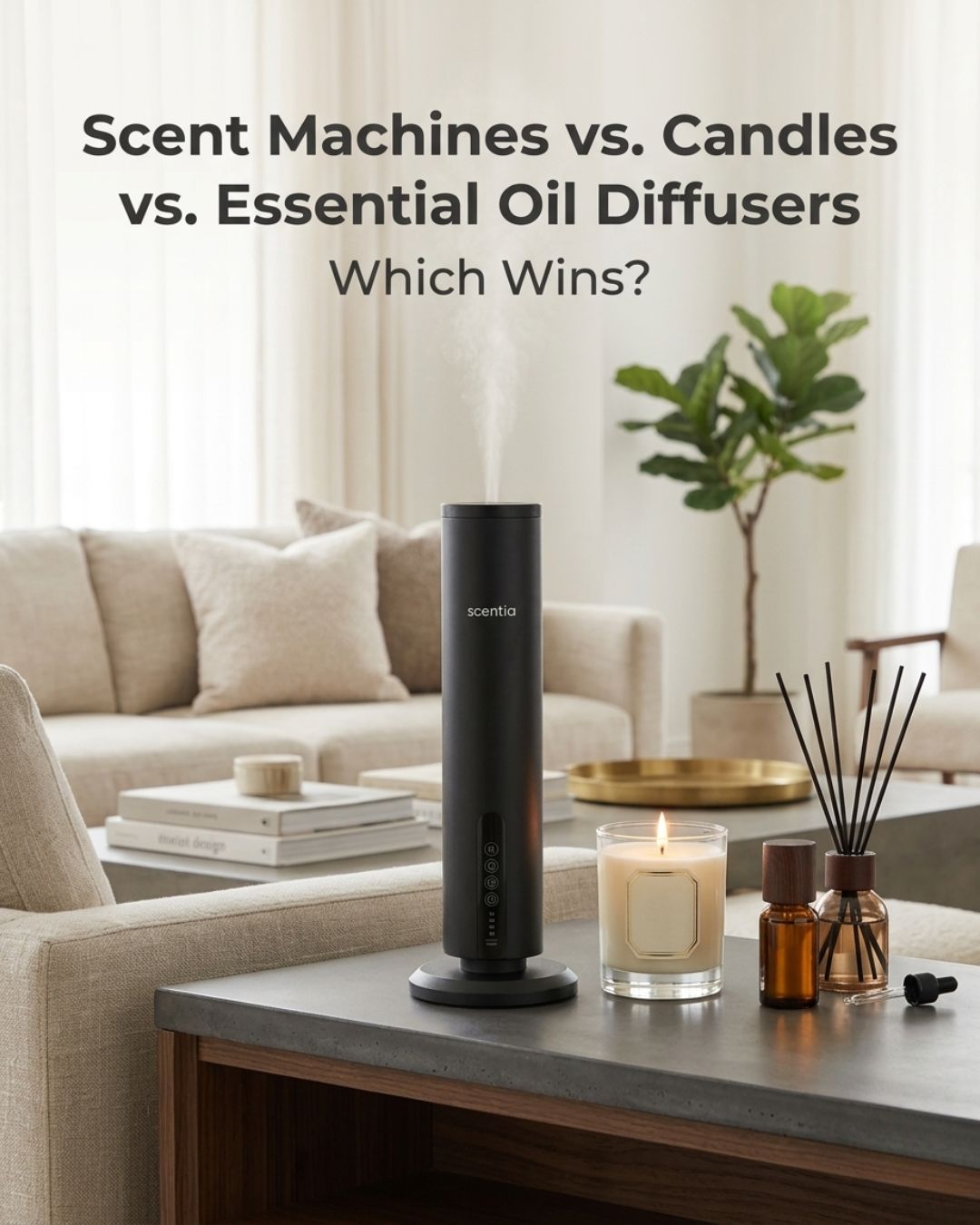
Someone once told me "candles are just diffusers for people who want to watch a flame." Kind of true, and also kind of the wrong framing. These categories aren't interchangeable. They do different jobs.
If you're trying to figure out which one to actually invest in, here's the honest comparison. I'll cover candles, reed diffusers, ultrasonic water-based diffusers, heated electric diffusers, plug-ins, and cold-air scent machines. I make the last category, so yes, bias noted — but I'll tell you where the other categories actually win.
Candles
How they work: Burn wax with fragrance oil mixed in. Heat releases the scent.
Coverage: Small. One room, maybe spilling into a doorway. Expect 200–400 sq ft of meaningful scent.
Longevity: Burn time varies — a typical 8 oz candle gives you 40–60 hours of burn. If you burn it 3 hours a day, that's about two weeks.
Fragrance quality: Top notes dominate. Base notes get partially destroyed by heat. Scent throw changes as the wick tunnels and the wax pool gets smaller.
Cost per hour: High. A $30 candle burning 60 hours is $0.50/hr. A $200 one at the same rate is over $3/hr.
When they win: Ambiance. Nothing else looks like a candle. If you want the flame, the soft light, and the ritual, candles are the category. They're also the easiest gift.
When they lose: Anything involving coverage, consistency, or safety while unattended. You cannot run a candle while you're asleep or out of the house. That's a hard limit.
Reed diffusers
How they work: Reeds sit in a bottle of fragrance oil. Capillary action wicks the oil up the reeds, which then release scent into the air.
Coverage: Tiny. 100–200 sq ft on a good day. Fine for a bathroom, powder room, closet, or small entryway.
Longevity: Two to four months depending on bottle size and room temperature.
Fragrance quality: Pure — there's no heat or water involved. But the intensity is low, and it fades fast as the bottle empties.
Cost: Moderate. $30–80 for a few months of a small space.
When they win: Bathrooms, closets, small rooms where you want something always-on without any device. Also good as decor — some of them look really nice.
When they lose: Any space larger than a bathroom. They physically can't push enough scent into a living room.
Ultrasonic water-based diffusers
How they work: You add water and a few drops of essential oil to a reservoir. An ultrasonic plate vibrates the water into a visible mist, which carries the oil into the air.
Coverage: 200–400 sq ft. Marketing materials say more. Reality is less.
Longevity: Each fill lasts a few hours. You're refilling frequently if you use it daily.
Fragrance quality: Diluted. You're smelling a version of the oil that's been mixed with water and pushed out as a damp vapor. Also, essential oils and fragrance oils behave differently in ultrasonic machines — many fragrance oils don't disperse well this way.
Cost: Low upfront ($30–80 for the device). Essential oil costs add up over time.
Scentia fragrance oils are made in the USA. Individual sensitivities vary among people and pets. Use in well-ventilated spaces, avoid prolonged operation, and keep oils and devices out of reach. Consult your veterinarian for pet-specific advice and avoid diffuser use in homes with birds. Follow our Safety & Use guidelines.
When they lose: Large spaces. Long sessions without refilling. Anyone trying to achieve the hotel-lobby feel.
Heated electric diffusers / wax warmers
How they work: Heat either a wax cube or an oil well electrically.
Coverage: Small, similar to candles but without the flame.
Longevity: Depends on the refill. Wax melts usually give you 8–12 hours per cube.
Fragrance quality: Similar to candles — heat destroys base notes and changes the balance. Top notes dominate.
Cost: Low upfront, moderate over time.
When they win: People who want the ambiance of a candle without the flame. Apartments where open flames aren't allowed.
When they lose: Coverage and fragrance integrity. Heat is not friendly to complex fragrances.
Plug-in air fresheners
How they work: Heat a wick or fan a small fragrance cartridge. Plug into a wall outlet.
Coverage: One room at best. Usually smaller.
Longevity: 30–60 days per refill.
Fragrance quality: Grocery-store synthetic in most cases. The high-end versions exist but are rare.
Cost: Low, but refills add up.
When they win: Nowhere I can recommend them, honestly. If the alternative is doing nothing in a small bathroom and you're on a budget, fine. Otherwise, skip.
When they lose: Everywhere else.
Cold-air scent machines
How they work: Waterless, heatless. Fragrance oil is broken into ultra-fine dry nano-particles by compressed air, then pushed out as a dry mist. No dilution, no combustion, no heat. Same category of device hotels use.
Coverage: Big. A home-grade unit like Scentia Max handles up to 1500 sq ft. Commercial units (like the HVAC-integrated Casa) handle multi-room homes evenly.
Longevity: A 120ml oil bottle runs for weeks on typical settings. Scheduling makes it last longer.
Fragrance quality: Preserves the full top-middle-base structure because there's no heat and no dilution. You smell what's actually in the bottle.
Cost: Higher upfront. Lower per hour of use than candles. Commercial oils are priced commercial — you're buying the concentration the hotels use.
When they win: Anything involving coverage, consistency, fragrance integrity, or always-on use. The only category that actually reproduces the hotel-lobby effect.
When they lose: Not a great choice for someone who wants a quick $15 candle for an evening, or for tiny spaces where a reed diffuser would be overkill.
Head-to-head on what actually matters
Coverage: Cold-air scent machine > ultrasonic > candle ≈ heated electric > reed diffuser > plug-in.
Fragrance integrity (scent as intended): Cold-air > reed diffuser > ultrasonic > candle > heated electric > plug-in.
Always-on safety: Cold-air ≈ ultrasonic ≈ reed diffuser > plug-in >> candle ≈ heated electric (never leave these unattended).
Cost over a year: Reed diffuser < plug-in < cold-air (lower per hour) < candles < heated electric refills.
Ambiance (visual): Candle wins. Nothing beats an open flame for mood. Cold-air diffusers look cleaner but they're not contributing to the atmosphere visually.
Hotel-lobby feel: Cold-air is the only category that delivers it. Nothing else comes close.
What I'd actually do
If I only had one fragrance format in my house, it would be a cold-air diffuser in the main living area. That's the workhorse. Always on at low-medium intensity, scheduled, filled with a quality oil.
I'd also keep reed diffusers in the bathrooms because they're low-maintenance and the spaces are small enough for them to work.
I'd keep one or two candles for specific moments — dinner parties, quiet evenings, when I want the visual. Not as my primary scenting strategy.
I wouldn't bother with plug-ins or heated wax warmers. They underperform in both fragrance quality and value.
Starting points
If you want to try the cold-air category without committing to a full system, the Sample Kit gives you three 20ml oils that work in any waterless diffuser. If you're ready for the real setup, Scentia Max handles most home sizes and is the direct equivalent of the hotel diffusers you've smelled before.
Different categories, different jobs. But if you have to pick one for your main living area, cold-air is the one that actually does what most people are hoping all of them would do.

Leave a comment
All comments are moderated before being published.
This site is protected by hCaptcha and the hCaptcha Privacy Policy and Terms of Service apply.