

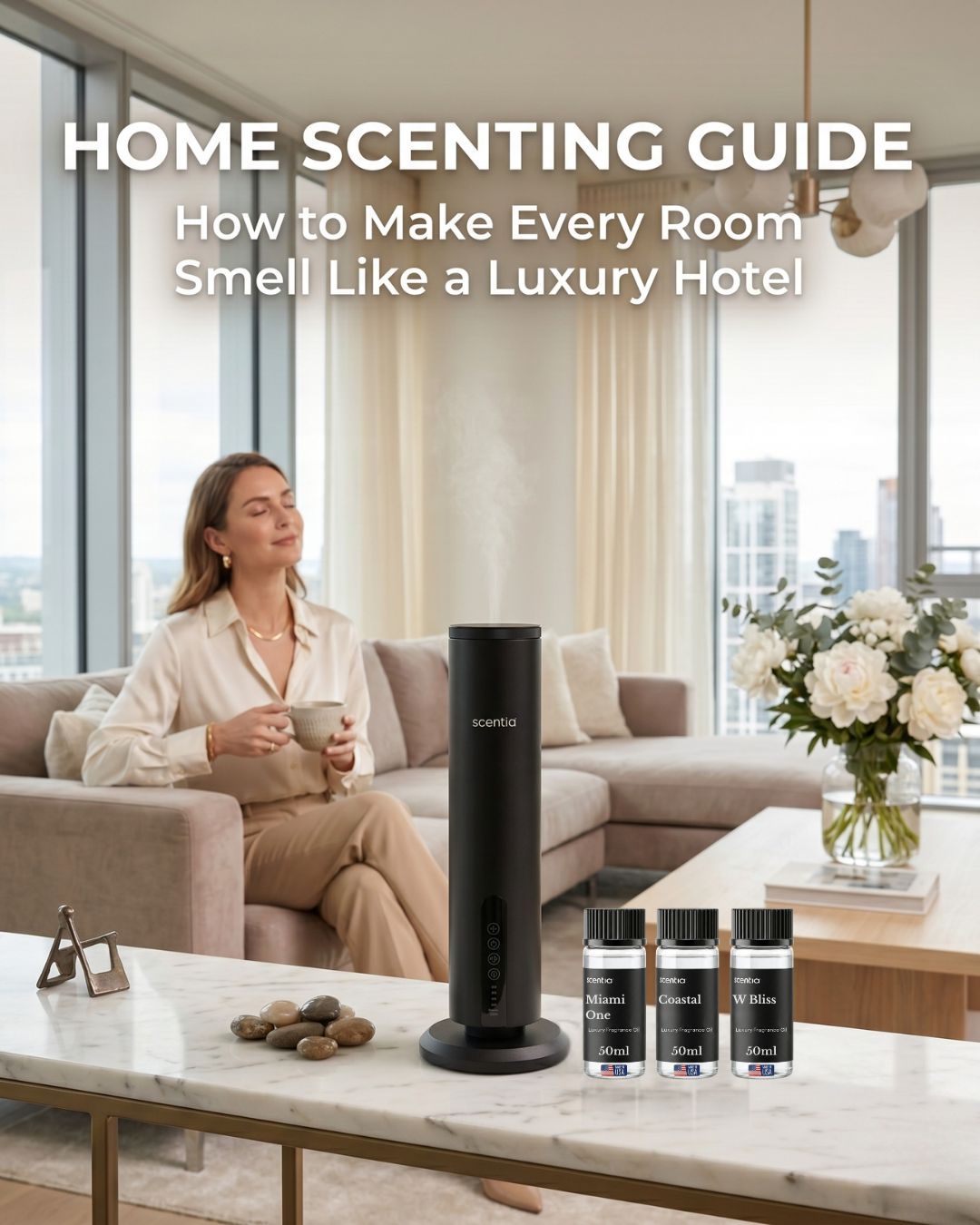
There is a specific moment that happens in a great hotel. You step through the lobby doors, and before you register the marble floors or the lighting or the staff, you smell it. A fragrance — warm, present, unmistakably intentional — settles around you. You feel something shift.
That experience is not accidental. Hotels with serious scenting programs spend months selecting a single fragrance to represent their brand. They install commercial-grade diffusion systems. They test placement, intensity, and timing until the scent becomes invisible — so natural to the environment that guests stop noticing it consciously but never forget it.
This guide is about bringing that same approach into your home. Not just plugging in a diffuser and hoping for the best — but understanding how scent actually moves through a space, which fragrances work in which rooms, how to set intensity correctly, and how to build a coherent scent experience across your whole home the way a hotel does it.
Everything here is built around cold-air diffusion — the same waterless, heatless technology that powers commercial hotel scenting. If you are new to it, we will explain why it works differently from candles or ultrasonic diffusers. If you already use one, this guide will take your setup from functional to exceptional.
Why Cold-Air Diffusion Is the Foundation
Most home fragrance — candles, plug-ins, reed diffusers, wax melts — works by applying heat or evaporation to release scent. The problem with heat is that it alters fragrance. The top notes — the bright, sharp opening of a scent — burn off fastest. What lingers is a flattened version of the original, heavier and less precise than what was intended.
Cold-air diffusion works differently. A small compressor forces air through a nozzle at high velocity, atomising the fragrance oil into a dry nano-mist of micro-particles. No heat. No water. No dilution. The oil enters the air in its complete, unaltered form — which is exactly why the scent in a hotel lobby smells so clean, so present, and so distinctly itself.
The practical difference in your home is significant. A cold-air diffuser covers 500 to 2,500 square feet depending on the model. It runs on a timer or app schedule. The scent intensity is adjustable. And because nothing is burning or evaporating, a 120ml bottle of fragrance oil lasts weeks rather than hours.
Scentia fragrance oils are made in the USA. Individual sensitivities vary among people and pets. Use in well-ventilated spaces, avoid prolonged operation, and keep oils and devices out of reach. Consult your veterinarian for pet-specific advice and avoid diffuser use in homes with birds. Follow our Safety & Use guidelines.
The Hotel Method: Scent as a System, Not a Product
The single most important thing hotels do that most homes do not is treat scent as a system. Not one candle on a coffee table. Not a reed diffuser in the bathroom because someone liked the bottle. A deliberate, consistent fragrance experience that moves through the space the same way every day.
There are four components to that system.
1. One signature scent per zone
Hotels choose one scent for the lobby, one for the spa, sometimes one for the pool deck. They do not mix. Each zone has a single fragrance identity. In your home, this means choosing one scent per area — not a different candle in every room. The living room, dining area, and entry hall can share a fragrance. The bedroom can have its own. The home office, a third. Three scent zones across a whole home is plenty.
2. Diffuser placement follows airflow
Hotels place scent diffusers where air naturally circulates — near HVAC returns, at the entrance to hallways, at breathing height rather than floor level. The goal is to put the fragrance where air is already moving, then let the system carry it. In your home: place your diffuser on a shelf or console at mid-height, in the central part of the room, away from windows and exterior doors where the scent will escape before it fills the space.
3. Intensity is calibrated, not maxed
The best hotel scenting is the kind you notice when you enter and then forget about. If you can smell it consciously while you are sitting still in a room, it is too strong. The target is presence without intrusion. Start your diffuser at its lowest intensity setting. Live with it for 24 hours. Increase only if the scent feels absent. Most people over-diffuse by 30 to 40 percent on their first attempt.
4. Scent runs on a schedule
Hotels do not run scenting 24 hours a day. They schedule it for the hours when the space is occupied and active. In your home, use your diffuser's timer or app to run scent during the hours you are actually in the room — morning and evening in the bedroom, afternoon in the living room, working hours in the home office. This extends oil life significantly and prevents olfactory fatigue, where you stop registering a scent because you have been around it too long.
Room-by-Room Scenting Guide
Each room in your home has a different purpose, different traffic, and different emotional register. The scent should match. Here is how to approach each space.
Entry Hall & Living Room
This is your signature. Whatever someone smells when they walk into your home is what they will associate with it forever. It should be your most considered, most intentional choice.
The characteristics to look for: warm without being heavy, present without being aggressive, complex enough to hold interest but immediately pleasant. Sandalwood, leather, bergamot, and amber all perform well in entry and living spaces because they have weight — they settle into a room and stay rather than dissipating quickly.
Scentia recommendation: Miami One — leather, sandalwood, and amber inspired by 1 Hotel Miami Beach. It was designed specifically for the kind of statement a hotel lobby makes at arrival. For a lighter, breezier entry — particularly in open-plan homes or beachside properties — Coastal (lemon, bergamot, marine, jasmine, inspired by The Ritz-Carlton) creates the same arrival moment with a fresher signature.
Diffuser recommendation: The Scentia Max covers up to 1,500 square feet — appropriate for most open living areas. For connected living and dining spaces in larger homes, the Scentia Casa integrates with your HVAC to carry scent through every vent simultaneously.
Placement: Shelf or console at mid-height, in the central part of the room. Avoid placing directly beside an exterior door — the scent will leave before it settles.
Bedroom
The bedroom is where the emotional register of your scenting changes completely. The living room is about impression. The bedroom is about how you feel while you are in it — and what state of mind it puts you in when you wake up.
The research on scent and sleep is clear: calming, soft fragrances with floral or tea notes reduce physiological stress markers and improve sleep quality. Lavender is the most studied, but white tea, aloe, jasmine, and vanilla have similar profiles — clean, soft, without the sharpness of citrus or the heaviness of oud.
Scentia recommendation: Dream Walk — white tea, aloe, ginger, and vanilla, inspired by Westin Hotels. Westin's signature scent, White Tea, became so associated with restful sleep that they began selling it commercially. Dream Walk is built around the same profile. For a bedroom that should feel more uplifting in the morning — a guest room or a space used for yoga or meditation — W Bliss (white tea, citrus, magnolia, koa wood, inspired by W Hotels) has the same calming base with more brightness.
Diffuser recommendation: The Scentia MiniPod — 500 square feet, wireless, runs on a 36-hour battery. Set it to run for one hour before you sleep and one hour in the morning. The bedroom is a contained space and requires far less coverage than the living room — resist the temptation to over-diffuse.
Placement: Nightstand or dresser top. Not directly beside the pillow — 4 to 6 feet of distance allows the scent to settle into the room rather than sitting at your face.
Home Office
The home office is an underrated scenting opportunity. Scent has a documented effect on focus and cognitive performance. Citrus fragrances — lemon, bergamot, orange — have been shown in workplace studies to improve alertness and reduce error rates. Woody and resinous notes like cedarwood and sandalwood support sustained concentration without the stimulating edge of citrus.
The home office is also a space where you can afford to be bolder. You are the primary occupant. No one is being introduced to your taste here — this is where you express it.
Scentia recommendation: Noir Mystique — oud, tobacco, and vetiver, inspired by Edition Hotels. It is Scentia's most complex, most adult scent. In a home office context it functions the way a good leather chair does: a signal to the room, and to yourself, that serious work happens here. For those who prefer something lighter during working hours, Coastal provides the citrus-forward alertness profile without the weight.
Diffuser recommendation: The Scentia Pod — 500 square feet, plug-in, app-controlled. Set it to your working hours only. Home offices are typically smaller and enclosed, meaning intensity should be set lower than you would in a living room of the same size.
Placement: On the desk or a shelf beside the desk. Keep it at breathing height — desk surface level is ideal in an office setting, since you are seated.
Bathroom & Powder Room
The bathroom is a high-humidity, high-traffic, small-volume space. The challenge is not making it smell good — it is making it smell intentional rather than functional. Most people reach for something floral or clean-linen for a bathroom. That works. But the better approach, borrowed again from hotels, is to use the same or a complementary scent to your bedroom. Hotels do not change the fragrance entirely between a guest room and its en suite bathroom — they extend it, at lower intensity.
Scentia recommendation: A lighter application of whatever you are using in the adjacent bedroom — or a 20ml sample bottle of W Bliss used at low intensity. Its white tea and magnolia profile reads as spa-like in a bathroom context without feeling incongruous with a more complex scent in the main bedroom.
Diffuser recommendation: The Scentia MiniPod is appropriate for bathroom use given its compact size. Alternatively, a 20ml sample bottle used in a standard plug-in is sufficient for a small powder room. Do not run it continuously — 20 to 30 minutes before guests arrive is the hotel approach.
Whole-Home Scenting
For homes where you want a single, consistent fragrance experience across multiple floors or an open floor plan — the approach that most closely replicates a hotel — the answer is HVAC integration.
The Scentia Casa connects directly to your existing HVAC system, diffusing fragrance through every vent simultaneously. Coverage is up to 2,500 square feet. The scent intensity is consistent across rooms because it is travelling through the same air distribution system that heats and cools the home. One device, one fragrance, one experience throughout the entire space.
For whole-home scenting, Miami One and Coastal are the two most versatile choices — warm and fresh respectively, both neutral enough to work in every room simultaneously without feeling out of place in any of them.
Diffuser Placement: The Rules That Actually Matter
Where you place a diffuser determines 50 percent of how well it works. The scent itself determines the other 50. Get placement wrong and even the best fragrance oil will underperform. Here are the rules that translate directly from commercial hotel scenting into residential use.
Work with airflow, not against it
Fragrance travels on air currents. Place your diffuser where air naturally moves through the room — near the entrance to an open hallway, beside an interior doorway, or centrally in an open-plan space. Avoid corners, alcoves, and dead-air zones where fragrance will pool rather than travel.
Mid-height beats floor and ceiling
Fragrance disperses best from mid-height — roughly 3 to 5 feet from the floor. At floor level, the mist settles rather than circulates. At ceiling height, it disperses upward into space where nobody is breathing. A shelf, console table, or sideboard at sitting or standing height is the target.
Distance from windows and exterior doors
An exterior door or open window will pull your scent out of the room faster than the diffuser can replace it. Keep at least 6 to 8 feet of distance between your diffuser and any point where air exits the space.
Avoid HVAC vents and returns (unless using Casa)
Placing a diffuser directly below an HVAC return pulls the fragrance out of the room before it has a chance to settle. Directly above a supply vent pushes the scent in an uncontrolled direction. For standard diffusers, keep 3 to 4 feet of clearance from any vent. If you want HVAC integration, the Scentia Casa is designed to attach at the return duct properly.
One diffuser per zone
Running two diffusers in the same room does not double the scent — it creates inconsistency and olfactory fatigue faster. One properly placed diffuser at the right intensity will always outperform two at half intensity. If coverage feels insufficient, move the single unit to a more central position before adding a second.
Intensity, Timing, and Avoiding the Common Mistakes
Start low and wait 24 hours
Your nose adjusts to a fragrance within 15 to 20 minutes of entering a room. You are not the right judge of whether your home smells good immediately after you set up a diffuser — ask someone who is arriving fresh. Start at the lowest intensity setting and live with it for a full day before deciding it needs to be higher.
Use the cycle timer correctly
All Scentia diffusers use an on/off cycle rather than continuous diffusion. A common starting point is 30 seconds on, 90 seconds off. This is more efficient than continuous operation and prevents the scent from becoming oppressive. Adjust by extending the on-time, not by increasing the intensity — it gives you finer control.
Rotate scents seasonally, not weekly
Hotels change their lobby scent with the seasons — a lighter, fresher fragrance for spring and summer, something warmer and more enveloping for autumn and winter. That seasonal rhythm makes sense. Changing fragrance weekly does not — it prevents your home from developing the signature scent identity that is the whole point. Pick a scent for each season and stay with it.
Seasonal scent guide
- Spring / Summer: Coastal (lemon, bergamot, marine) or W Bliss (white tea, citrus, magnolia)
- Autumn: Miami One (sandalwood, leather, amber) or Dream Walk (white tea, aloe, vanilla)
- Winter: Noir Mystique (oud, tobacco, vetiver) or Miami One for the whole home
Clean your diffuser when changing oils
When switching from a heavy oil (Noir Mystique, Miami One) to a lighter one (Coastal, W Bliss), run the diffuser with a bottle containing a small amount of isopropyl alcohol for 5 to 10 minutes before loading the new oil. This clears the atomiser of residual heavy molecules that would muddy the new fragrance. All Scentia diffuser care guides cover this in detail — see the Scentia Max Setup Guide for step-by-step cleaning instructions.
How to Build a Coherent Scent Identity for Your Home
A hotel's scent identity is coherent because one person — usually a fragrance director working with the hotel's brand team — makes all the decisions. In your home, you are that person. Here is a simple framework for building a scent identity that feels intentional rather than assembled by accident.
Choose one anchor scent
Your anchor scent is what the living room and entry hall smell like — the first thing anyone registers when they arrive. This is your home's signature. Everything else should either complement it or contrast with it deliberately. If your anchor is warm and woody (Miami One), your bedroom can be softer and cooler (Dream Walk) without feeling mismatched. If your anchor is fresh (Coastal), your bedroom can be warmer (W Bliss) for the same reason.
Keep secondary spaces quieter
The bedroom, home office, and bathroom should operate at lower intensity than the main living space. They are supporting characters, not leads. If every room has an assertive scent, none of them feel special.
Do not mix fragrance families in adjacent rooms
Walking from an oud-heavy room directly into a sharp citrus room is disorienting. If your rooms connect — open plan, or through a doorway — keep the fragrances in the same family. Woody/amber scents belong together. White tea and floral scents belong together. Coastal/marine and citrus scents belong together. Crossing families works best when rooms are separated by a closed door and a hallway.
Not Sure Where to Start?
If you have not yet found your signature scent, the Top 5 Sample Set is the most straightforward starting point. It includes 20ml of Miami One, Coastal, W Bliss, Dream Walk, and Noir Mystique — one to two weeks of use in a standard room for each scent. Run each one for a full week before deciding. The one you find yourself looking forward to when you come home is your signature.
You can also use Scentia's Fragrance Finder to answer four questions about your home and mood and get a personalised recommendation.
For help choosing the right diffuser for your space — by room size, lifestyle, and whether you want wireless, plug-in, or whole-home coverage — see the Scentia Diffuser Comparison Guide.
Frequently Asked Questions
How many diffusers do I need for my whole home?
One diffuser per scent zone. A typical three-bedroom home needs two to three diffusers: one for the main living area (Max or Pod), one for the master bedroom (MiniPod), and optionally one for a home office. For whole-home single-scent coverage, the Scentia Casa HVAC diffuser replaces all of them with one unit.
How long does a 120ml bottle of Scentia oil last?
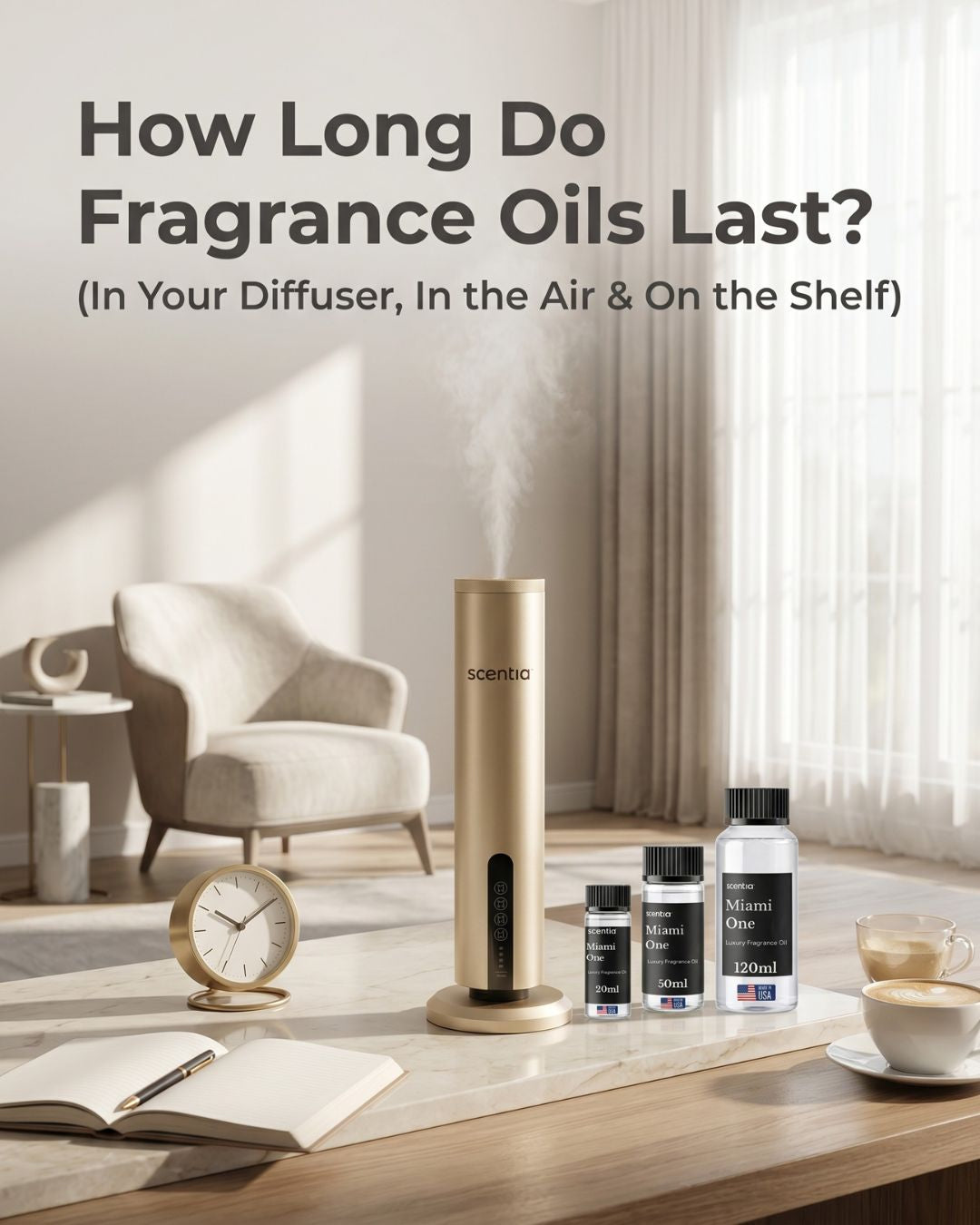
At standard intensity and a 30-on/90-off cycle, a 120ml bottle lasts approximately four to six weeks in a mid-size room. Higher intensity settings, larger rooms, and longer diffusion cycles will shorten that. A 50ml bottle typically lasts two to three weeks under the same conditions.
Can I use Scentia oils in another brand of cold-air diffuser?
Yes. Scentia fragrance oils are compatible with cold-air nebulizing diffusers regardless of brand, ultrasonic diffusers, and reed diffusers. Follow the diffuser manufacturer's directions for use.
What is the best home scent for people with allergies?
Fragrance sensitivities vary. If you have asthma, allergies, or a known fragrance sensitivity, consult your healthcare professional before use. Stop use if irritation or discomfort occurs. For ingredient information about a specific fragrance, contact cs@scentiausa.com.
How do hotels make their lobbies smell so good?
Commercial hotel scenting uses the same cold-air nebulizing technology as Scentia's residential diffusers, scaled up. Hotels install diffusion units that connect to HVAC returns, dispersing fragrance oil through every vent simultaneously. They choose a single signature scent, calibrate intensity to be present but not intrusive, and run the system on a timer tied to guest traffic hours. The Scentia Casa replicates this setup for residential homes.
Is it safe to run a diffuser in a room with pets?
Individual sensitivities vary among pets. Consult your veterinarian before use, especially for cats or animals with respiratory conditions. Keep pets out of the room while diffusing, provide an unscented area, and keep oils and devices out of reach. Avoid diffuser use in homes with birds. Follow our Safety & Use guidelines.
Want to understand the hotel-scent effect? See what scents hotels use and how hotel scenting works →
Build your home scenting setup: compare diffusers by room size, learn about whole-house and HVAC scenting, and use our home fragrance selection guide.

Leave a comment
All comments are moderated before being published.
This site is protected by hCaptcha and the hCaptcha Privacy Policy and Terms of Service apply.