

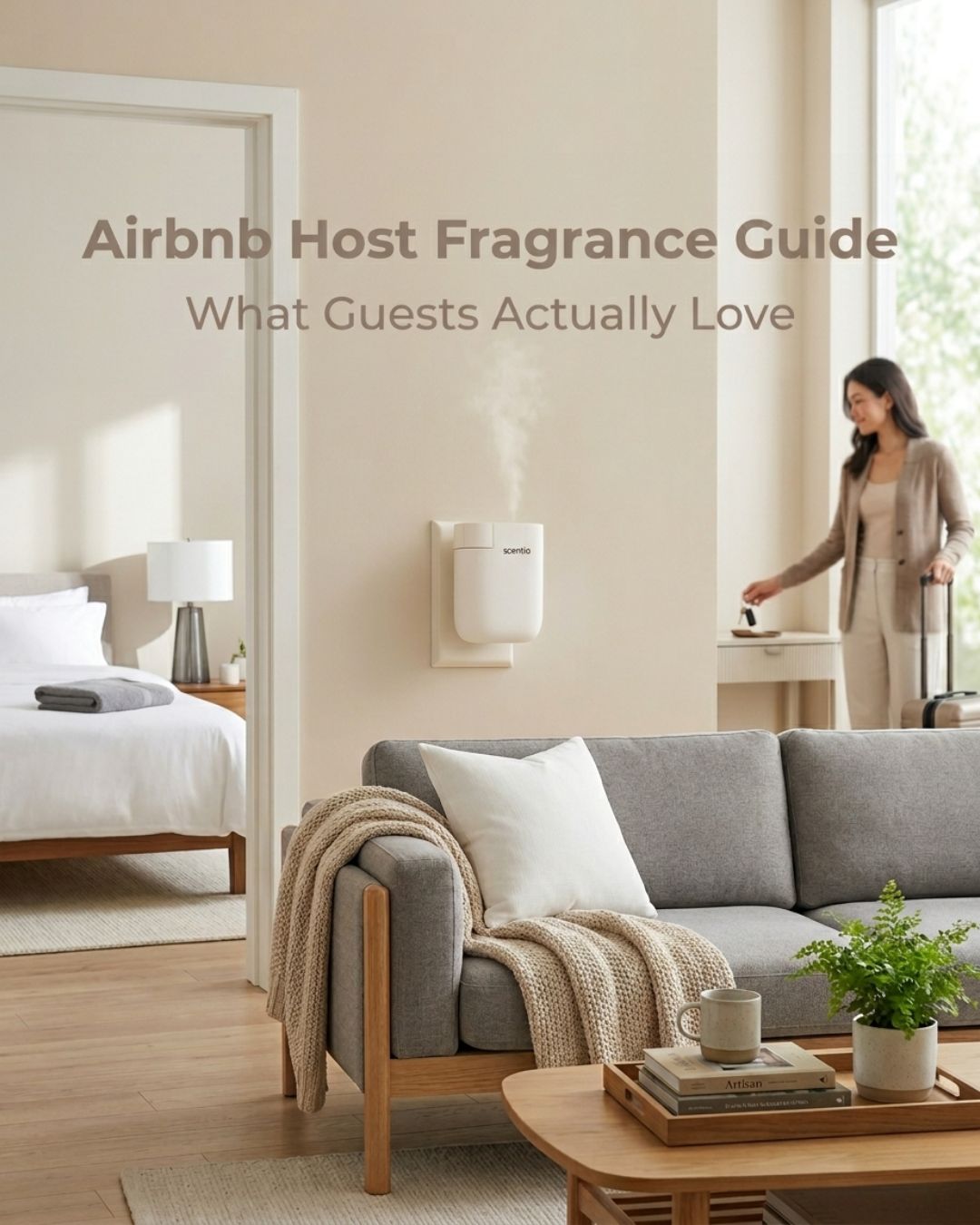
Check the reviews of any short-term rental that's mid-performing and you'll find two complaints that come up over and over: "it smelled weird" or "the air freshener was overpowering." The first kills bookings. The second drops the review a full star.
Scent is underrated as a lever in the short-term rental business. Everyone photographs their property. Everyone writes good descriptions. Few hosts think carefully about what the space smells like when a guest walks in after a twelve-hour flight.
Here's what actually works for Airbnb, VRBO, and short-term rentals.
The reason scent matters more in an STR than in your own home
In your own house, your guests are your friends and family, mostly, and they're there for a few hours. An Airbnb guest is spending the night. They're decompressing from travel. They notice everything, and scent is the first thing their nose registers before they've even put their bags down.
The right scent signals "clean, cared for, professional host." The wrong one signals "cover-up" — which makes guests suspicious that there's something you're hiding.
Three rules that apply to every STR
Rule 1: Signal clean, don't compete with it. The scent should read as a follow-up to a clean room, not a replacement for one. If your cleaners actually cleaned, a light, neutral scent reinforces the feeling. If they didn't, a heavy scent makes it worse.
Rule 2: Stay neutral. You don't know your guest. They could be allergic to florals. They could hate vanilla. They could be a chef who wants to smell the coffee they're brewing in the morning. Go with scents that the widest possible range of people will find pleasant or at least inoffensive.
Rule 3: Moderate intensity always. An STR is not the place to show off your signature scent. Think "nice hotel," not "candle store."
The fragrance families that perform
Clean whites (white tea, cotton, linen, spa). Universally safe. Read as "recently washed sheets, clean bathroom." Best for bedrooms and bathrooms.
Light citrus (lemon, bergamot, grapefruit, yuzu). Fresh and bright without being perfumey. Good for main living areas and kitchens.
Marine and airy (ocean mist, sea breeze, bergamot-marine). Especially good for coastal or beach properties where guests already expect that kind of scent.
Soft florals (jasmine, neroli, light green florals). Fine in moderation. Skip anything heavy like tuberose or gardenia.
The fragrance families to avoid
Heavy gourmand (vanilla, caramel, cinnamon, pumpkin). Too sweet, too specific. Plus, they read as "trying to cover something" to a savvy guest.
Strong musk, oud, leather, tobacco. Great scents, but polarizing. In an STR, polarizing is bad.
Spiced anything (clove, cardamom-heavy, pepper). Personal preference territory. Avoid.
Anything synthetic-smelling. This is where most host-grade plug-ins and sprays fall. Guests can tell the difference between a commercial-grade fragrance oil and a grocery-store plug-in within one breath. It drops the perceived quality of everything around it.
Scents I'd actually use
The Scentia Resort Collection was built around the scent profiles luxury hotels use, which is almost exactly what you want for an STR.
Coastal — bergamot, jasmine, marine. Works anywhere, especially for beach and coastal properties. This is a strong default.
Dream Walk — softer, more neutral, like a clean hotel suite. Great for bedrooms.
W Bliss — bright citrus-floral. Good for living areas and entryways.
For a property I wanted to scent at a higher tier, I'd pick one scent and run it throughout. Pick your property's "signature" — the one that matches the vibe you've photographed — and stay with it.
The setup that works in an STR
Turn on the diffuser an hour before check-in. Not when the guests arrive. An hour before. This way the fragrance is already settled into the room at the right level when they walk in. If you run it hard during their first five minutes, it feels like the staging it is.
Run it at low intensity during their stay. You want the scent to be there in the background but never to dominate. 20–30% intensity on a cold-air diffuser is usually the right range.
Schedule it, don't run continuously. Most cold-air diffusers have schedulers. Set it for a morning burst and an evening burst and let it off in between. Continuous running wastes oil and can start to feel heavy.
Use one diffuser per "zone." Main living area gets one. Primary bedroom can get a smaller one. Don't put diffusers in every room — guests will notice the scent shifting as they move around and it's distracting.
Size matters: match the diffuser to the property
For a studio or small one-bedroom, one ScentiaMiniPod in the main area is plenty. It covers up to 500 sq ft, rechargeable, quiet, and small enough to tuck on a shelf.
For a larger one-bedroom or a two-bedroom with an open layout, a Scentia Max in the living area handles up to 1500 sq ft.
For a larger home or multi-story STR, you've got two options. Either run multiple units — a Max downstairs, MiniPods in the bedrooms — or go HVAC-integrated with Scentia Casa if the property has central air.
Things that hurt reviews
Plug-ins in bathrooms. They create a specific "hiding something" smell that guests pick up on immediately.
Heavy candles left burning before check-in (a) are a fire risk and (b) leave that "someone lit a candle to cover up a cat" vibe.
Running a diffuser at maximum intensity during turnover. By the time the guest arrives, their eyes water when they walk in.
Mixing scent categories in different rooms. Lemon in the living room and lavender in the bedroom creates a jarring transition. Pick one scent family and commit.
Stale old oils. Fragrance oil degrades. If you topped up six months ago and just keep running the same bottle, it might not smell like it did originally. Refresh every 3–6 months.
The host ROI conversation
A cold-air diffuser setup for an STR runs a few hundred dollars upfront plus $30–50 a month in oil for typical use. If it pushes your reviews from 4.7 to 4.85 — which scent alone absolutely can do, especially in a competitive market — that pays back fast. Airbnb's algorithm rewards reviews. One additional booking a month from better search placement pays the monthly oil cost several times over.
More importantly, it sets your property apart. Most Airbnbs smell either like nothing or like cheap air freshener. A property that smells like a nice hotel is something guests remember and mention in reviews. "Smelled amazing when we walked in" is one of the most common free-text compliments in five-star reviews of properties that got this right.
Starting point
If you run one or two STRs, Scentia Max in each main living area plus a MiniPod in the primary bedroom covers most situations. Pair with Coastal or Dream Walk as a default.
If you run several properties, Scentia Casa on HVAC becomes more cost-effective at scale because you're running one system per house with one oil refill.
Either way, this is one of the easiest review-level upgrades in the business. Nobody's complained about a short-term rental smelling like a W Hotel.

Leave a comment
All comments are moderated before being published.
This site is protected by hCaptcha and the hCaptcha Privacy Policy and Terms of Service apply.