

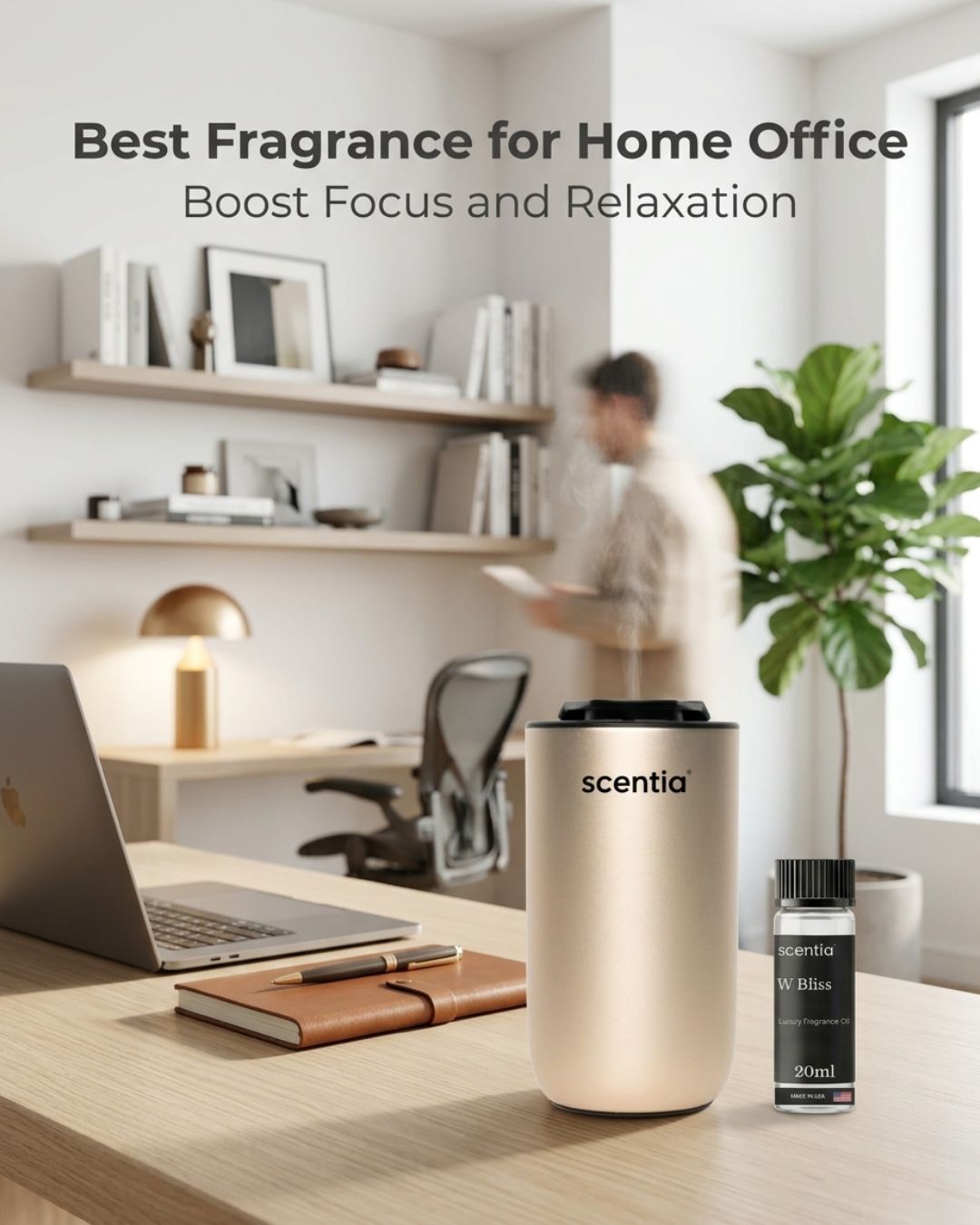
I run two businesses from a home office. By the end of a typical day I've been at this desk for ten hours. Scent in a workspace isn't a nice-to-have for me — it's one of the things that helps me stay functional through the afternoon slump without getting twitchy from another coffee.
The research on scent and productivity is real but smaller than you'd think. A lot of what gets repeated online is either based on one study from the 1990s or is aromatherapy marketing. Here's what's actually supported, and what I've found works after years of trial and error in my own workspace.
What the research actually supports
Peppermint has some decent evidence for alertness and cognitive performance — a handful of studies show improved memory and reaction time with exposure. The effect is modest, not miraculous.
Rosemary similarly has some backing for memory and alertness in small studies.
Citrus (especially lemon) has evidence for mood elevation and perceived stress reduction. Mood matters for focus more than people realize — a bad mood is a focus killer.
Lavender has evidence for relaxation and lower stress, but it's a double-edged sword in a workspace. You want calm, not sleepy.
Pine and certain wood notes have been linked to reduced perceived stress and improved mood in small forest-bathing studies, though the home-office equivalent is less studied.
The catch: most of these studies test essential oils in controlled settings, and the effect sizes are modest. Don't expect the fragrance to turn a bad work day into a great one. But it can be a small, consistent edge.
What actually matters more than the specific scent
Consistency. The same scent every work day builds an association. Your brain pairs the scent with "focus mode," and over a few weeks it helps get you into work mindset faster. This is Pavlovian, not magical, but it's real.
Moderate intensity. Heavy fragrance is distracting. The scent should be background, not foreground. If you notice it constantly, it's too strong.
Fresh, not musty. Old stale fragrance oil is worse than no fragrance at all. Keep your oils fresh, and clean your diffuser periodically.
Match it to the task. Different kinds of work benefit from different scents. More on this below.
Scent families for different kinds of work
Deep focus / cognitive work (writing, coding, analysis)
Light citrus with a supporting note that isn't too sweet. You want alertness without the stimulation turning into jitters.
Our W Bliss works well here. Lemon and jasmine at the top, koa wood at the base. Bright enough to keep you alert, grounded enough to not feel like you're in a juice bar.
Creative work (design, brainstorming, writing that requires voice)
Softer, more complex scents. Something with a bit more depth that your brain can play with.
I've had good results with Miami One during creative sessions — cardamom, citrus, sandalwood, amber. It has enough going on to feel interesting but not so much that it distracts.
Administrative work (email, admin, Zoom calls)
This is the category where mood elevation matters most. Boring work feels less boring with a scent that puts you in a better mood.
Anything citrus-forward works. Coastal is good here — bergamot, jasmine, marine. Clean and bright.
End-of-day wind-down
When you're finishing up and trying to transition out of work mode, shift to something softer. Light floral, soft whites, or a gentler marine note.
Dream Walk works as a transitional scent — it's neutral and calm without being sedating.
What to avoid during work hours
Gourmand scents — vanilla, caramel, pumpkin. These are cozy scents. Cozy is not what you want at 2 PM when you have three more hours of work.
Heavy lavender. Even if you love it. Lavender at work hours often translates into afternoon drowsiness.
Loud florals — tuberose, gardenia, rose-heavy blends. Too personal, too present. Harder to focus through.
Ouds and heavy musks during the day. These are beautiful scents in a living room in the evening. In an office at 10 AM they read as too much.
The setup I actually use
MiniPod on a shelf behind my desk, about six feet from where I sit. Not too close. You don't want the diffuser blowing toward you — the scent builds up and your nose adapts faster when it's concentrated.
Intensity: low-to-medium, around 30%. More than that is distracting.
Schedule: 10 minutes on, 30 minutes off, during work hours. The intermittent pulse keeps the scent fresh and keeps your nose from adapting into "smelling nothing."
Oil: I rotate. W Bliss during deep work mornings, Coastal for admin afternoons, sometimes Scentia You for creative sessions (it's designer-inspired, energetic citrus-woody — a good "get into it" scent).
I don't run it on weekends. That reinforces the work-mode association.
Office size and diffuser pairing
Small home office (under 200 sq ft): A MiniPod is plenty. Don't go bigger — you'll overwhelm the space.
Medium home office (200–400 sq ft, maybe a home office plus adjacent reading nook): MiniPod still works, or a Max on low intensity if you want more flexibility.
Open-plan work-from-home setup (desk in living area): Scentia Max in the living area at low-medium intensity, on a work-hours schedule.
A note on Zoom calls
If you have back-to-back video meetings, keep the fragrance lighter than usual. You want the scent to support you, not to be something you're aware of while trying to track what someone else is saying. Low intensity, citrus-forward, and set a schedule that matches your meeting blocks.
One thing the research doesn't capture
Smell has a strong memory association. If you pair a specific scent consistently with good work — deep focus, finishing projects, winning sales — the scent eventually becomes a cue that primes you for that state. It's not magic. It's just conditioning over time.
The reason I recommend picking a "work scent" and sticking with it for several weeks before switching is this: you're building that association. Rotate too fast and the brain never pairs the scent with the state.
Starting point
Pick one oil from a category that matches your main work mode. Put it in a MiniPod or Max at low intensity behind your desk. Run it during work hours for three weeks before judging whether it's helping.
The Home Scenting collection has the full lineup. If you're not sure what suits your work style, the Sample Kit lets you test W Bliss, Coastal, and Miami One in 20ml sizes before you commit.
The real productivity win isn't the specific scent. It's the discipline of creating a workspace that signals "time to focus" the moment you walk in. Scent is one of the most consistent ways to do that.


Leave a comment
All comments are moderated before being published.
This site is protected by hCaptcha and the hCaptcha Privacy Policy and Terms of Service apply.