

A $4 plug-in from the grocery store and a $90 bottle of luxury diffuser oil are both, technically, home fragrance. They both make the house smell like something. But they are not the same product at different price points. They're different categories of product that happen to share a shelf in your brain.
If you've been wondering why anyone would spend serious money on fragrance oil when you can grab something that "smells fine" for a few dollars, here's the actual breakdown.
What you're paying for, in order
1. Fragrance oil concentration
This is the big one. Commercial-grade diffuser oils from quality houses run 20–40% fragrance concentration. Grocery-store air fresheners run 1–5%.
The rest is solvent, filler, propellant, or water. Which means when you spray a $4 air freshener, you're mostly spraying the carrier. The fragrance is a small minority of what comes out.
Higher concentration doesn't just mean "stronger." It means the top, middle, and base notes all make it into the air. Low-concentration products basically only project the top notes — the ones that hit you first and then fade fast.
2. Fragrance note complexity
Think about a luxury hotel scent. It might have bergamot and lemon at the top, jasmine and rose in the middle, and sandalwood, oud, and amber at the base. Ten to fifteen individual ingredients working together, each one present in the right proportion.
Now think about a grocery-store air freshener labeled "Hawaiian Breeze." That's probably two or three synthetic aroma chemicals blended to approximate "tropical." The top note is fine. There is no middle. There is no base.
This is why luxury fragrance has what perfumers call "drydown" — the way the scent changes and deepens over time. Cheap air fresheners don't have drydown. They have a single phase that slowly fades.
3. Ingredient quality
Not all fragrance ingredients are created equal. Natural and premium synthetic aroma chemicals can cost ten to a hundred times more per kilogram than the bulk commodity versions used in mass-market products.
A good sandalwood note might use Mysore or Australian sandalwood accords. A cheap one uses a synthetic woody amber that vaguely reads as "wood." Both will sort of smell like wood. Only one will smell like actual sandalwood.
4. Safety and compliance
Scentia maintains supplier-issued IFRA conformity documentation and Safety Data Sheets for individual fragrance formulations. IFRA conformity is application-specific and does not establish suitability for every person or pet. Contact cs@scentiausa.com for documentation for a specific fragrance.
Luxury brands like Scentia go further — our oils are paraben-free, phthalate-free, petroleum-free, vegan, cruelty-free, and compliant with California CARB standards and the Toxic Substances Control Act.
Grocery-store air fresheners have a reputation for containing whatever was cheap that quarter, and the full ingredient list usually isn't disclosed. Some use phthalates as fragrance carriers. Some use propellants that are legal but not great to breathe long-term.
If you're running scent in a home with kids, pets, or anyone sensitive, this difference matters.
5. Delivery mechanism
The oil is only half the product. The other half is how it gets into the air.
A plug-in air freshener heats a wick and fans the vapor. This destroys heat-sensitive base notes and projects a small radius.
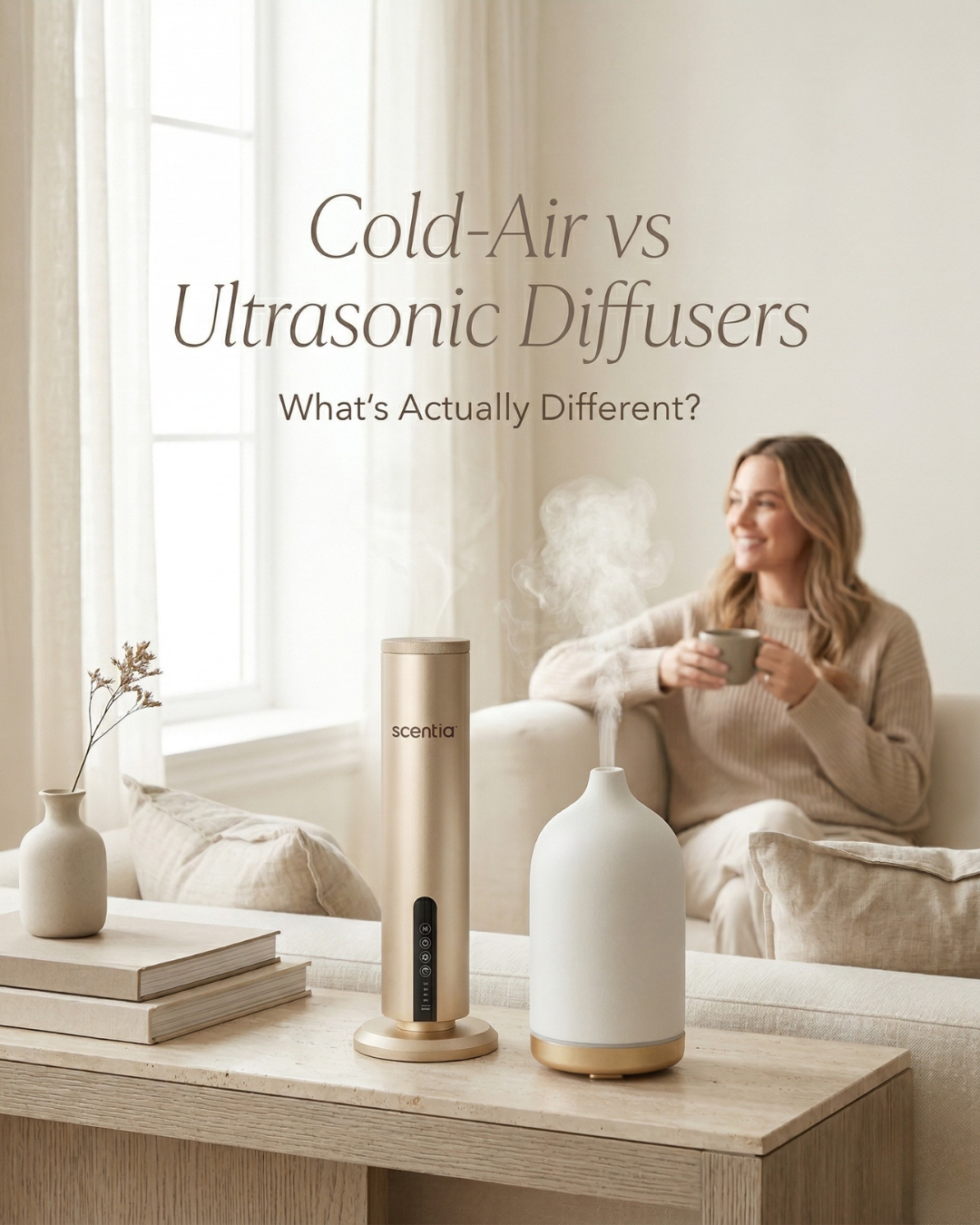
A cold-air diffuser atomizes oil into ultra-fine dry particles using compressed air. No heat, no dilution, no degradation. The oil hits the air essentially unchanged.
The same fragrance smells different out of different devices. Luxury fragrance oil in a cheap heated diffuser is wasted. Luxury diffuser plus luxury oil is when you actually get the full experience.
6. Longevity per dollar
This is where most people miscalculate. They look at the price of a 120ml bottle of premium oil ($80–120 depending on the scent) and compare it to a $4 air freshener. The air freshener looks cheaper.
Except the air freshener lasts 30 days in one small room. A 120ml bottle of quality oil in a cold-air diffuser running on a reasonable schedule lasts 4–8 weeks in a whole living area.
Do the math per square foot per month and premium oil is often cheaper per coverage than cheap refills. Not even close when you factor in the quality difference.
What you're not paying for
Fancy packaging adds cost but not fragrance. Celebrity endorsement does nothing for the scent. Big brand names often charge more than smaller independents for roughly equivalent oil quality — the independent brands don't have retail markup or mass ad spend built in.
Price isn't a perfect signal. Some expensive fragrances are overpriced. But below about $40 for a 100ml+ bottle of diffuser oil, you're almost certainly buying something that's been cost-engineered rather than fragrance-engineered.
How to tell the difference before buying
Read the ingredient list. If you see phthalates, parabens, or "fragrance" listed without any further specification from a brand that won't tell you what's in it, that's a mass-market air freshener regardless of price.
Check the concentration. Premium brands will often state their fragrance concentration or IFRA compliance. Mass-market brands won't.
Look at the note structure. If the product description describes top notes, middle notes, and base notes separately — real fragrance. If it just says "Lavender Breeze" with no further detail — probably simple synthetic.
Check the diffusion method. Is this oil designed for cold-air, ultrasonic, HVAC, or reed? Premium brands design their oil around specific diffusion methods. Mass-market doesn't care because the delivery is always the same heated wick.
See if they disclose manufacturing. Made in the USA? Made in EU? Made in "various countries"? Disclosure is usually a sign of pride in the product.
What the difference actually feels like
I'll be honest about what this looks like in practice. A room scented with a cheap air freshener has a top-note fragrance that hits you when you walk in and then fades into the wallpaper. It smells "fine" but you're never going to have a guest say "your house smells incredible — what is that?"
A room scented with premium oil in a proper diffuser has a fragrance that unfolds as you move through the space. It has depth. It lingers. It's the kind of scent people notice and remember, and it's often tied to good memories — hotel stays, beautiful homes, meaningful experiences.
That's what you're paying for. The product isn't just "scent." It's the ability to create a specific atmosphere in your home reliably.
Which category you need depends on the job
If all you need is to neutralize a bathroom odor, a $4 air freshener is fine. It's the right tool for that job.
If you want your home to smell like an environment you've chosen and are proud of — like a signature for your house, the same way you have a signature style of decor or lighting — you're in the luxury home fragrance category, and air fresheners will always disappoint you.
It's not a more-is-better situation. It's a right-tool-for-the-job situation.
Starting point
If you've only ever used grocery-store fragrance and you're not sure what "luxury" actually feels like in practice, grab the Sample Kit. Three 20ml oils, inspired by W Hotel, Ritz-Carlton, and 1 Hotel fragrances. Under $30. Works in any waterless diffuser you already own.
You'll know within a few days whether you're in the "fine with the plug-in" camp or the "oh, this is what people mean by luxury fragrance" camp. Scentia exists for the second group. If you become one of them, the full collection goes from there.

Leave a comment
All comments are moderated before being published.
This site is protected by hCaptcha and the hCaptcha Privacy Policy and Terms of Service apply.