

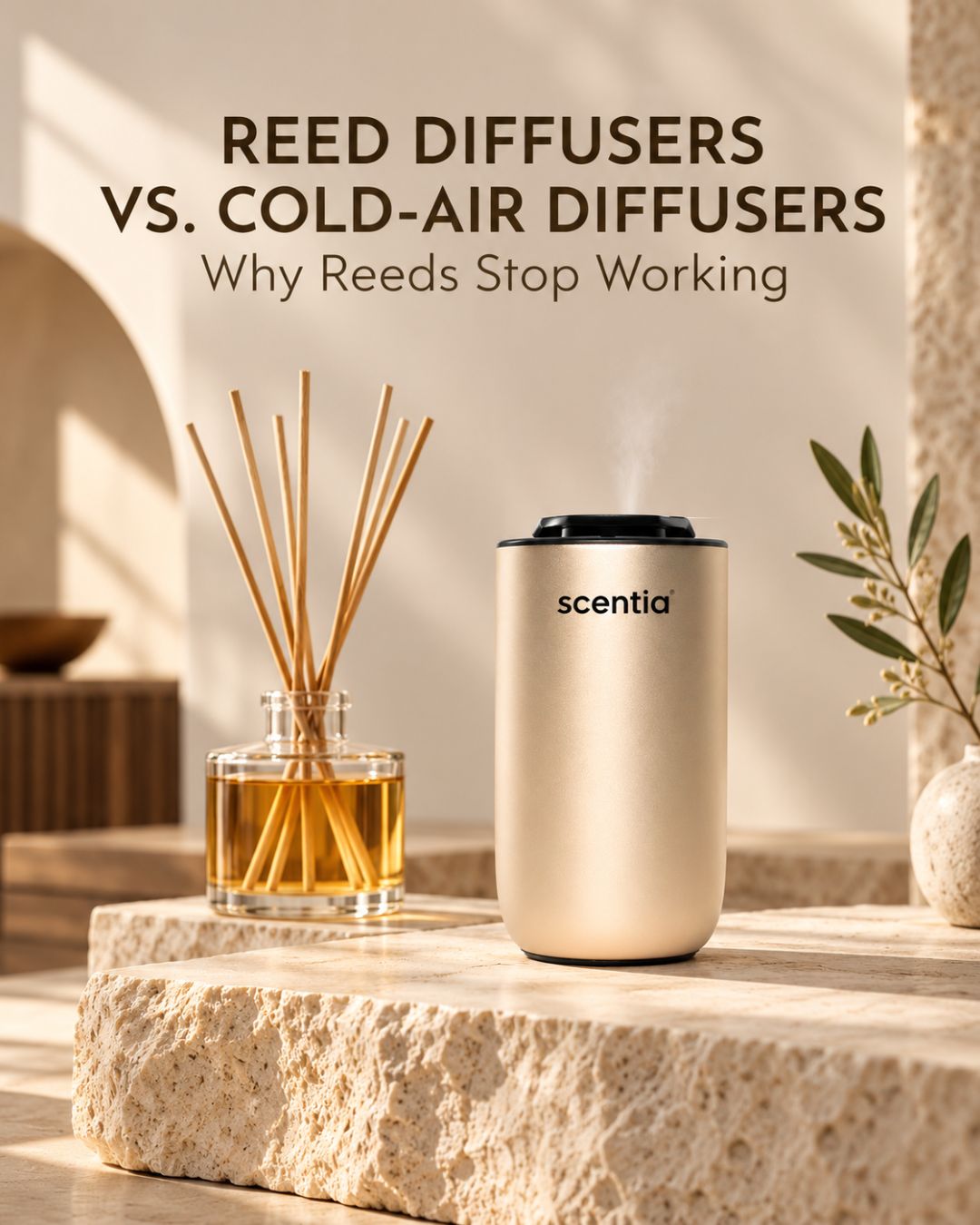
Quick answer: Reed diffusers work by capillary action: oil climbs the reeds and evaporates from the surface. They fade because the reeds saturate, dust clogs their pores, and the lightest fragrance notes evaporate first. They suit small, still spaces like a powder room. For any room larger than a closet, a cold-air diffuser delivers more scent, more evenly, for longer.
How does a reed diffuser actually work?
A reed diffuser is a bottle of scented oil with porous sticks (rattan or fiber) standing in it. Oil travels up through tiny channels in the reed and evaporates into the air from the exposed surface. There is no fan, no pump, no heat. The amount of scent you get depends entirely on how much oil reaches the top of the reed and how fast the air around it moves.
Why do reed diffusers stop smelling?
This is the question behind most "reed diffusers that actually work" searches. There are four reasons, and they stack:
- The reeds saturate and clog. Once the channels are full of older, thicker oil residue, fresh oil cannot climb as fast. Flipping the reeds helps for a day or two, then the same thing happens.
- Dust seals the surface. Reeds sit exposed for weeks. Household dust settles on them and blocks evaporation.
- Top notes evaporate first. The light, bright notes you smelled on day one are the most volatile. They leave fastest, and what remains is the heavier base, which throws less scent.
- You stop noticing it. Olfactory fatigue sets in within days of constant low-level exposure. The diffuser may still be working; your nose has tuned it out. We cover this in why you stop smelling your own home.
How does a cold-air diffuser work differently?
A cold-air (nebulizing) diffuser uses a small pump to push air through the fragrance oil, breaking it into a dry micro-mist that is carried into the room. No water, no heat, no reeds. Because the oil is atomized rather than evaporated, the whole fragrance profile is released together, top notes and base notes at the same time. And because the unit runs on cycles, you get a fresh burst each interval instead of a slow fade.
The practical differences for a shopper:
| Reed diffuser | Cold-air diffuser | |
|---|---|---|
| Coverage | A few feet around the bottle | 500 to 5,500 sq ft depending on model |
| Scent strength | Fixed; fades over weeks | Adjustable; consistent each cycle |
| Control | Add or remove reeds | Intensity, timer, app scheduling |
| Upkeep | Flip reeds, replace when clogged | Refill oil; occasional wipe |
| Upfront cost | Low | Higher (hardware) |
| Ongoing cost | New bottle plus reeds | Oil only |
| Spill risk | Open bottle of oil | Sealed bottle inside the unit |
When is a reed diffuser the right choice?
Reeds are not useless. They make sense when:
- The space is small and enclosed: a powder room, a linen closet, a reading nook.
- You want zero power and zero noise.
- You like the look of the bottle and reeds as decor.
- A subtle, background scent is all you want.
If any of those describe you, buy a reed diffuser with a wide-mouth bottle and thick reeds, keep it out of direct sun and away from HVAC vents, and plan to replace the reeds, not just flip them, every few weeks.
When should you switch to a cold-air diffuser?
- You want to scent a whole room, not the corner the bottle sits in.
- You are tired of buying a new reed set every month to get the same first-week effect back.
- You want the scent on a schedule: on before guests arrive, off overnight.
- You want to change scents without buying a whole new bottle-and-reeds set.
For a bedroom, office, or bathroom, the Scentia MiniPod (500 sq ft, rechargeable) replaces a reed diffuser directly and costs about the same as two or three premium reed sets. For a hallway or kitchen, the plug-in Scentia Pod adds app scheduling. See the full range in the diffuser collection, or read our best home diffusers guide for every type ranked.
Can you use reed diffuser oil in a cold-air diffuser?
Generally no. Reed diffuser oil is formulated with a carrier that is designed to wick and evaporate slowly. Cold-air diffusers need a thinner fragrance oil made for atomization; thicker reed oil can clog the nozzle. Use oils labeled for cold-air or nebulizing diffusers. Scentia's fragrance oils are made in the USA and formulated for cold-air diffusion; browse the fragrance oil collection.
Frequently asked questions
How long does a reed diffuser last?
A typical 100 ml reed diffuser lasts one to three months, but scent output drops noticeably after the first two or three weeks as the reeds clog and top notes evaporate.
Why does my reed diffuser smell strong at first and then nothing?
The lightest, most noticeable notes evaporate first. What remains is the heavier base, which throws less scent, and your nose also adapts to constant exposure within days.
Does flipping the reeds help?
Briefly. Flipping brings oil-soaked reed into the air for a short boost, but it does not clear clogged channels. Replacing the reeds works better than flipping.
Is a cold-air diffuser worth it over a reed diffuser?
If you want to scent more than a small enclosed space, or you want control over strength and timing, yes. The hardware costs more upfront, but ongoing cost is oil only, and the scent does not fade between refills.
Which is safer around pets and kids: reeds or a cold-air diffuser?
A reed diffuser is an open bottle of oil that can be knocked over; a cold-air diffuser keeps the bottle sealed inside the unit. For fragrance ingredient documentation, see our Fragrance Standards & Safety page.


Leave a comment
All comments are moderated before being published.
This site is protected by hCaptcha and the hCaptcha Privacy Policy and Terms of Service apply.