

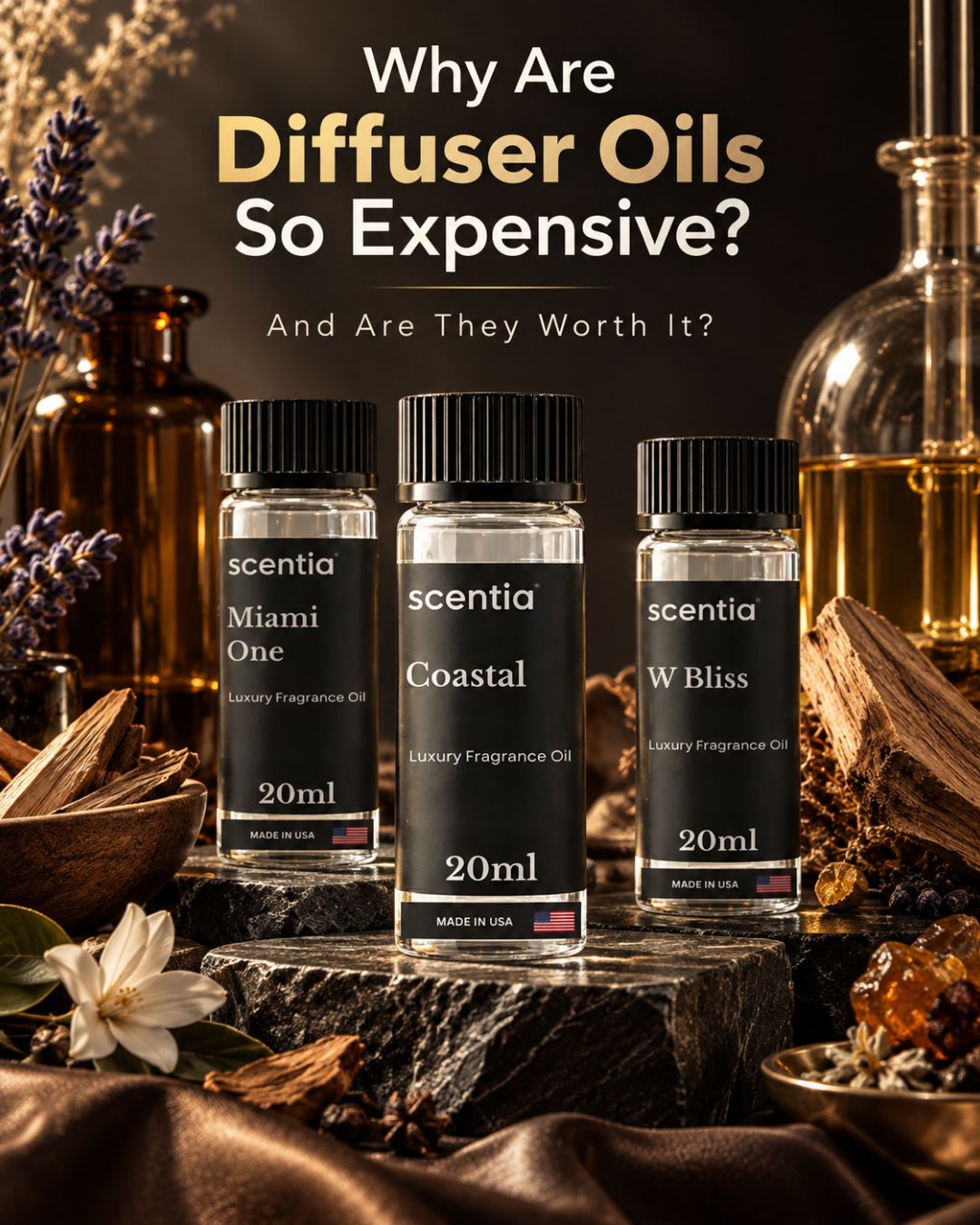
A bottle of premium diffuser oil can cost significantly more than a supermarket air freshener, and it's fair to ask whether that price is justified. Here's what actually goes into the cost — and how to think about value rather than sticker price alone.
What Drives the Price
- Formulation complexity: A layered, multi-note fragrance oil with top, heart, and base notes takes more development than a single synthetic scent note.
- Ingredient standards: Phthalate-free formulation, sourced and made in the USA, costs more than unregulated, imported bulk fragrance oil. See our ingredient standards article for what that actually means.
- Hardware compatibility testing: Diffuser oils formulated specifically for cold-air atomization require viscosity testing that generic fragrance oil skips.
- Concentration: Premium oils are typically more concentrated, meaning less product is needed per diffusion cycle to achieve the same scent throw.
Is the Price Actually Justified by Value?
This is where cost-per-use matters more than sticker price. A more concentrated, well-formulated oil that lasts weeks on interval settings can work out cheaper per day of use than a larger bottle of diluted, weaker oil that needs to run longer or more frequently to achieve the same effect. See our How Long Do Fragrance Oils Last guide and our companion piece, How Much Does It Cost to Run a Diffuser Daily, for the actual math.
What You're Paying For vs. a Cheap Alternative
A cheap, unbranded diffuser oil may use synthetic fillers, inconsistent batches, or carrier additives that dilute the scent and shorten shelf life. A premium oil trades a higher upfront price for a stronger, more consistent, longer-lasting result — and, in Scentia's case, phthalate-free and made-in-USA sourcing on the oils themselves.
Making the Spend Worth It
To get the most value from a premium oil: use interval diffusion rather than continuous run, store bottles away from direct heat or sunlight to preserve the formulation, and choose the size that matches your actual usage pattern rather than always buying the smallest bottle. Browse our full range across 20ml to 500ml sizes to find the best cost-per-use fit.
Frequently Asked Questions
Are expensive diffuser oils actually better quality?
Generally, yes — higher price usually reflects formulation complexity, ingredient sourcing, and concentration, all of which affect scent strength and longevity.
Is a bigger bottle always a better value?
Not necessarily. Cost-per-use depends on concentration and how efficiently the oil is used, not just the total volume.
Do cheap diffuser oils damage diffusers?
Cheaper oils are more likely to contain fillers or inconsistent viscosity, which can increase the risk of clogging or uneven atomization over time.
How can I make an expensive diffuser oil last longer?
Use interval diffusion instead of continuous run, and store bottles away from heat and direct sunlight to preserve the formulation.

Leave a comment
All comments are moderated before being published.
This site is protected by hCaptcha and the hCaptcha Privacy Policy and Terms of Service apply.