

Luxury Home Fragrance · Comparison
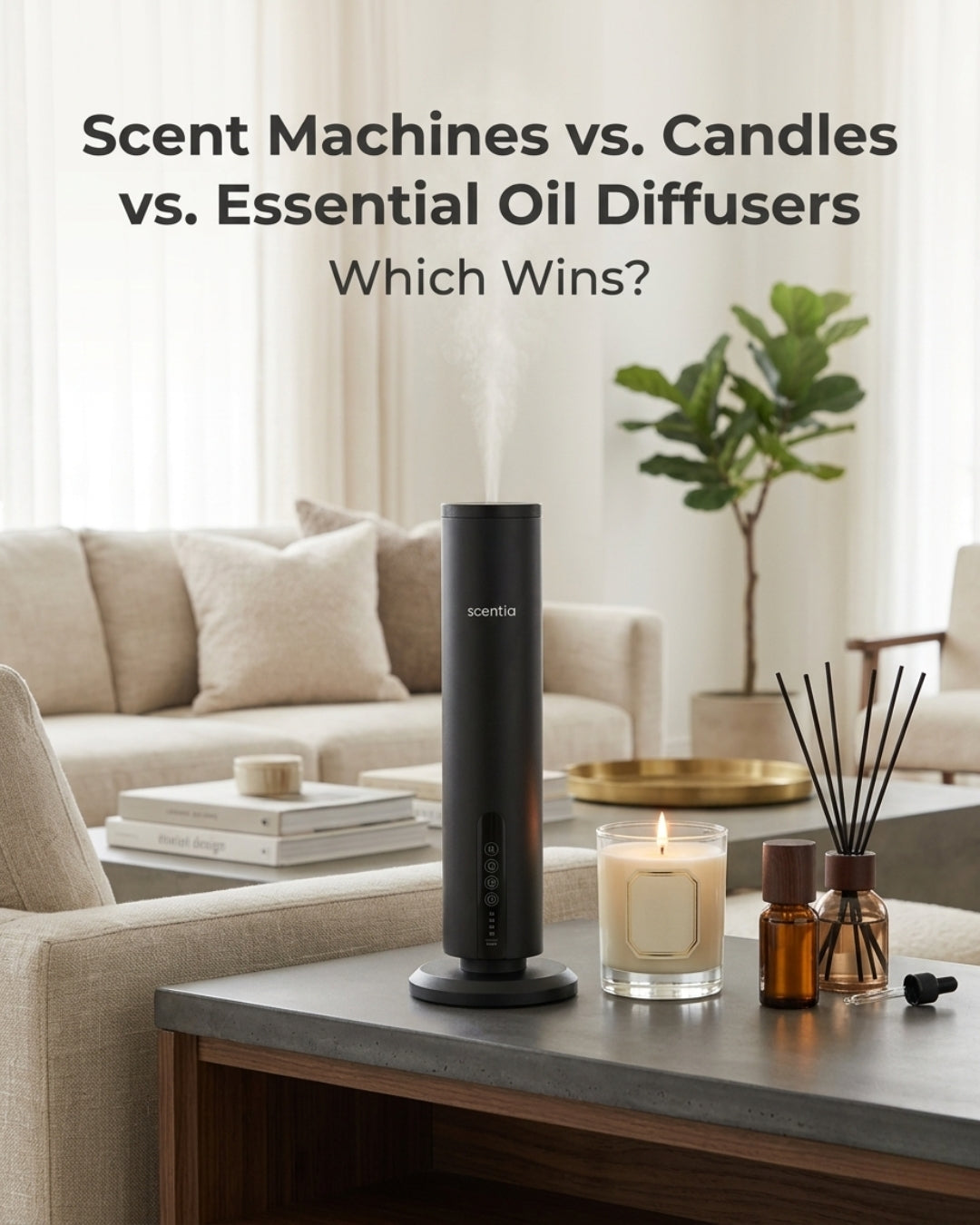
Scent Machines vs. Candles vs. Essential Oil Diffusers: Which Wins?
Candles, reed diffusers, wax warmers, plug-ins, ultrasonic diffusers, and cold-air scent machines all do different jobs. Here's an honest, no-spin comparison of coverage, cost, safety, and scent quality.
Updated September 2026
At a Glance
Key Takeaways
Candles: Ambiance, Not Consistency
Great for ritual and flicker. Scent throw is inconsistent — weak early, peaks mid-burn, can turn muddy late. Open flame risk.
Ultrasonic: Small Rooms Only
Water dilutes the oil and caps how far scent travels. Good for a nightstand, not a living room.
Cold Air: Coverage and Consistency
No water, no heat, no flame. Scentia Max covers up to 1,500 sq ft with a consistent scent profile hour to hour.
Candles and Ultrasonic Diffusers: What They're Actually Good At
People ask me this constantly, usually right before telling me they already own two or three of the categories below. Fair enough — most homes end up with a mix, and honestly that's not the worst approach. But if you're trying to figure out where to put your money and which one actually does the job you want, here's how they stack up, no spin.
Candles win on ambiance and lose on almost everything else. There's something a lit candle does that no diffuser replicates — the flicker, the ritual of lighting one, the fact that it signals "we're settling in" in a way a diffuser just doesn't. That's real and I'm not going to pretend it isn't. But as a scenting tool, candles are inconsistent by design. Scent throw depends on burn time, room airflow, and how much of the wax pool has melted, so the fragrance is weak for the first twenty minutes, peaks somewhere in the middle, and can turn muddy by the end as the wick struggles through built-up wax. They're also the only category here with an open flame, which matters if you've got kids, pets, or you just forget things are burning, which, be honest, everyone has done at least once.
Ultrasonic essential oil diffusers are the ones with the little water reservoir and the color-changing light. They're genuinely good at what they're built for: small rooms, gentle ambient scent, a bit of visible mist for the aesthetic. The problem is the mechanism. Ultrasonic diffusion mixes oil with water and vibrates it into a fine mist, which dilutes the fragrance and caps how far it can travel. Great for a nightstand in a bedroom. Not going to touch a living room, let alone an open floor plan. There's also a maintenance side nobody mentions in the marketing — water reservoirs need regular cleaning or you get mineral buildup and, worse, mold in the tank if you're not on top of it.
Reed Diffusers, Wax Warmers, and Plug-Ins: The Smaller Categories
Three more categories worth knowing about, even though none of them are built for a whole home. Reed diffusers work by capillary action — the reeds sit in a bottle of fragrance oil and slowly wick it up, releasing scent passively with no power source at all. That's their appeal: always-on, no maintenance beyond flipping the reeds occasionally, nothing to plug in. The tradeoff is coverage. A reed diffuser handles roughly 100–200 sq ft on a good day, which makes it a natural fit for a bathroom, closet, or small entryway and a poor fit for anything bigger. A bottle typically lasts two to four months depending on room temperature.
Wax warmers and heated electric diffusers solve the open-flame problem of candles without solving much else. They heat a wax cube or oil well electrically instead of burning it, so there's no soot and nothing to blow out — genuinely useful if you're in a rental that doesn't allow candles. But the fragrance behaves the same way it does in a candle: heat degrades the base notes over time, so what you smell in the first hour isn't quite what you smell by hour six, and coverage stays limited to roughly the same single-room range as a candle. Most wax cubes run 8–12 hours per melt.
Plug-in air fresheners are the category we'd steer you away from if you're set on any of the others. They heat a small fragrance cartridge, or run a fan over one, plugged straight into a wall outlet, and refills last 30 to 60 days. The scent itself is usually the limiting factor — most plug-in cartridges use synthetic fragrance blends built for shelf stability rather than nuance, which is a different experience than an actual fragrance oil. They're inexpensive and easy, which is the whole case for them; if budget is the only constraint and the space is genuinely small, that's a legitimate reason to use one. Otherwise, it's the category with the least to recommend it.
Recommended
The Long-Term Cost Math
Candles
$20–40 per candle, roughly 40–60 hours of burn time. Scenting a room daily means buying a new one every couple of weeks.
Ultrasonic Diffusers
Lower upfront cost, but limited range and regular reservoir cleaning to avoid mineral buildup and mold.
Cold-Air Diffusers
Higher upfront cost, but oil goes a long way and there's no hardware being consumed the way wax is.
Where Cold-Air Diffusion Wins — and the Honest Cost Math
Cold-air diffusion, which is what we build, is a different mechanism entirely. No water, no heat, no flame. It atomizes pure fragrance oil into a dry mist using air pressure, which means the fragrance stays undiluted and travels further — our Scentia Max is rated for spaces up to 1,500 square feet, which is a different category of coverage than a $30 ultrasonic unit or a reed diffuser. Because there's no heat involved, the scent doesn't degrade or change character the way a burning candle's or wax warmer's does. What you smell at hour one is what you smell at hour six.
Cost is where it gets more interesting than people expect. A candle runs $20–40 and lasts maybe 40–60 hours of burn time before you're buying another one — so if you're scenting a room for a few hours a day, that's a candle every couple of weeks, forever. A cold-air diffuser is a bigger upfront cost, but the oil itself lasts a long time since a little goes a long way, and the hardware doesn't get consumed the way wax does. Long-term, for anyone who wants a home scented consistently rather than occasionally, the math tends to favor the diffuser.
Safety is the other real differentiator. No flame means no fire risk, no soot on your walls or ceiling near where you burn candles regularly (that gray smudge above a candle you've had for months — that's soot, and it's not great to be breathing regularly), and nothing hot for a curious toddler or a cat with bad judgment to knock over.
My honest take, and I'll own the bias since we sell one of these: candles for the occasional evening when you want the visual and the ritual, reed diffusers for a bathroom or closet you don't want to think about, ultrasonic for a small personal space where you don't need much throw, and cold-air diffusion for anyone who actually wants their home to smell intentional and consistent, room to room, day after day, without babysitting a flame or refilling water every other day. If I had to pick one system to run as the default in a home, it's cold air, and it's not particularly close. But there's no rule against running a candle on top of it for a dinner party.
Frequently Asked Questions
Is a cold-air diffuser better than a candle?
For consistent, room-filling fragrance, yes — cold-air diffusion doesn't rely on heat, so the scent doesn't intensify or degrade the way a burning candle's does over a few hours. Candles still win for the ritual and visual ambiance, which a diffuser doesn't replicate.
Why does my ultrasonic diffuser not scent the whole room?
Ultrasonic diffusers mix fragrance oil with water and vibrate it into a fine mist, which dilutes the oil and limits how far it can travel. They're built for small spaces like a nightstand, not open living areas.
Are essential oil diffusers safe to run all day?
Scentia fragrance oils are made in the USA. Individual sensitivities vary among people and pets. Use in well-ventilated spaces, avoid prolonged operation, and keep oils and devices out of reach. Consult your veterinarian for pet-specific advice and avoid diffuser use in homes with birds. Follow our Safety & Use guidelines.
What's the most cost-effective way to scent a home long-term?
For anyone scenting a space daily rather than occasionally, cold-air diffusion tends to win on long-term cost — the oil lasts longer per use than candle wax gets consumed, and there's no recurring hardware replacement the way there is with candles.
Are reed diffusers or wax warmers a good alternative to a cold-air diffuser?
Reed diffusers work well for small, enclosed spaces like a bathroom or closet, and wax warmers solve the open-flame problem of candles, but neither is built for coverage beyond a single small room. For anything larger than about 200 sq ft, a cold-air diffuser is the more consistent option.
Ready to see the full lineup? Compare all four Scentia diffusers →
Miami · Luxury Home Fragrance
No Flame. No Water. No Guesswork.
Cold-air nebulizing technology delivers consistent, room-filling fragrance without the maintenance of candles, reed diffusers, wax warmers, or ultrasonic diffusers.
Free shipping over $79.99 · Free MiniPod with oil orders over $99 · Use code SCENT10 for 10% off your first order

Leave a comment
All comments are moderated before being published.
This site is protected by hCaptcha and the hCaptcha Privacy Policy and Terms of Service apply.