

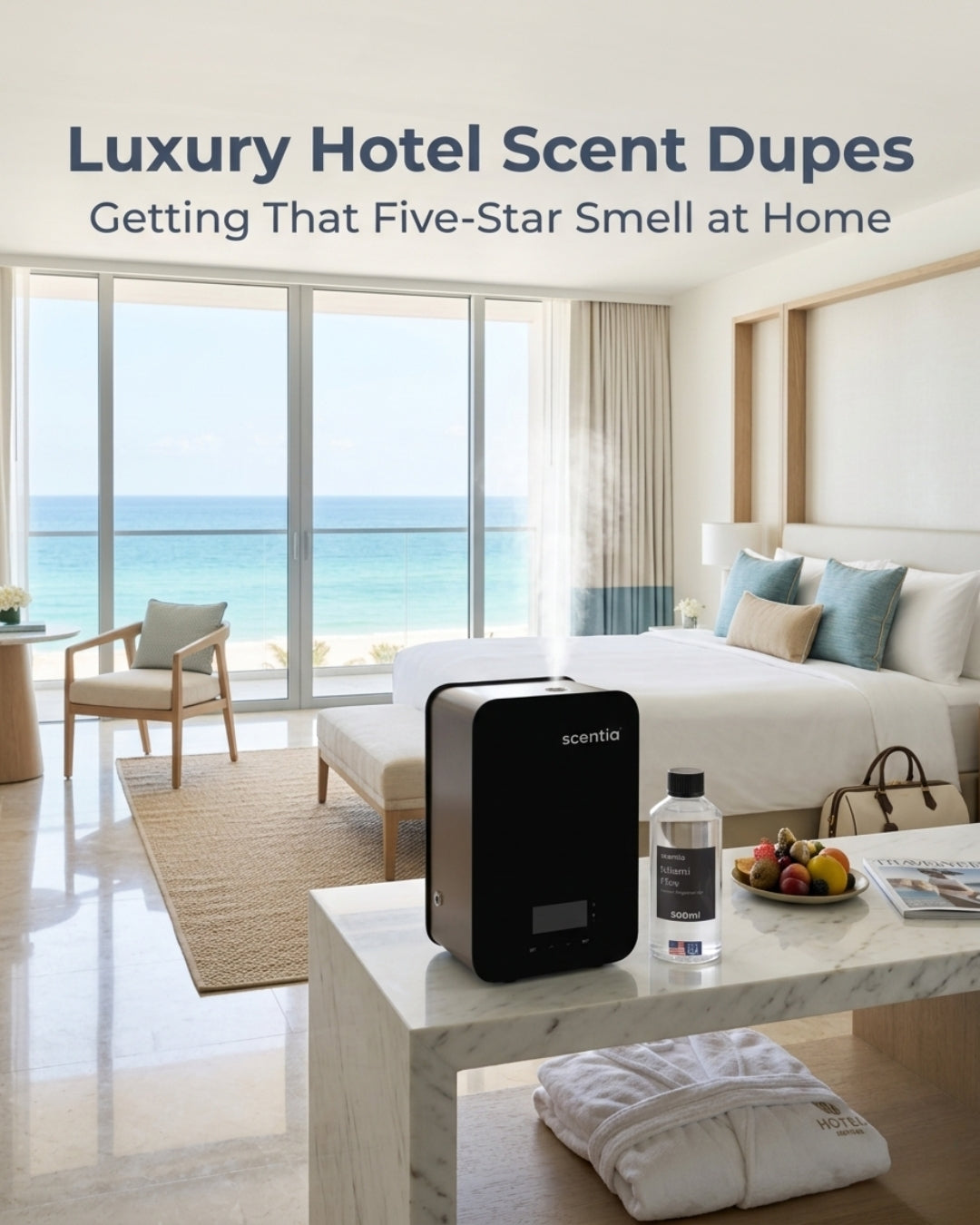
Luxury Home Fragrance · Buyer's Guide
Hotels spend real money engineering that lobby smell. Here's what's actually in it, why the delivery method matters as much as the oil, and how to get close to it at home.
At a Glance
Key Takeaways
It's Built Like a Perfume
Top, heart, and base notes — not a single flat scent. A W Hotel lobby leans citrus-sweet on top with sandalwood underneath.
Cold Air, Not Heat
Hotels use cold-air nebulizing diffusion almost exclusively. Heat burns off top notes fast, which is why candles smell different at minute 90 than minute 5.
The Right Family Matters
Ritz-Carlton-style profiles lean citrus-and-marine. Sandalwood, white tea, bergamot, oud, and ocean mist are the core five-star building blocks.
What's Actually in a Hotel's Signature Scent
You know the smell. You walk into a certain hotel lobby and something happens — you relax a little, the trip stress drops, and some part of your brain files the place as expensive before you've even looked at the room rate. That's not the marble. That's not the flowers. It's almost always a diffused fragrance running through the HVAC or a bank of cold-air units near the entrance, and it's a bigger part of the hospitality budget than people assume.
I'll say the obvious thing first: I run a company that sells fragrance oils inspired by these hotel scents, so take the rest of this with that in mind. But the mechanics here are true whether you buy from us or figure it out yourself.
Hotel scenting almost never uses a single simple note. It's built the same way a perfume is built — top notes that hit you first and fade fast, a heart that carries the character of the scent, and a base that lingers after you've walked past. A W Hotel lobby leans citrus and something slightly sweet on top, with sandalwood or amber underneath. A Ritz-Carlton property tends toward something crisper and more marine — think jasmine and sea air rather than vanilla and musk. These aren't accidents. Hospitality groups work with fragrance houses the same way perfume brands do, and the scent gets locked in as part of the brand identity, tested across markets before it goes into every property.
The technology matters as much as the formula. Hotels use cold-air nebulizing diffusion almost exclusively for lobby scenting, not candles, not plug-ins, not reed diffusers. Cold air pushes pure, undiluted oil into the space as a dry mist, no water, no heat. That's important because heat changes a scent's chemistry — it burns off the lighter top notes faster than the base notes, so a candle smells different at minute five than it does at minute ninety. Cold-air diffusion keeps the full profile intact and consistent for as long as the machine runs, which is exactly why the hotel smells the same walking in on day one and day four of your stay.
Recommended
Resort-Inspired, Built for the Same Technology Hotels Use
Scentia Max
Same cold-air nebulizing tech hotels use for lobby scenting, sized for a home rather than a commercial space.
Coastal
Lemon and bergamot up top, jasmine and sea notes through the heart — that breezy, clean-linen Ritz-Carlton-style profile.
Luxury Resort Collection
Built around the five scent families most associated with five-star properties: sandalwood, white tea, bergamot, oud, ocean mist.
Why the Diffuser Matters as Much as the Oil
This is the part most home diffuser reviews miss entirely: you can buy a fragrance oil with the right notes, but if you're running it through a plug-in or a wax warmer, you're not getting the hotel effect. The delivery mechanism is half the equation. We built the Scentia Max around this exact gap — same cold-air nebulizing tech, sized for a home instead of a lobby, so a resort-style oil actually performs the way it's supposed to.
On the oil side, our Luxury Resort Collection is built around the scent families most associated with five-star properties: sandalwood, white tea, bergamot, oud, ocean mist. Coastal leans into that Ritz-Carlton-style citrus-and-marine profile — lemon and bergamot up top, jasmine and sea notes through the heart, settling into something warmer underneath. If you've stayed somewhere with that breezy, clean-linen lobby smell, that's the family you're after.
A few things actually matter if you're trying to get close to a specific hotel's scent at home. Don't skimp on the diffuser's coverage rating for your space — an underpowered unit in a large room gives you a faint version of the scent instead of the real thing. Don't run the oil at max intensity hoping it'll smell more "hotel-like" — hotels run these systems at a level calibrated for the space, not maxed out, and overdoing it just makes it heavy. And give it a few days. Your nose adjusts to a new scent faster than a guest walking in fresh would, so don't judge it after twenty minutes.
If you're not sure which profile is closest to the property you're chasing, our Sample Kit is the cheapest way to test two or three before committing to a full bottle. Cheaper than one night at most of the hotels this fragrance is trying to recreate, for what it's worth.
Frequently Asked Questions
What makes a hotel lobby smell so distinct?
Most luxury hotels use cold-air nebulizing diffusion to disperse an undiluted fragrance oil through the lobby or HVAC system, built with a layered top/heart/base note structure the same way a perfume is formulated. It's a deliberate part of the brand identity, not incidental.
Can I recreate a hotel scent with any home diffuser?
Not exactly. The delivery method changes the result — a plug-in or wax warmer uses heat, which alters the scent's chemistry and burns off lighter top notes faster than base notes. Cold-air diffusion, the same technology hotels use, keeps the full fragrance profile intact.
What scent notes are most associated with five-star hotels?
Sandalwood, white tea, bergamot, oud, and ocean mist show up most consistently across luxury hospitality scenting programs. A Ritz-Carlton-style profile typically leans citrus-and-marine; a more classic five-star lobby often leans sandalwood-and-amber.
How long does it take a new hotel-inspired scent to feel right at home?
Give it a few days. Your nose adjusts to a new fragrance faster than a guest walking in fresh would, so judging a scent after twenty minutes tends to undersell it.
Want to compare Scentia directly against Aroma360 and Scentiment? Read the full brand comparison →
Miami · Luxury Home Fragrance
The Lobby Smell, Without the Room Rate
Cold-air diffusion and resort-inspired fragrance oils, built to recreate the scent experience of a five-star stay at home.
Free shipping over $79.99 · Free MiniPod with oil orders over $99 · Use code SCENT10 for 10% off your first order
Want to understand the hotel-scent effect? See what scents hotels use and how hotel scenting works →

Leave a comment
All comments are moderated before being published.
This site is protected by hCaptcha and the hCaptcha Privacy Policy and Terms of Service apply.