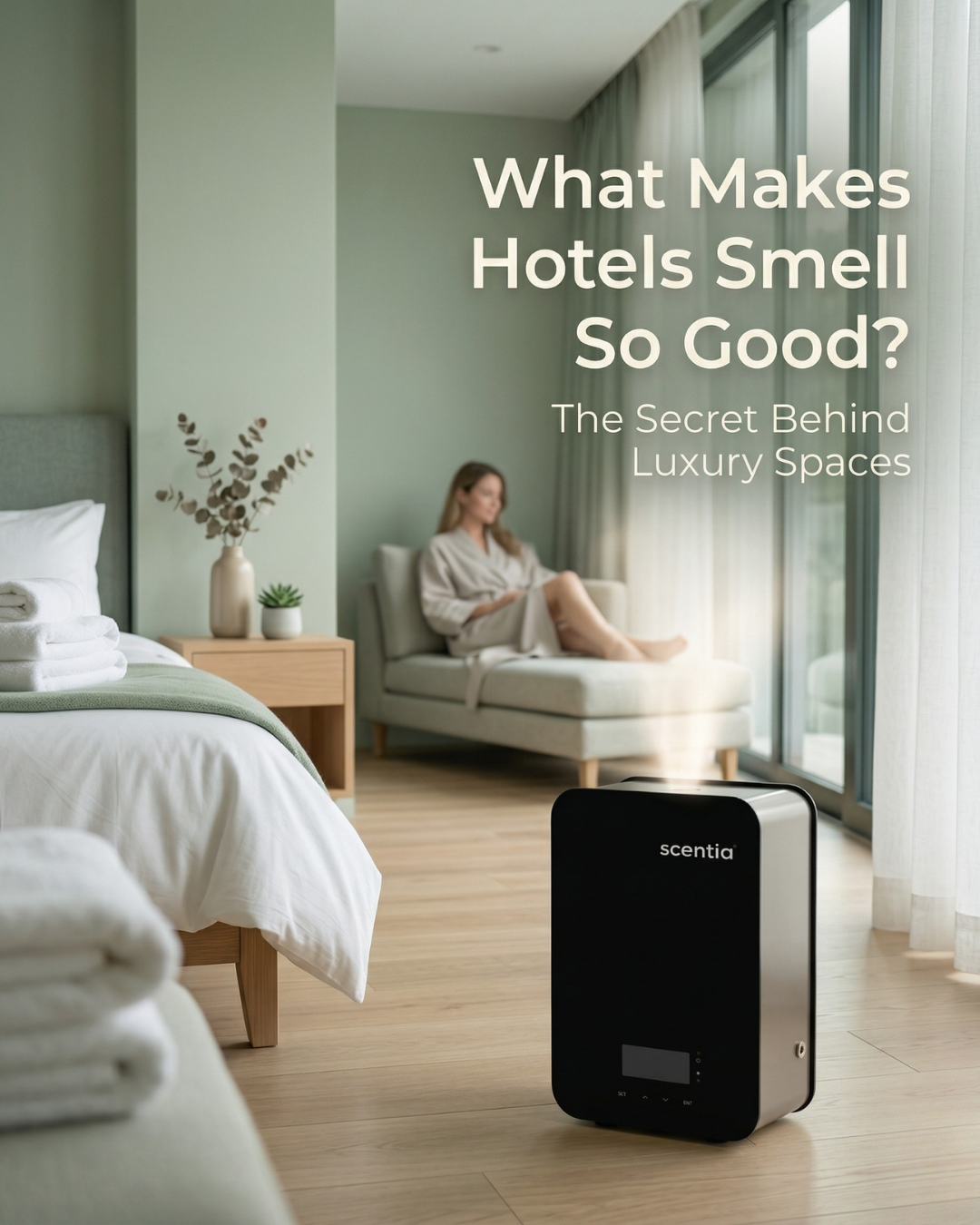
What Makes Hotels Smell So Good?

scentia usa diffuser machine Makes Hotels Smell So Good

There's real science behind why hotel lobbies smell the way they do — and why that smell affects you the way it does before you've even had time to think about it.

Walk into a good hotel and something happens almost immediately. Before you've registered the chandelier, the marble, or the staff greeting you, there's a feeling — something like relief, or arrival, or the particular relaxation of being somewhere that isn't your everyday environment. And there's a smell underneath all of it.

Most people notice it somewhere between three seconds and a minute after walking through the door. What most people don't realize is that the smell hit first. The feeling came from the smell. Everything else came after.

This is not an accident. It's not air freshener. It's a designed experience, and the science behind it is more interesting than the result.

Why smell is different from every other sense

Every sensory experience you have travels a similar path: receptor in the sense organ, signal through the nervous system, processing in the brain's sensory cortex, interpretation, emotional response. See something scary: eyes detect light, signal travels, visual cortex processes, thalamus routes it, you feel afraid. The whole chain takes some fraction of a second.

Smell doesn't work this way.

Olfactory receptors in the nose connect directly to the olfactory bulb, which sits right next to the amygdala and hippocampus — the brain structures most directly involved in emotion and memory. The signal doesn't go through the thalamus. It doesn't get filtered and routed the way visual or auditory signals do. It arrives in the emotional brain almost immediately, before conscious awareness has caught up.

This is why a smell can drop you into a specific memory from twenty years ago in under a second. Your visual system might recognize a face and your auditory system might recognize a voice, but smell bypasses the processing layers that regulate how you consciously experience other senses. It hits the emotional brain directly.

75%
of emotions generated daily are triggered by smell, according to research by the Sense of Smell Institute
65%
of people can recall a smell with 65% accuracy after a year — compared to 50% accuracy for visual memories after just three months
31.8%
longer time spent in a scented retail environment versus unscented, per Washington State University research

Hotels understood this before the research confirmed it. The deliberate use of signature scents in hospitality goes back decades — Singapore Airlines registered their cabin scent (Stefan Floridian Waters) in the 1990s, applied it to crew members and warm towels, and made it part of a recognizable brand identity. Westin developed White Tea and made it the olfactory signature of every property. Marriott, 1 Hotel, Edition, Fairmont — all of them have dedicated fragrance programs.

The investment runs into the hundreds of thousands of dollars for large hotel chains. That's not marketing indulgence. It's a calculated decision based on what the research shows scent does to guest behavior and satisfaction.

What's actually in a hotel lobby scent

Hotel fragrances aren't random pleasant smells. They're engineered around specific psychological and behavioral goals.

The base notes — sandalwood, cedar, vetiver, oud — do the emotional work. These are the notes you don't consciously notice but that create the feeling of the space. Warm, grounding, slightly woody. They signal stability, quality, and a certain timelessness. They're also notes that work across cultural backgrounds and personal preferences, which matters when you're designing for guests from dozens of different countries.

The middle notes — bergamot, white tea, soft florals — provide the character. These are what make a lobby smell like this hotel rather than generically expensive. The Westin's white tea is distinctive enough that regular guests recognize it immediately. It's brand identity delivered through the air. Scentia's Luxury Resort Collection is built around these exact note structures — sandalwood, white tea, bergamot, oud — the same architecture used in commercial hotel fragrance programs.

The top notes — the first thing you smell when you walk in — are usually lighter, fresher, and more immediately pleasant. Sea salt, citrus, green notes. These create the arrival experience — the moment of "oh, this place smells good" before the fuller fragrance settles in.

The specific combination is designed so that none of these layers are individually noticeable. You're not thinking "I smell sandalwood." You're thinking "this place feels right." That's the goal — scent as atmosphere rather than scent as smell.

The delivery system matters as much as the fragrance

Understanding why hotel scents hit the way they do also requires understanding how they're delivered. And the delivery system explains why most home fragrance products fall short of the same effect.

Hotels use cold-air nebulizing diffusers connected to their HVAC systems. The fragrance is atomized into microscopic dry particles using pressurized air — no heat, no water, no dilution. These particles are small enough to stay suspended in the air for extended periods and light enough to travel with the building's air circulation.

The result is that you can't locate the source of the scent. It arrives with the air, from the same vents that cool the lobby. It's everywhere and nowhere. This is critically different from a candle or a plug-in air freshener, where you can identify the source and the scent radiates outward from a fixed point, strongest near the source and weakening as you move away.

When you can't find where a smell is coming from, you stop trying and just experience it. The scent becomes atmospheric rather than sourced. That's a significant perceptual difference.

The reason hotel lobbies smell "everywhere" rather than "coming from that corner" is HVAC distribution. The fragrance travels with the air. Recreating this at home either requires an HVAC-connected system like the ScentiaCasa or positioning a cold-air diffuser near an air return so the HVAC carries the scent through the space.

Why the same scent makes you feel different in different spaces

One of the less obvious things about olfactory psychology: the same fragrance creates different emotional states depending on the context in which you encounter it.

Sandalwood in a hotel lobby signals luxury and arrival. Sandalwood in a meditation studio signals calm and interiority. Sandalwood in a retail store signals quality and justifies a premium price point. The molecule is identical. The context is doing the emotional work.

This is why buying a hotel's signature scent and running it at home produces a slightly different experience than walking into that hotel. Your brain is building the association in real time. The first week you run Miami One in your living room, it's just a pleasant fragrance. After a month it's become associated with your home, your evenings, the particular feeling of settling in. The scent memory is forming.

Hotels benefit from a head start — you arrive already primed to feel like you're somewhere special. The scent confirms it. At home, you're building the association from scratch. It takes longer, but the effect is the same once the memory anchor is formed. After a few weeks of consistent diffusion, walking into your home and catching that familiar fragrance will produce a genuine emotional response — not because the fragrance is special, but because your brain has wired it to that experience.

The consistency factor

The reason hotel scent programs require so much investment isn't the fragrance itself. It's the systems required to deliver it consistently. A hotel lobby that smells perfect on Monday and like nothing on Thursday because a diffuser ran out of oil breaks the psychological effect. Consistency is what builds the association. Inconsistency destroys it.

This maps directly to home use. A diffuser you remember to turn on occasionally creates an occasional pleasant smell. A diffuser on a timer, running the same fragrance at the same intensity every day, is what actually builds an olfactory identity for your home. The technology is the same. The consistency is the variable.

Most people who try home diffusion and feel like it "didn't work" ran a diffuser inconsistently — different oils, different intensity, inconsistent timing. The scent never had a chance to become atmospheric. It stayed as an occasional nice smell rather than becoming part of how the space feels. If you want to understand the technology difference that makes consistency easier, this explains why cold-air diffusion outperforms ultrasonic for exactly this reason.

The goal isn't to make your home smell good occasionally. It's for your home to have a smell — the same one, every day — that becomes part of how it feels to be there.

What this means practically

The science is interesting. The practical implications are straightforward:

Pick one fragrance for your main living space and stick with it. Don't rotate oils constantly in search of variety — that prevents the memory anchor from forming. Hotels don't change their signature scent seasonally. You can try different oils in different rooms — the room-by-room scent guide covers exactly which profiles work where — but the main space should have consistency.

Run the diffuser on a timer. Same hours, every day. The goal is atmospheric consistency, which requires routine.

Use cold-air diffusion. The technology matters because it determines how the scent fills the space. Ultrasonic produces a visible mist in a limited area. Cold-air produces an invisible, atmospheric presence that distributes with airflow. The second one is what creates the "how does this place smell so good" effect. The first one creates a nice smell near the diffuser. All Scentia diffusers use cold-air nebulizing technology — the same system hotels use.

Position it for airflow. Near an air return, in a central location, not in a corner. The HVAC system is your distribution mechanism if you use it. For larger homes, the large home scenting guide covers placement and coverage in detail.

And give it time. The first week it's a fragrance. After a month it's part of your home.

The Luxury Resort Collection

Built on the same fragrance architecture hotel scent programs use. Cold-air compatible, IFRA compliant, made in the USA.

Shop the Collection →
FREQUENTLY ASKED QUESTIONS
Why do hotel lobbies smell so good?
Hotels use purpose-designed signature fragrances delivered through cold-air nebulizing diffusers connected to HVAC systems. The fragrance travels with the conditioned air, creating an even, atmospheric scent with no identifiable source. The specific fragrance profiles — sandalwood, bergamot, white tea, cedar — are chosen to be welcoming and universally appealing across different guest backgrounds. Scentia's Luxury Resort Collection is built around these same hotel scent profiles.
Why does smell affect emotions so strongly?
Olfactory signals bypass the thalamus and connect directly to the amygdala and hippocampus — the brain structures most responsible for emotion and memory. Unlike vision and hearing, smell reaches the emotional brain almost immediately, before conscious processing. This is why a specific scent can trigger a strong emotional or memory response faster than any other sensory input.
Can I buy the actual scent from a hotel?
Some hotels sell their signature fragrance through their own retail channels. The Westin's White Tea blend and some 1 Hotel fragrances are available commercially. Alternatively, fragrance oils built around the same note structures — sandalwood, white tea, bergamot, oud — reproduce the character of these scents without being exact copies. Scentia's Luxury Resort Collection is designed around these hotel scent profiles.
How long does it take for a home to develop its own scent identity?
With consistent daily diffusion of the same fragrance, most people notice the association forming within 2-4 weeks. After 30 days, walking into the space and catching that fragrance produces a genuine atmospheric response — the scent has become part of how the space feels rather than just something it smells like. Starting with the Fragrance Sample Collection lets you find the right profile before committing to a full bottle.
What fragrance notes are most commonly used in luxury hotels?
Warm woods dominate the base: sandalwood, cedar, vetiver, and oud. Middle notes typically include bergamot, white tea, and soft florals for character. Top notes skew fresher — sea salt, light citrus, green notes. The combination is designed to be distinctive without being assertive, and to work across a wide range of cultural backgrounds and personal preferences. See the room-by-room guide for which of these profiles work best in each space.

Reading next

Scent a Large Home by scentia
Best Home Diffuser That Actually Works: A Buyer's Guide (2026)

Leave a comment

All comments are moderated before being published.

This site is protected by hCaptcha and the hCaptcha Privacy Policy and Terms of Service apply.