

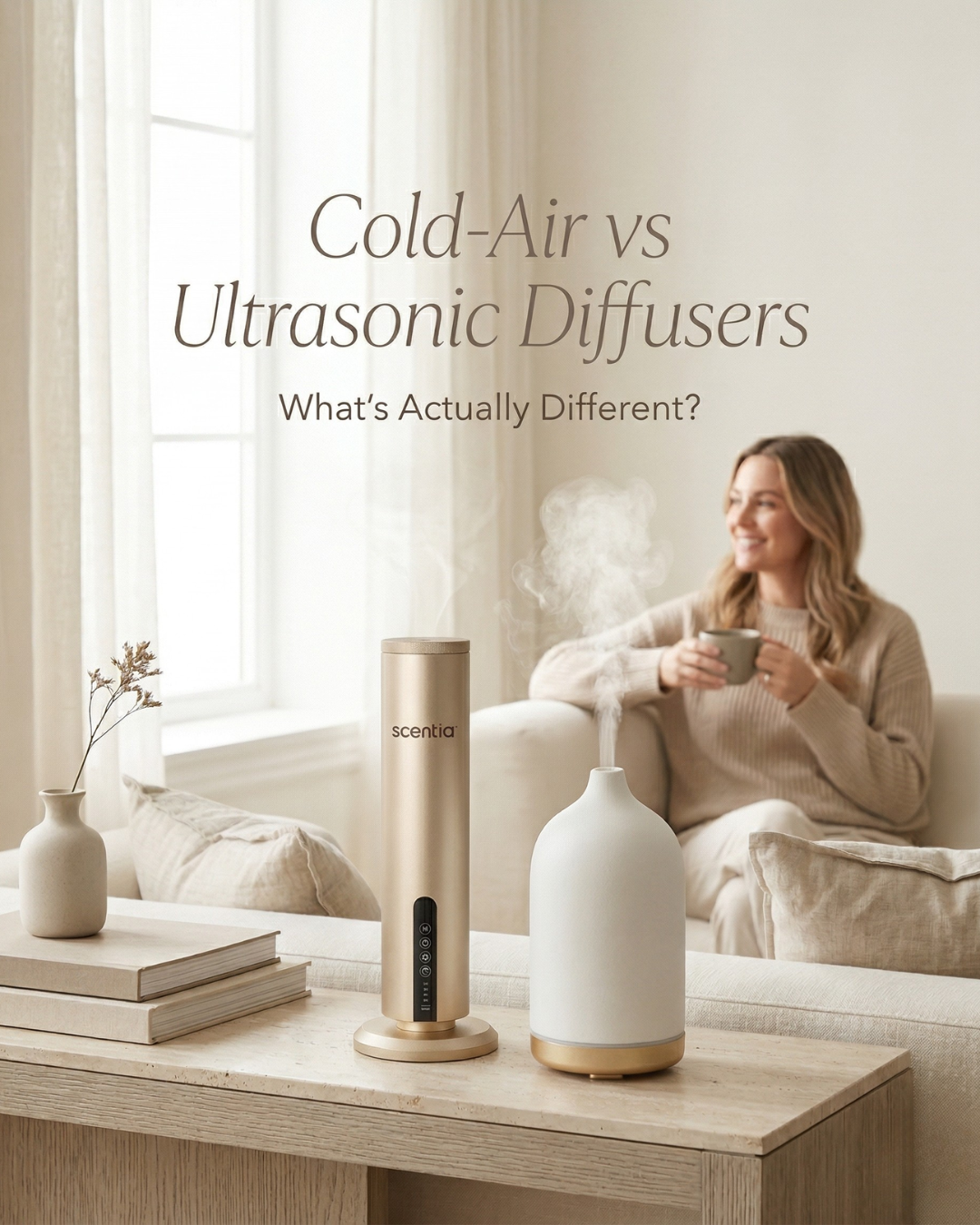
Most people buy an ultrasonic diffuser and wonder why it doesn't fill the room the way a hotel lobby does. The issue isn't the fragrance oil. It's the machine.
Here's a question worth asking: why do hotel lobbies smell so unmistakably good — not overwhelming, just present and intentional — while most home diffusers produce a faint scent that disappears 20 minutes after you leave the room?
The short answer is the technology is completely different. Hotels don't use ultrasonic diffusers. They use cold-air nebulizing systems, and the difference in how each works explains almost everything about the difference in results.
How an ultrasonic diffuser actually works
Ultrasonic diffusers are everywhere — Amazon, Target, every gift shop. You fill a reservoir with water, add a few drops of essential oil, and a vibrating plate at the bottom breaks the water into a fine mist that carries the fragrance into the air.
That design has a few unavoidable limitations.
The fragrance is diluted. You're not diffusing oil — you're diffusing water that smells like oil. Depending on how many drops you use and how large the reservoir is, the actual fragrance concentration in the mist might be 2-3%. The rest is water vapor.
Coverage is limited. Ultrasonic diffusers are rated for small spaces — typically 200 to 400 square feet. Put one in an open-plan living room and it'll scent maybe the 10 feet directly around it, then fade.
The mist is wet. It's adding moisture to the air, which is fine in dry climates but can be a problem in already-humid spaces. Over time, surfaces near the diffuser collect a faint residue.
None of this makes them bad products. For a small bedroom or bathroom, a $30 ultrasonic diffuser does the job. The problem is when people expect a cheap ultrasonic to do what a hotel does, and then conclude that home diffusion just doesn't work that well. It works — just not with that technology.
How cold-air nebulizing works
Cold-air diffusers work differently at every level.
Instead of water, they use pressurized air. The diffuser pushes cold air through a small tube submerged in pure, undiluted fragrance oil. The air pressure atomizes the oil into particles measured in microns — dry, light, and small enough to stay suspended in the air for extended periods.
No water. No heat. No dilution.
Because the oil isn't heated or mixed with anything, you get the full scent profile — the top notes you notice immediately when you walk in, and the base notes (sandalwood, cedar, oud) that linger for hours after the diffuser has cycled off. Heat breaks down fragrance molecules. Cold air doesn't. It's the difference between hearing a recording of music and hearing it live.
Coverage that actually fills a room
A cold-air diffuser set to moderate output can cover 1,000 to 2,000 square feet consistently. The ScentiaMax, for instance, is rated for spaces up to 2,000 sq ft — an open-plan living area, a large master suite, or a small commercial space.
The ScentiaPod handles rooms up to 1,000 square feet. The ScentiaMiniPod works well up to 500 sq ft — a bedroom, home office, or studio apartment. And the ScentiaCasa connects to your HVAC system and distributes scent through your existing ductwork, covering an entire house.
The coverage difference between an ultrasonic and a cold-air system isn't incremental. It's roughly 5 to 10 times the area.
Side-by-side comparison
| Feature | Ultrasonic | Cold-Air Nebulizing |
|---|---|---|
| Technology | Water + vibration plate | Pressurized air + pure oil |
| Fragrance concentration | 2-5% (heavily diluted) | 100% pure oil |
| Room coverage | 200-400 sq ft | 500-2,000+ sq ft |
| Scent longevity | 30-60 min after shutoff | Several hours after shutoff |
| Residue on surfaces | Yes (moisture + oil) | None (completely dry) |
| Humidity added | Yes | No |
| Heat applied to oil | No (but ultrasound degrades) | None |
| Maintenance | Clean tank regularly (mold risk) | Simple nozzle wipe monthly |
| Typical price range | $20-$80 | $80-$300+ |
The hidden maintenance problem with ultrasonic diffusers
This doesn't come up in product descriptions, but it matters over time. A water tank that sits warm and partially full is a hospitable environment for bacteria and mold. If you use your ultrasonic diffuser regularly and don't clean it every week or so — draining completely, wiping the reservoir, cleaning the plate — it starts to smell wrong. Not like fragrance. Like wet.
Cold-air diffusers don't have this problem because there's no water involved. The only maintenance is wiping the nozzle tip with a dry cloth once a month to prevent oil residue buildup. That's it.
What about the cost?
Cold-air diffusers cost more upfront. A quality ultrasonic might run $30-$60. The ScentiaPod starts at $99, the ScentiaMax higher than that.
Whether that's worth it depends on what you're trying to do. If the goal is a light background scent in a single small room, an ultrasonic works fine and the price difference isn't worth it. If the goal is consistent, room-filling fragrance — the kind where guests actually comment on how good your home smells — the math changes. You'll go through oil faster with an ultrasonic because it's less efficient, the scent fades quickly, and you end up running it constantly to maintain any presence.
A 120ml bottle of pure Scentia fragrance oil in a cold-air diffuser running 8 hours a day at medium intensity lasts 30-60 days. In an ultrasonic, that same oil (mixed with water) might last longer by volume, but the scent experience is weaker and less consistent the whole time.
The question isn't really "which diffuser is better?" It's "what do I want my home to smell like, and how seriously?" An ultrasonic is a starter. Cold-air is what hotels use when they want the scent to be part of the experience.
Which one should you buy?
Get an ultrasonic if: you want to lightly scent one small room, you're working with a tight budget, or you mostly want the visual effect of mist.
Get a cold-air diffuser if: you want consistent coverage across a larger space, you've tried ultrasonic and been underwhelmed, or you want the fragrance to actually be present when you walk in the front door.
For most people who've been disappointed by diffusers before, the technology was the issue — not the oil, not the placement. Cold-air diffusion is just a fundamentally different thing.
Not sure which diffuser fits your space?
ScentiaMax covers up to 2,000 sq ft. ScentiaPod handles medium rooms. MiniPod for bedrooms and offices. All include a fragrance sample pack. Check below
https://scentiausa.com/collections/diffusers

Leave a comment
All comments are moderated before being published.
This site is protected by hCaptcha and the hCaptcha Privacy Policy and Terms of Service apply.