

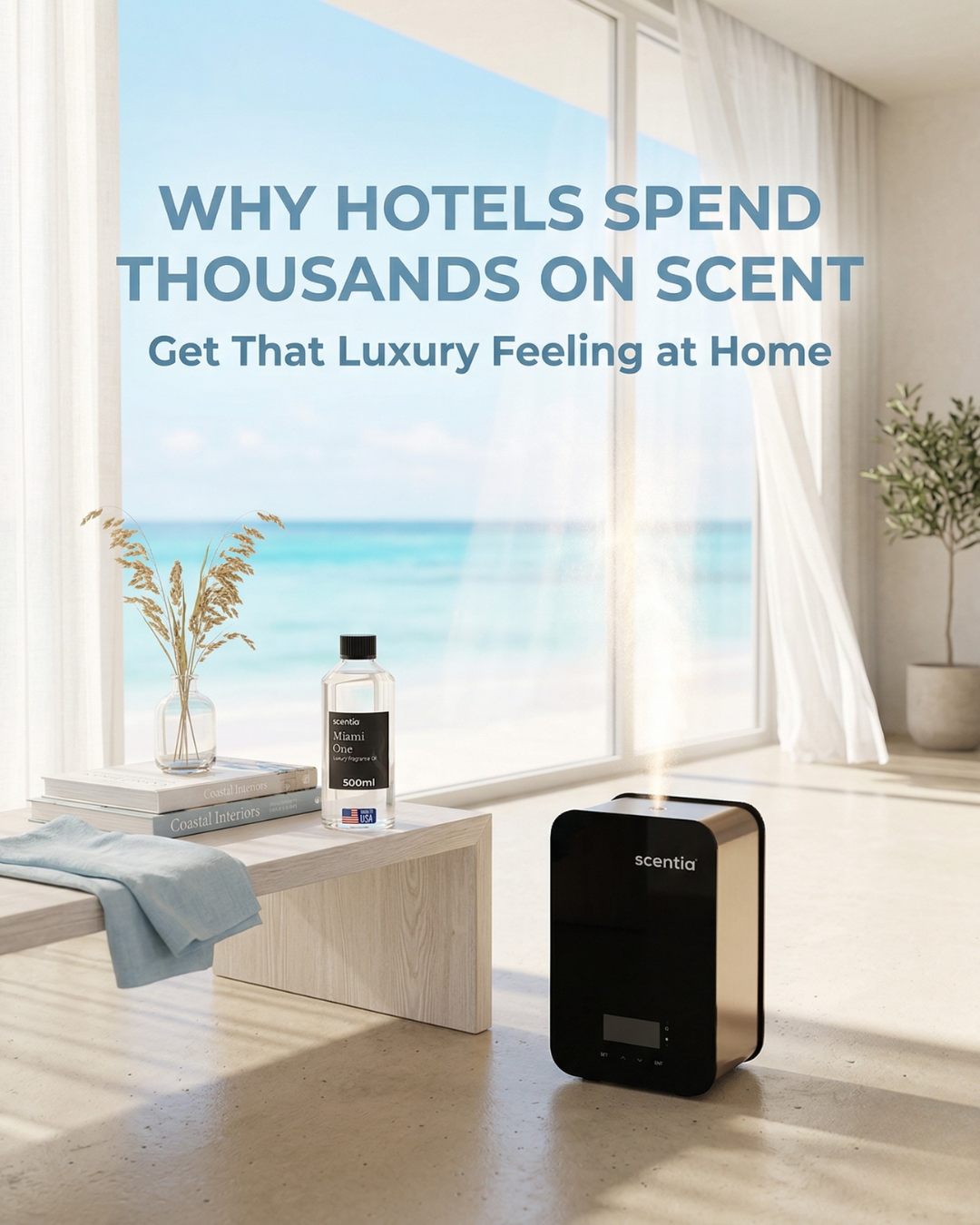
Hotels don't leave their scent to chance. There's real science behind why you remember how a lobby felt long after you've forgotten what it looked like. Here's how they do it, and what it takes to recreate that at home.
You walk into a hotel you've never been to and immediately feel something. Not comfort exactly — more like a lowering of whatever tension you were carrying from the airport. The room isn't even that remarkable. Nice enough. Good lighting. But there's a smell that does something to the atmosphere, and you'll notice it every time you walk back in, even after three days.
That's not an accident.
The Westin has a fragrance called White Tea. The 1 Hotel in Miami uses a sandalwood-forward blend called My Way. The Marriott signature scent has been described as "clean focus" — bergamot and cedar with something like fresh linen. These aren't air fresheners. They're purpose-built fragrance programs that cost serious money to develop and run.
The question is why. What does a hotel chain get from spending thousands of dollars a year on how their lobby smells?
What the research actually says
Smell is the only sense with a direct pathway to the limbic system — the part of the brain that handles emotion and memory. Every other sense gets processed and filtered before an emotional response. Smell bypasses that. It hits the emotional brain almost immediately, which is why a specific scent can drop you into a memory from 20 years ago in about half a second.
Hotels have understood this for a long time, even if the formal research is more recent. A study from Washington State University found that customers in a scented retail environment spent 31.8% more time browsing than in an unscented one. Nike reported a 24% increase in purchase intent when stores were scented with specific blends. Singapore Airlines has had a registered scent — Stefan Floridian Waters — sprayed on every cabin crew member and on their warm towels since the 1990s.
The principle is straightforward: scent creates emotional states, emotional states influence behavior, and behavior drives revenue. Hotels spend thousands on fragrance because it pays off in guest satisfaction scores, return rates, and the thing that's hardest to measure but most valuable — how guests describe the experience to other people.
"The smell of a place is part of its brand. You can replicate the furniture, the lighting, even the service scripts. But if you don't get the scent right, something feels off and guests can't say why."
Why the same scent doesn't work everywhere
Scent branding isn't just about picking something pleasant. Hotels develop fragrances specifically for their context — the architecture, the guest demographic, the time of day, the emotional state they want guests to arrive in.
A business hotel targeting corporate travelers uses different profiles than a beach resort or an urban boutique property. The 1 Hotel in Miami leans into sandalwood, earth, and vetiver — grounding, organic, disconnected from the city. Edition Hotels go warmer and more theatrical. Westin chose white tea and cedar specifically because they test well with a broad demographic and communicate "clean" and "calm" without being aggressive.
The delivery system matters too. Hotels use cold-air nebulizing diffusers connected to their HVAC systems, which means the scent arrives with the air itself — distributed evenly, consistent in intensity, present everywhere in the lobby without a single obvious source. When you don't know where the smell is coming from, you stop trying to locate it and just experience it.
Translating this to a home
The mechanics are the same. The goal is the same. The scale is smaller and the budget is very different.
What hotels do that most home setups don't:
- They use cold-air technology. Not candles, not ultrasonic diffusers, not plug-ins. Cold-air nebulizing systems atomize pure fragrance oil without heat or water, which means full scent expression and consistent coverage over large areas.
- They use pure, undiluted fragrance oil. Not water-diluted, not candle wax, not synthetic air freshener. Concentrated oil designed for dry diffusion.
- They position the diffuser with airflow in mind. Near an air return or a central point in the space, not in a corner on a shelf.
- They run it on a timer. Consistent, predictable, calibrated to the space — not just when someone remembers to turn it on.
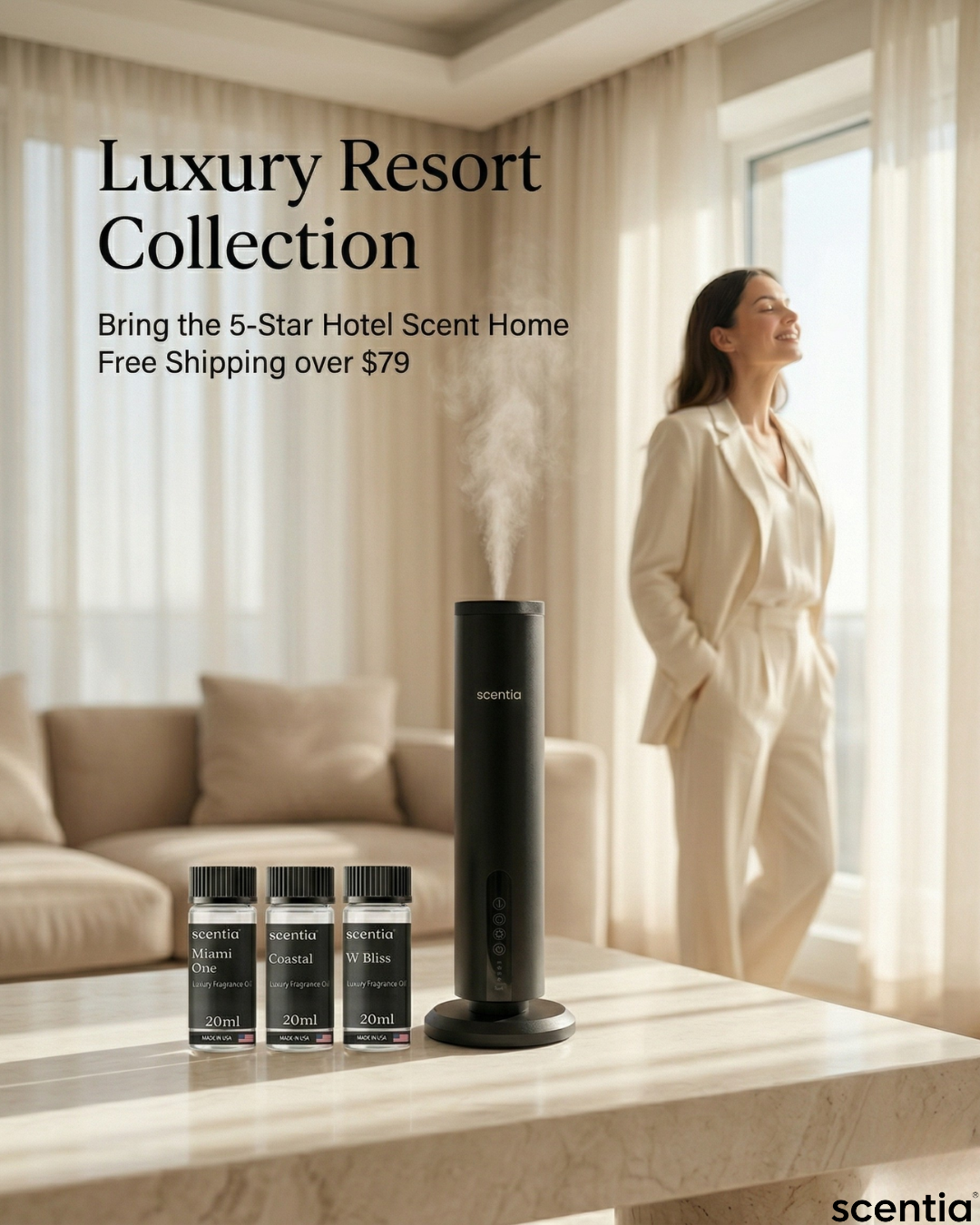
All of this is reproducible at home. The Scentia lineup covers spaces from a single bedroom (ScentiaMiniPod, up to 500 sq ft) to large open-plan living areas (ScentiaMax, up to 1,500 sq ft) to whole-home HVAC diffusion (ScentiaCasa, up to 5,500 sq ft). The fragrance oils in the Luxury Resort Collection were built around the same scent profiles that hotel fragrance programs use — sandalwood, bergamot, white tea, oud, ocean mist.
Choosing a fragrance for your home
There's no universal answer, but there are useful starting points based on what hotels have learned works in what contexts.
THE HOTEL SCENT RULE
Hotels design their fragrance to be noticeable on arrival and unnoticeable after 15 minutes. That's the target. If you're still actively smelling it an hour after arriving home, it's too strong. If guests never comment on how good your home smells, it might be too subtle. Calibrate intensity until it's in that middle zone.
The part most people miss: consistency
The reason hotel scent experiences are memorable isn't just the fragrance quality. It's that the scent is the same every single time. You walk in on Tuesday and it smells exactly like it did on Saturday. The repeatability is what builds the association between the smell and the feeling of that place.
Most home setups fail here. Someone lights a candle when they feel like it, uses different products on different days, or runs a diffuser until the oil runs out and then forgets to refill it for two weeks. The scent experience is inconsistent, and inconsistency means no memory anchor gets built.
The fix is simple. Pick one fragrance for the main living space and run it on a timer — same hours every day, same intensity. A month in, that scent will be part of how your home feels to the people who spend time in it, including you.
That's what hotels figured out. Not magic. Just consistency and the right technology to maintain it.
The Luxury Resort Collection
Built around the same fragrance profiles used in five-star hotel environments. Cold-air compatible, IFRA compliant, made in the USA
Want to understand the hotel-scent effect? See what scents hotels use and how hotel scenting works →

Leave a comment
All comments are moderated before being published.
This site is protected by hCaptcha and the hCaptcha Privacy Policy and Terms of Service apply.