

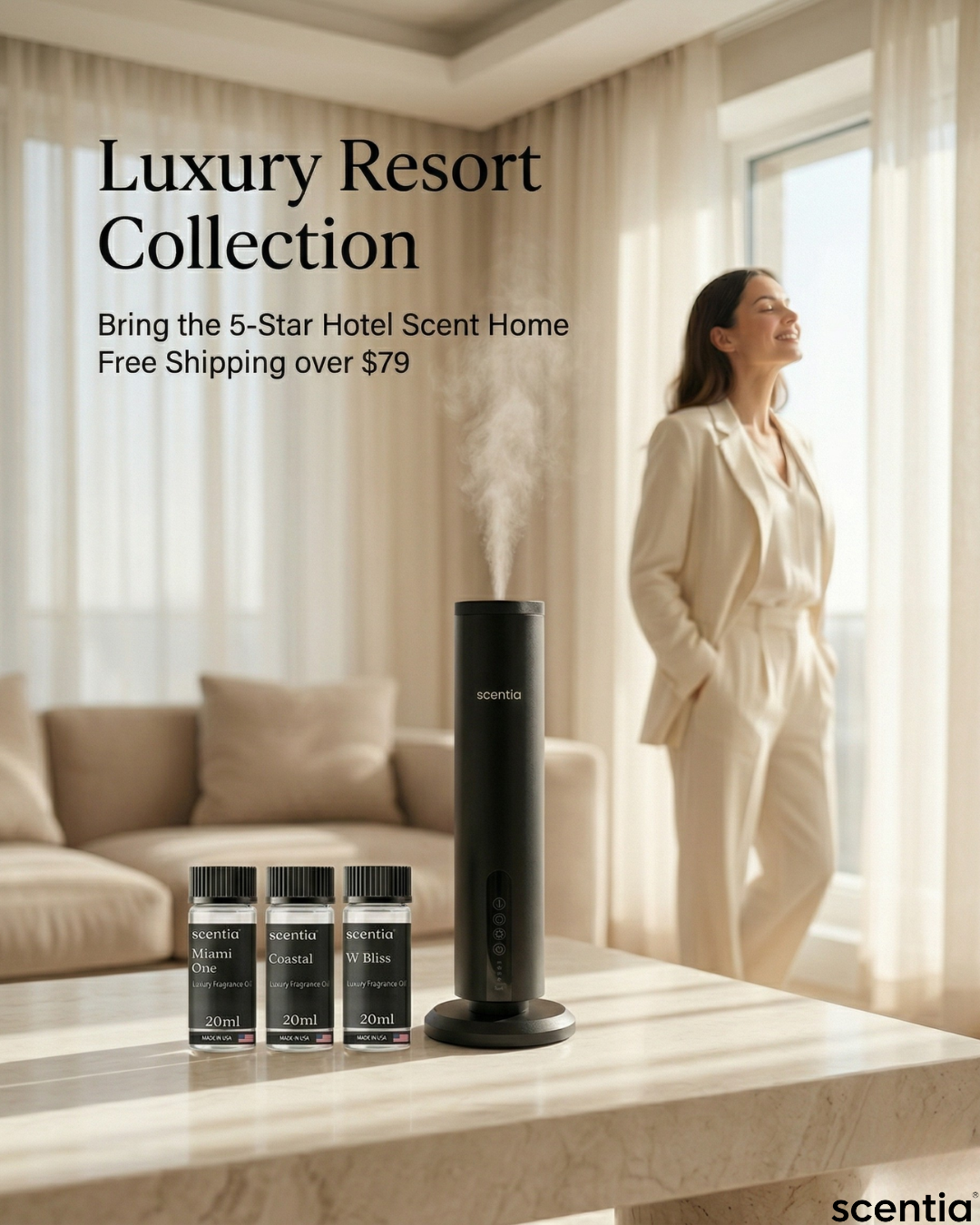
That specific smell — the one you notice the second you walk into a great hotel — isn't an accident. Here's how to recreate it at home, and why most people get it wrong.
You know the feeling. You walk into a hotel lobby — a good one — and something hits you before you've even processed the chandelier or the marble or the view. It's a smell. Specific, unhurried, expensive without being loud. And for the next few days, that scent becomes part of how you remember the whole trip.
Hotels engineer this on purpose. They spend thousands of dollars developing signature fragrances, hire scent branding consultants, and run commercial-grade diffusion systems 24 hours a day. The goal isn't just to make the place smell nice. It's to make you feel a certain way the moment you arrive.
The good news: you don't need a concierge budget to get there. You need the right technology, the right fragrance, and a basic understanding of how scent actually works in a space.
Why your home doesn't smell like a hotel (yet)
Most home fragrance products are solving the wrong problem. Candles, plug-ins, and cheap ultrasonic diffusers are designed to mask odors — to make a room smell like "not bad" instead of something intentional. Hotels aren't trying to cover anything up. They're creating an atmosphere from scratch.
There are three main reasons the gap exists:
1. The technology is completely different
Hotel lobbies use cold-air nebulizing diffusers — also called dry diffusion systems. These machines atomize pure fragrance oil into microscopic particles using pressurized air, with no heat and no water involved. The result is a dry, consistent mist that fills a space evenly for hours without any residue on surfaces.
A standard ultrasonic diffuser uses water. It dilutes the fragrance, produces visible steam, and struggles to cover more than 400–500 square feet consistently. The scent tends to be weak at the edges of a room and overwhelming right next to the unit.
Cold-air diffusion is different. Because the oil isn't diluted or heated, every note in the fragrance comes through intact — the top notes you notice first, and the base notes that linger for hours. It's the difference between hearing a song through laptop speakers versus a proper sound system.
2. The fragrance quality matters more than most people think
Consumer candles and plug-ins use fragrance concentrations of 6–10%. Commercial hotel diffuser oils typically run 100% pure. That concentration difference is part of why a hotel lobby has presence — the fragrance fills a space without being aggressive, and it stays consistent throughout the day rather than fading quickly.
The specific scent profiles matter too. Hotel fragrances tend to be built around base notes that are warm, grounding, and slightly woody — sandalwood, cedar, vetiver, oud. These are the notes that make a space feel expensive and calm rather than just clean. Most mass-market home fragrance products lean heavily on top notes — citrus, florals, mint — which smell great immediately but evaporate fast.
3. Placement and coverage are usually wrong
A hotel lobby has a diffuser positioned near the HVAC intake or centrally in the space so scent distributes with airflow. Most people put their home diffuser in a corner or on a shelf, which creates fragrance "hot spots" near the unit and dead zones everywhere else.
The short answer: Cold-air diffusion + pure fragrance oils + central placement = the hotel experience. Everything else is a shortcut that produces shortcut results.
What are the alternatives to luxury hotel scents?
The alternatives fall into three groups: hotel-branded retail products, generic "hotel-inspired" candles, and pure fragrance oils formulated for cold-air diffusion. Only the third recreates what you actually smelled.
Hotel-branded retail lines are usually reformulated for candles or reed diffusers at a fraction of the original concentration. Generic hotel-inspired candles lean on top notes that evaporate quickly. Pure fragrance oils run through a cold-air nebulizing diffuser use the same delivery method as the commercial systems hotels install — undiluted oil, dry mist, no heat.
Scentia's Luxury Resort Collection is built on that third approach: 100% pure oils, made in the USA and hand-poured in Miami, phthalate-free and IFRA-compliant. The Top 3 Sample Set is the cheapest way to find out which profile matches the hotel you're thinking of.
Choosing the right diffuser for your space
Room size is the starting point. Cold-air diffusers are rated by square footage, and getting this right makes a significant difference in how the scent fills the space.
For a single room or apartment up to 500 square feet, a compact portable diffuser like the Scentia MiniPod or Scentia Pod covers the space without overpowering it. These are also wireless, which makes placement much easier — you can position them centrally without needing to run cables.
For an open-plan living area, large primary suite, or home covering up to 1,500 square feet, the Scentia Max is the right level of diffusion. It runs quietly, has programmable timer controls, and handles the kind of coverage where a smaller unit would just create scent near wherever it's sitting.
For whole-home diffusion — if you want the experience to carry through an entire house — the Scentia Casa connects to your HVAC system and distributes fragrance through your existing ductwork. This is how hotels actually do it for large properties. Scent travels with the air, so every room gets the same consistent level rather than gradually fading the further you are from a unit. Compare all four on the diffuser comparison page.
Placement rules that actually matter
- Position near airflow, not in corners. Near an air return, in the center of a room, or near an interior doorway — anywhere that lets natural air movement carry the scent rather than waiting for it to drift.
- Elevation at about 4–5 feet works best. Fragrance particles are slightly heavier than air, so they settle over time. Starting them at mid-height gives a longer distribution arc.
- Start lower than you think you need. It's easier to increase intensity than to clear out a space that's been over-diffused. Most diffusers have adjustable output — start at 20–30% and adjust over a few days until you find the right level for your space.
Picking the right fragrance
The scent you choose matters as much as the equipment. Here's how to think about it rather than just guessing based on what smells good in the bottle.
Match the mood to the room
Hotel lobbies tend to use welcoming, grounding fragrances built around sandalwood, bergamot, white tea, or light oud — notes that are warm without being heavy, and that work on people regardless of their personal scent preferences. They're designed for universal appeal rather than a strong individual statement.
Bedrooms are different. A scent that works well in a lobby can feel too alert for a space where you want to sleep. Lighter, cooler profiles — white tea, clean linen, soft cedar — tend to work better in rooms where the goal is rest rather than arrival.
If you have a home office, citrus and slightly green fragrances have been studied for their effect on focus and mental clarity. Not dramatically so, but the effect is real enough to be worth considering.
What the Luxury Resort Collection is built around
The Scentia Luxury Resort Collection was developed specifically to recreate the scent profiles used in five-star hotel environments. The formulations are built on the base note structures that make lobby fragrances work — sandalwood, oud, bergamot, ocean mist, white tea — and they're 100% pure oils formulated for cold-air nebulizing diffusers.
If you're not sure where to start, the Top 3 Sample Set is a practical first step. You'll find out quickly which profiles work in your actual space rather than guessing based on descriptions alone. Or take the scent quiz.
Scent note cheat sheet
Sandalwood, oud, cedar — warm, grounding, expensive-feeling. Good for living areas, entryways, anywhere you want "resort lobby."
White tea, bergamot, clean linen — fresh, light, calm. Good for bedrooms, bathrooms, spaces where you want clarity.
Ocean, sea salt, light citrus — open, airy, energizing. Good for kitchens, home offices, morning spaces.
Amber, musk, dark florals — intimate, atmospheric, evening-appropriate. Good for dining rooms, reading areas, home theaters.
The maintenance part nobody talks about
One thing that distinguishes hotel scenting from home scenting: consistency. The reason a hotel lobby smells the same every time you walk through is that the system runs on a schedule — same output level, same timer, same oil refill routine.
Replicating this at home is simple but requires actually doing it:
- Set a timer schedule on your diffuser. Most cold-air units have programmable timers — running 6–8 hours a day, offset by a few hours when you're not home, keeps the scent consistent without going through oil quickly.
- Check oil levels weekly. Running a cold-air diffuser dry can damage the pump mechanism. It takes about 30 seconds.
- Clean the diffusion nozzle monthly. Residue can build up and affect the quality of diffusion. See our diffuser care guide.
How long until it actually feels different
This is the question most people have and don't ask. Honestly: the effect is immediate, but it takes a few days to calibrate. The first time you run a cold-air diffuser in a new space, you'll be adjusting intensity and placement until you find what works. After about 3–4 days of consistent running, the scent becomes part of the background of the room in the way that hotel scents do — present without being the thing you're thinking about.
The bigger shift is what happens when you've been gone for a few days and come back. That's when it hits differently. Walking into your own home and having it smell intentional is genuinely different from walking into a place that smells like nothing, or worse, like whatever you last cooked.
That's the hotel experience. It's not magic — it's a diffusion system, a good fragrance, and a schedule. All of which are now available for considerably less than what you'd spend on a weekend at the property that inspired the scent.
Start with the Scentia Max Starter Kit — includes the diffuser and three fragrance oils from the Luxury Resort Collection. Free shipping on orders over $79.99.
Want to understand the hotel-scent effect? See what scents hotels use and how hotel scenting works →


Leave a comment
All comments are moderated before being published.
This site is protected by hCaptcha and the hCaptcha Privacy Policy and Terms of Service apply.