

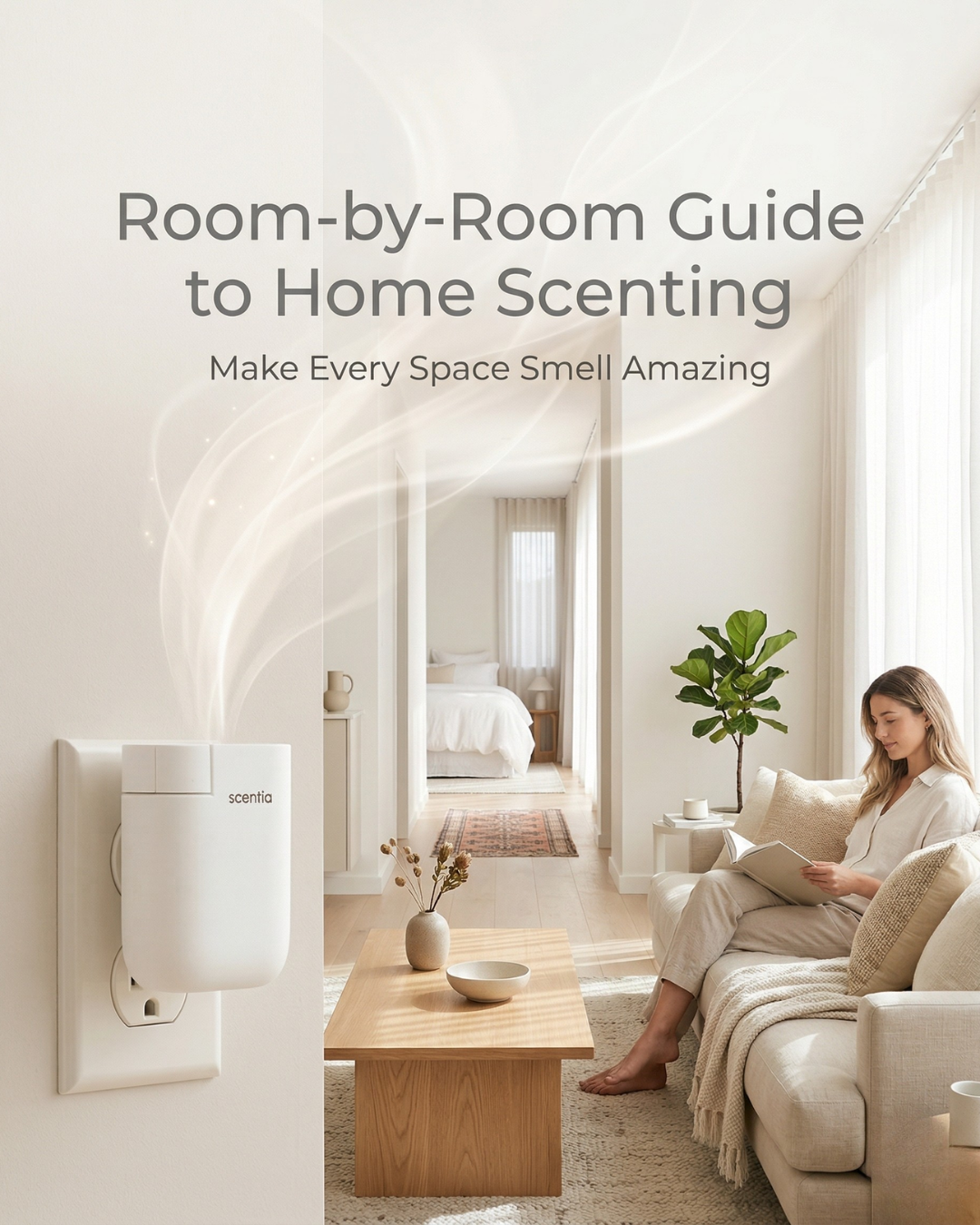
The question comes up constantly from people who buy their first cold-air diffuser, put it in the living room, and discover that it smells great in a 15-foot radius and like nothing at the far end of their kitchen. They assumed "up to 2,000 sq ft" meant the whole floor. What it actually means is under ideal conditions — central placement, good airflow, no obstructions — which is not how most homes are built.
Large home scenting is a solved problem. Hotels do it at 50,000 square feet. The approach scales down. But it requires understanding how fragrance actually moves through a space, which diffusion systems work at which scales, and how to set up coverage without creating dead zones. If you're still figuring out which diffuser type to use, start with cold-air vs ultrasonic — what's actually different.
How fragrance moves (and why rooms don't fill evenly)
Fragrance particles are heavier than air. They settle and pool rather than rising and spreading evenly. This is why a diffuser placed on a high shelf fills the upper half of a room while the floor level barely registers, and why a unit tucked in a corner creates a strong-smelling zone near it and very little elsewhere.
Airflow is the mechanism that distributes scent. Without air movement, even a powerful cold-air diffuser will create a concentrated scent bubble around itself. With airflow — from HVAC vents, ceiling fans, natural cross-ventilation — the fragrance travels with the air and distributes more evenly.
This is why hotels connect their scenting systems to HVAC. The air is already moving everywhere in the building. Introducing fragrance at the air handler means every room gets consistent exposure as part of the normal air circulation. It's the most efficient possible distribution system for a large space.
Matching the system to the space
The HVAC approach — what it is and when it makes sense
The ScentiaCasa is Scentia's HVAC-integrated diffusion system. It connects to your existing central air system at the air handler and releases fragrance into the return air stream, which then distributes through the ductwork to every room in the house.
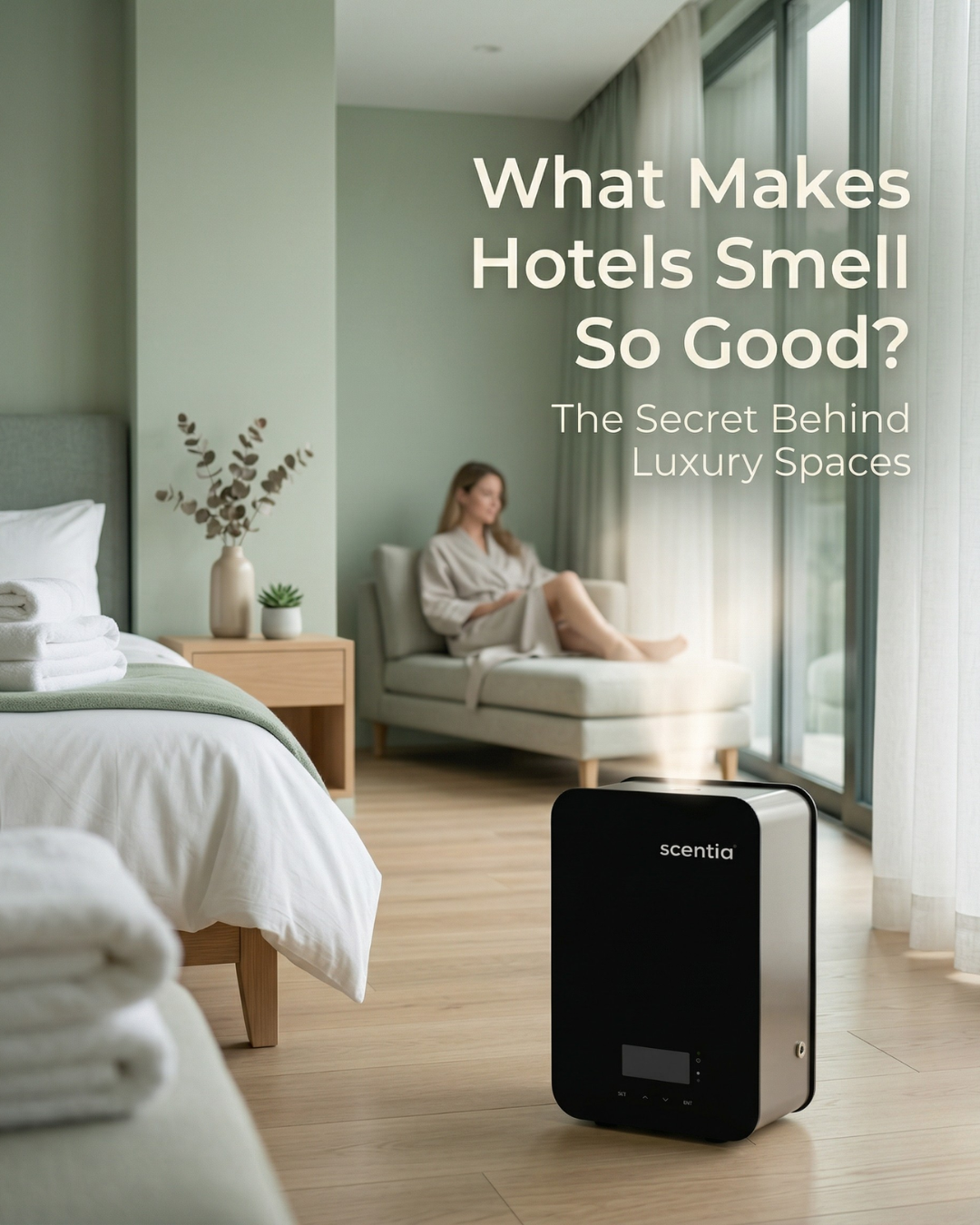
It's how large hotels and commercial properties scent their spaces. The scent arrives with the conditioned air — consistent across the entire building, no dead zones, no hot spots. You don't notice where it's coming from because it's coming from the same place as the air.
When does HVAC make sense over standalone units? Three situations:
- Your home is over 2,500 square feet and you want consistent whole-home coverage
- Your floor plan is irregular — multiple wings, L-shaped, or multi-level — making standalone unit placement difficult
- You want the scent experience to be invisible — present without any obvious diffuser in sight
The tradeoff is installation. Connecting to an HVAC system requires accessing the air handler, which for most people means 20–30 minutes with basic tools or a brief visit from an HVAC technician. It's not complicated, but it's not plug-and-play either. If you're on the fence, the ScentiaMax standalone unit at 2,000 sq ft is the natural step before committing to HVAC integration.
Multi-unit strategy for large open-plan spaces
If HVAC connection isn't an option or the layout doesn't require it, multiple standalone units positioned correctly can cover a large space effectively. The key word is "positioned correctly."
The rule is coverage overlap without scent collision. You want each unit's coverage area to overlap slightly with the adjacent unit's, so there's no dead zone between them. But if two units are running different fragrance oils in overlapping zones, you'll get an unpredictable blend in the middle.
Two ways to handle this:
Same oil, multiple units. Run the same fragrance across all units. No collision problem, seamless coverage. This works when you want a consistent whole-home scent experience — the hotel lobby approach. Browse the Luxury Resort Collection for oils built around the same profiles hotels use.
Zone separation. Run different oils in different rooms with doors between them. The kitchen diffuser and the bedroom diffuser can run different profiles as long as the spaces are genuinely separated. The issue only arises when two different oils diffuse into the same open air. For more on choosing the right oil per room, see the room-by-room scent guide.
Placement fundamentals at scale
These rules become more important the larger the space:
Central positioning beats corner placement by a significant margin. A unit in the center of a room or near a central hallway distributes scent in all directions. A unit in a corner concentrates 75% of its output into the area already nearest to it.
Near air returns or fans is better than still air. Place units within 5–6 feet of an air return if possible. The HVAC system will carry the scent wherever the air goes.
Mid-height is better than floor level or ceiling. Fragrance particles settle. Starting them at 3–4 feet gives maximum distribution before they drop. Very high ceilings (14 feet+) may need two units at different heights.
Intensity scales with volume, not just area. A room with 14-foot ceilings has roughly 40% more air volume than the same footprint with 9-foot ceilings. If your space has tall ceilings and the scent feels thin at mid-intensity, increase intensity rather than adding units.
Managing oil consumption at scale
More units or higher intensity means faster oil consumption. This is worth planning for.
A single ScentiaMax running 8 hours per day at medium intensity uses roughly 1.5–2ml of oil daily. A 120ml bottle lasts 60–80 days. Two units running simultaneously at the same settings double that consumption — one 120ml bottle per unit per 60–80 days.
For whole-home setups, keeping a stock of oil makes more sense than buying single bottles when you run out. Running a diffuser dry can damage the pump mechanism, so staying ahead of refills matters more at scale. The Luxury Resort Collection oils are available in 20ml, 50ml, and 120ml sizes — the 120ml is the most economical option for daily use across multiple units.
PRACTICAL STARTING POINT FOR A LARGE HOME
Start with the main living area and one secondary room — not every room at once. Get the coverage and intensity right in those two spaces, then add rooms incrementally. Large-scale home scenting that's calibrated well takes 2–3 weeks to dial in. Doing it all at once makes it impossible to troubleshoot. The Scentia starter kits are designed for exactly this — diffuser plus oils together so you can get one zone right before expanding.
The 1500 sq ft coverage rating on the ScentiaMax assumes central placement in a space with normal ceiling heights and reasonable airflow. In a long, narrow, or segmented floor plan, realistic effective coverage is closer to 1,200–1,500 sq ft from a single unit. Plan accordingly.
What doesn't work at large scale
Ultrasonic diffusers. Full stop. They're designed for single rooms up to 400–500 square feet. Buying six ultrasonic diffusers and distributing them around a large home produces six competing scent bubbles, not whole-home coverage. The technology doesn't scale. If you're currently using an ultrasonic and wondering why coverage is disappointing, this explains the difference.
Candles and reed diffusers face the same limitation — small-area products that don't translate to large spaces regardless of how many you use.
The only technologies that scale to large homes are cold-air nebulizing (standalone units or HVAC-connected) and commercial HVAC scenting systems. Everything else is working around the problem rather than solving it.
Whole-home coverage
ScentiaCasa connects to your existing HVAC system. ScentiaMax covers up to 2,000 sq ft standalone. Both ship free on US orders over $79.
Planning whole-home scenting? Compare HVAC-integrated, standalone and zoned whole-house diffuser setups →
Choosing equipment for a large space? Start with the Scentia home diffuser comparison, or see the waterless diffuser guide to understand cold-air technology.

Leave a comment
All comments are moderated before being published.
This site is protected by hCaptcha and the hCaptcha Privacy Policy and Terms of Service apply.