

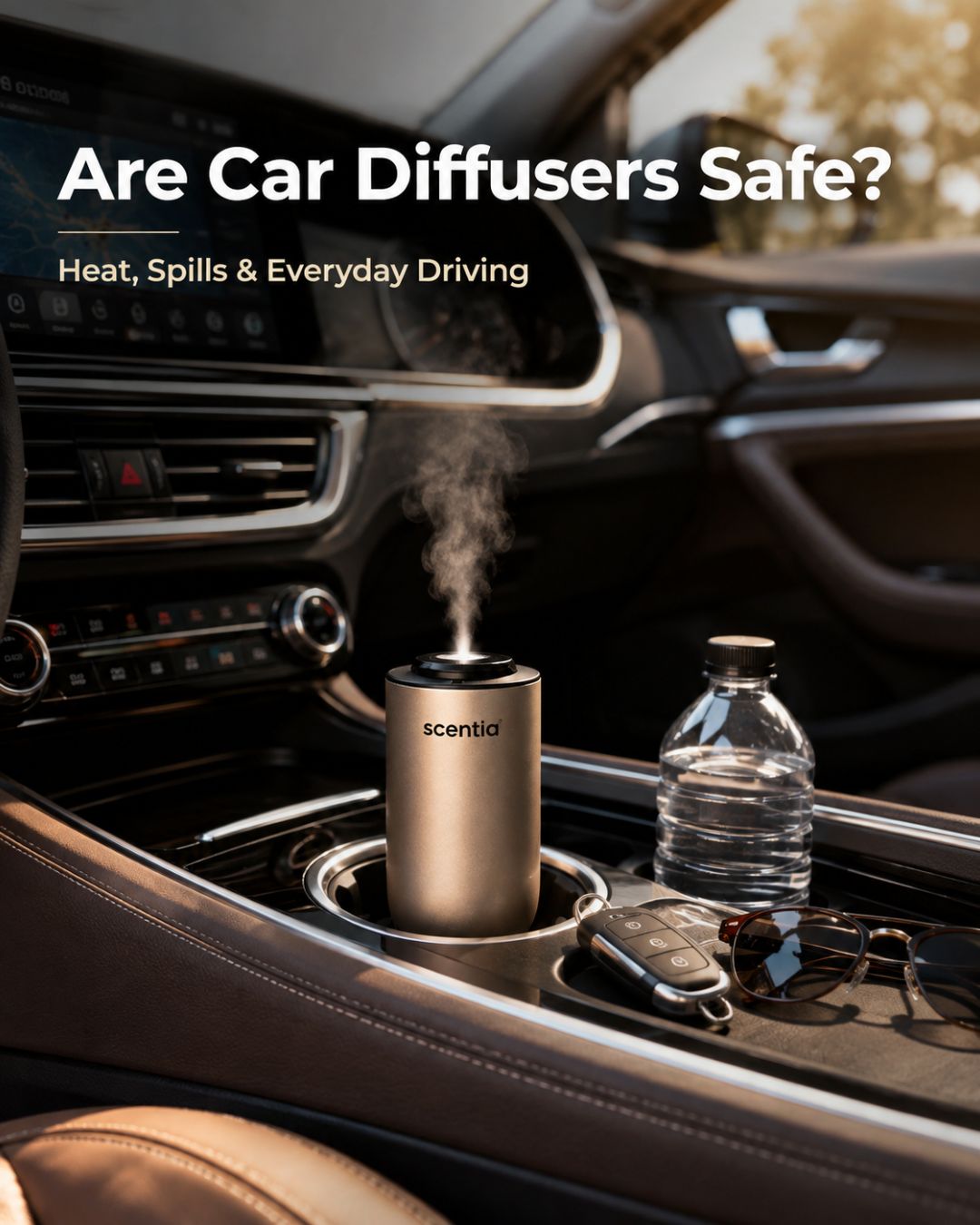
There are three genuine concerns with putting a fragrance device in a car, and a lot of noise around them. The real ones are heat, spills, and anything that pulls your attention off the road. Everything else is mostly marketing.
Heat
A car parked in the sun gets far hotter than the air outside it. That is the environment any car fragrance product has to survive, and it is worth being straight about what it does and does not do.
Heat does not make fragrance oil dangerous. What it does is change it. Fragrance is a blend of components with different volatilities, and sustained high temperature drives off the lighter ones faster than the heavier ones. A blend left through a summer of that will gradually smell less like the top notes it was built around and more like its base.
In practice, our own experience running a diffuser through Miami summers has been fine. Ordinary warm-weather driving, including a car sitting in a parking lot for a few hours, has not been a problem. What I would avoid is leaving any fragrance oil in a fully closed car in extreme heat for days at a time. Take it inside if the car is going to sit for a week in August.
The heat question is also why the diffusion method matters. A device that uses heat to disperse fragrance is applying the same effect deliberately, every time it runs. Cold-air diffusion does not heat the oil at all, which is one less variable in a car that is already hot.
Spills
This is the concern I would actually rank first, and almost nobody talks about it.
Fragrance oil is concentrated. Spilled on upholstery or a dashboard, it is not a wipe-up job. It soaks in, it can affect some plastics and finishes, and the smell does not politely fade. A water-based unit with an open reservoir in a vehicle that corners and brakes is asking for this.
Two things reduce the risk to near zero. First, no open liquid: a sealed oil chamber rather than a tank you top up. The Scentia Car Diffuser's anti-leak sealed design exists for this reason. Second, a stable position. A cupholder holds a device upright through normal driving. A device balanced on a dashboard does not.
Distraction
Anything you have to look at, reach for, or fiddle with while driving is a safety issue, and fragrance is not worth any of that.
This is a design question more than a user one. A device with an app you check, or a touch panel you have to look at to adjust, is the wrong thing to put in a car. A physical switch you set once, in a fixed position you can reach without looking, is the right thing. Set it before you drive and leave it alone.
What about breathing it in all day?
A car cabin is small, which means the amount of fragrance needed is small, and overdoing it is easy. The practical answer is intensity rather than safety: if the scent is noticeable enough to think about while driving, it is too strong. Fragrance in a car should be something you register getting in and then forget.
If you or a regular passenger has asthma or a fragrance sensitivity, treat a car more carefully than a room. There is no ventilation to speak of and no way to move away from the source. Run it lower, air the car out, or skip it on those journeys. The same principle applies at home, which we cover in scenting without overpowering.
On ingredients, the useful question is what is actually in the bottle rather than whether "fragrance" as a category is safe. Our fragrance safety and ingredients page covers what goes into Scentia oils and what does not.
Practical rules
- No water reservoirs in a car. Sealed oil chambers only.
- Keep the device in a cupholder or another fixed position, never loose on a seat or dash.
- Set intensity before you drive, not during.
- Run it lighter than you would at home. A car needs very little.
- Take the oil inside if the car will sit in extreme heat for an extended period.
- If a passenger is sensitive, turn it off. It costs you nothing.
Upkeep
A cold-air unit needs very little. Wipe the exterior occasionally, keep the chamber closed when you are not changing oil, and change the scent when you actually want a change rather than layering a new oil on top of an old one. The care and maintenance guide covers cleaning between scents.
None of this is complicated. The main thing is choosing a device that does not create the problems in the first place, which mostly means no water, sealed oil, and one switch you set before you pull out of the driveway.
Frequently Asked Questions
Are car diffusers safe in hot weather?
In everyday warm-weather conditions, yes. Sustained extreme heat will gradually change how a fragrance oil smells by driving off its lighter notes first, so take the oil indoors if the car will sit unused in extreme heat for an extended period.
Can a car diffuser leak?
An open water reservoir can. A sealed oil chamber in a cupholder is far less likely to. Avoid water-based units in a vehicle entirely.
Is it safe to breathe a diffuser in a small car cabin?
Fragrance sensitivities vary. If you have asthma, allergies, or a known fragrance sensitivity, consult your healthcare professional before use. Stop use if irritation or discomfort occurs. For ingredient information about a specific fragrance, contact cs@scentiausa.com.
Do car diffusers damage a car interior?
Only if the oil spills. Concentrated fragrance oil can affect some plastics and soft finishes, which is why a sealed chamber and a stable position matter more than anything else.
Should I turn a car diffuser off when parked?
It should do that itself. Car Mode on the Scentia Car Diffuser uses motion sensing and stops diffusing when the car stops moving.
Sealed, stable, and set once
No water, no heat, one physical switch. Made in the USA.



Leave a comment
All comments are moderated before being published.
This site is protected by hCaptcha and the hCaptcha Privacy Policy and Terms of Service apply.