

Luxury Home Fragrance · Buyer's Guide
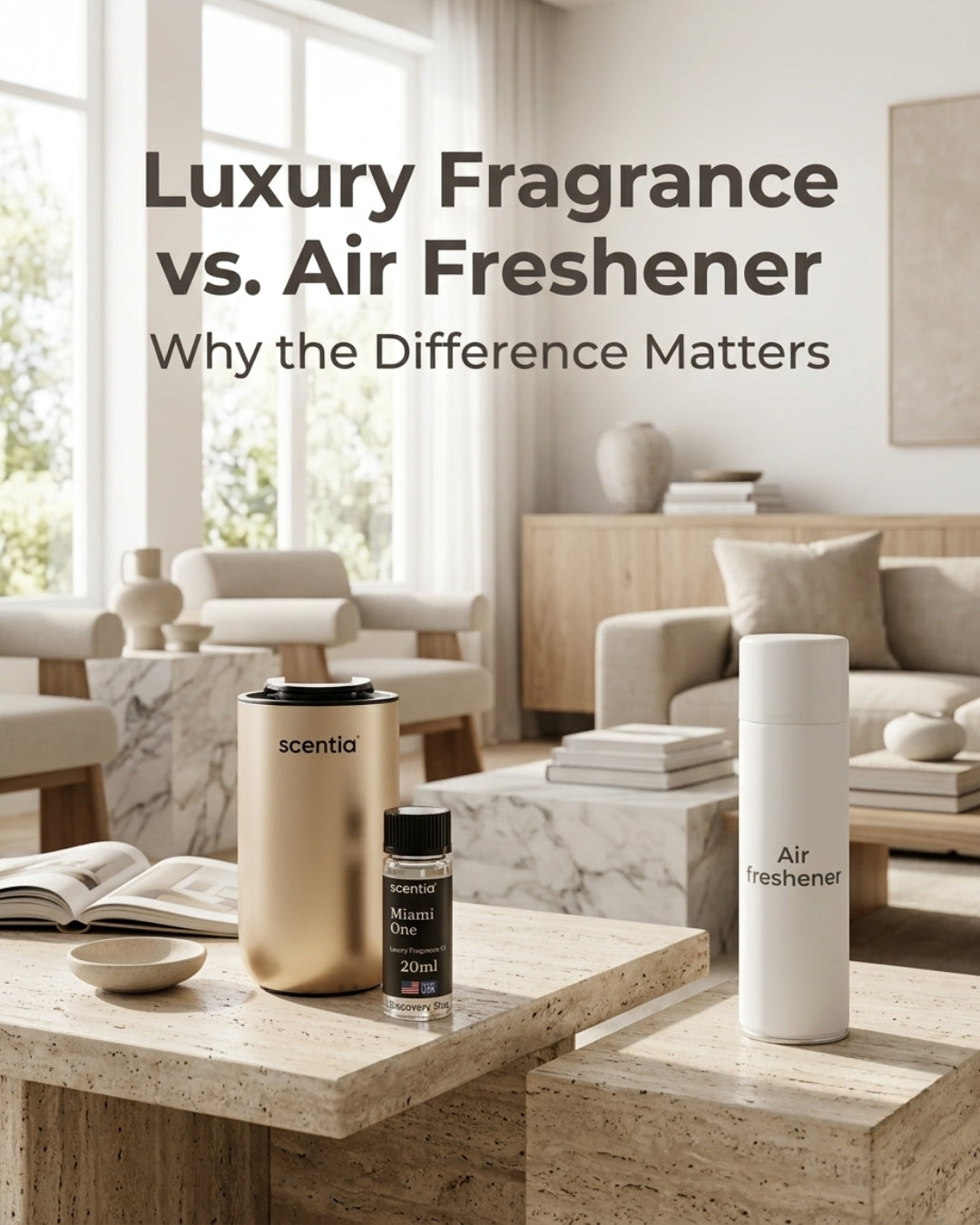
Luxury Fragrance vs. Air Freshener: Why the Difference Matters
Air fresheners mask odor. Fragrance oils are formulated like a perfume. Here's the real difference in ingredients, structure, and why the price gap isn't just branding.
Updated July 2026
At a Glance
Key Takeaways
Masking vs. Perfumery
Air fresheners are engineered to mask, often by dulling your olfactory receptors. Fragrance oils are structured with top, heart, and base notes, like a perfume.
Ingredient Standards Differ
Scentia oils are IFRA compliant, RIFM Research, phthalate-free, and paraben-free — no aerosol propellants.
Layering vs. One Flat Note
A fragrance oil unfolds over time. An air freshener hits all at once and doesn't meaningfully develop.
What's Actually in Each Product
"Isn't this just a fancy air freshener?" is a question I've gotten enough times that I think it deserves an honest answer rather than a defensive one. The short answer is no, they're genuinely different product categories doing different jobs, but the reasoning behind that is worth actually walking through instead of just asserting.
A standard aerosol or plug-in air freshener is engineered primarily to mask, not to be worn or lived with the way a fragrance is. Look at the ingredient list on most mass-market air fresheners and you'll usually find a mix of synthetic fragrance compounds designed to be detected strongly and briefly, propellants, and in a lot of cases, odor-masking agents that work by dulling your olfactory receptors rather than actually neutralizing the smell they're covering. That's why a heavily air-freshened room can still smell faintly bad underneath the floral top note if you're paying attention — the freshener didn't remove anything, it just competed with it.
Fragrance oils, the kind used in cold-air diffusion, are built on a completely different premise. These are formulated the way a perfume is: top, heart, and base notes designed to develop and layer over time, using fragrance concentrates that are meant to be present in a room, not just blast through it and dissipate. The ingredient standards are different too. Ours are IFRA compliant and RIFM Research, phthalate-free, paraben-free, made without the harsh propellants that give aerosol fresheners their instant, sharp throw.
Recommended
Real Fragrance Concentrate, Delivered Consistently
Cold-Air Diffusion
No propellant, no heat degrading the formula — what you smell an hour in isn't meaningfully different from the start.
Luxury Resort Collection
Built around layered top, heart, and base notes the way a perfume is formulated, not a single synthetic compound.
Steady, Not Fading Fast
Delivered on a timer, fragrance oil maintains a consistent presence without needing constant reapplication.
Why the Scent Experience Is So Different
The scent experience itself is where this shows up most obviously if you put them side by side. An air freshener tends to hit you all at once — one flat, undifferentiated blast of "floral" or "clean linen" that doesn't really evolve. A well-made fragrance oil, run through cold-air diffusion, actually unfolds. You get a lighter top note first, then it settles into something rounder as the heart notes take over, and if you're around it for a while you start noticing the base notes underneath. That layering is the entire point of using real perfumery structure instead of a single synthetic compound, and it's the difference between a room that smells like "air freshener" and a room that smells like something you can't immediately place, which is usually the compliment people are reaching for when they ask "what is that, it smells amazing."
There's also a longevity and consistency difference that matters more than people expect. Aerosol fresheners are designed to fade fast, which is by design; you're meant to spray again. Cold-air diffused fragrance oil, delivered on a timer through a machine like our Scentia Max, maintains a steady, consistent presence in the room without needing constant reapplication, and because there's no propellant or heat degrading the formula, what you smell an hour in isn't meaningfully different from what you smelled at the start.
None of this is to say air fresheners don't have their place — for a quick fix in a bathroom or covering a specific one-off smell, they do exactly what they're built for. But treating them as a substitute for how a home actually smells day to day, or expecting them to deliver the kind of layered, hotel-lobby-style fragrance experience people are chasing, is comparing two different products against the wrong job description.
The price difference reflects that gap in raw materials and formulation complexity, not just branding — real fragrance concentrate costs meaningfully more to produce than a synthetic single-note compound and a can of propellant. If what you want is a room that smells intentional rather than just not-bad, that's the category difference that actually matters, and it's worth understanding before deciding a fragrance oil is "just an expensive air freshener" with a nicer bottle.
Frequently Asked Questions
Is fragrance oil just an expensive air freshener?
No — they're different product categories. Air fresheners are engineered primarily to mask odor, often using ingredients that dull your sense of smell rather than neutralize what they're covering. Fragrance oils are formulated with a layered top, heart, and base note structure the way a perfume is, meant to be present in a room rather than blast through it.
Why does an air freshener smell flat compared to a diffused fragrance oil?
Most air fresheners rely on a single synthetic compound designed to hit hard and fade fast. A well-made fragrance oil run through cold-air diffusion unfolds over time — a lighter top note first, then a rounder heart, then a base note that lingers — which reads as more complex and less "artificial."
Are luxury fragrance oils safe compared to standard air fresheners?
Standard aerosol air fresheners often rely on propellants and synthetic masking agents. Scentia's fragrance oils are IFRA compliant, RIFM Research, phthalate-free, and paraben-free, with no propellant involved in the diffusion process.
Do air fresheners actually remove odors or just cover them?
Most mass-market air fresheners work by competing with or dulling detection of an existing smell rather than neutralizing it, which is why a heavily air-freshened room can still smell faintly off underneath the added fragrance if you're paying attention.
Want to see how Scentia stacks up against other diffuser brands directly? Read the full brand comparison →
Miami · Luxury Home Fragrance
A Different Category of Product Entirely
Real fragrance concentrate, cold-air diffused, built to unfold over time instead of blasting and fading.
Free shipping over $79.99 · Free MiniPod with oil orders over $99 · Use code SCENT10 for 10% off your first order


Leave a comment
All comments are moderated before being published.
This site is protected by hCaptcha and the hCaptcha Privacy Policy and Terms of Service apply.