

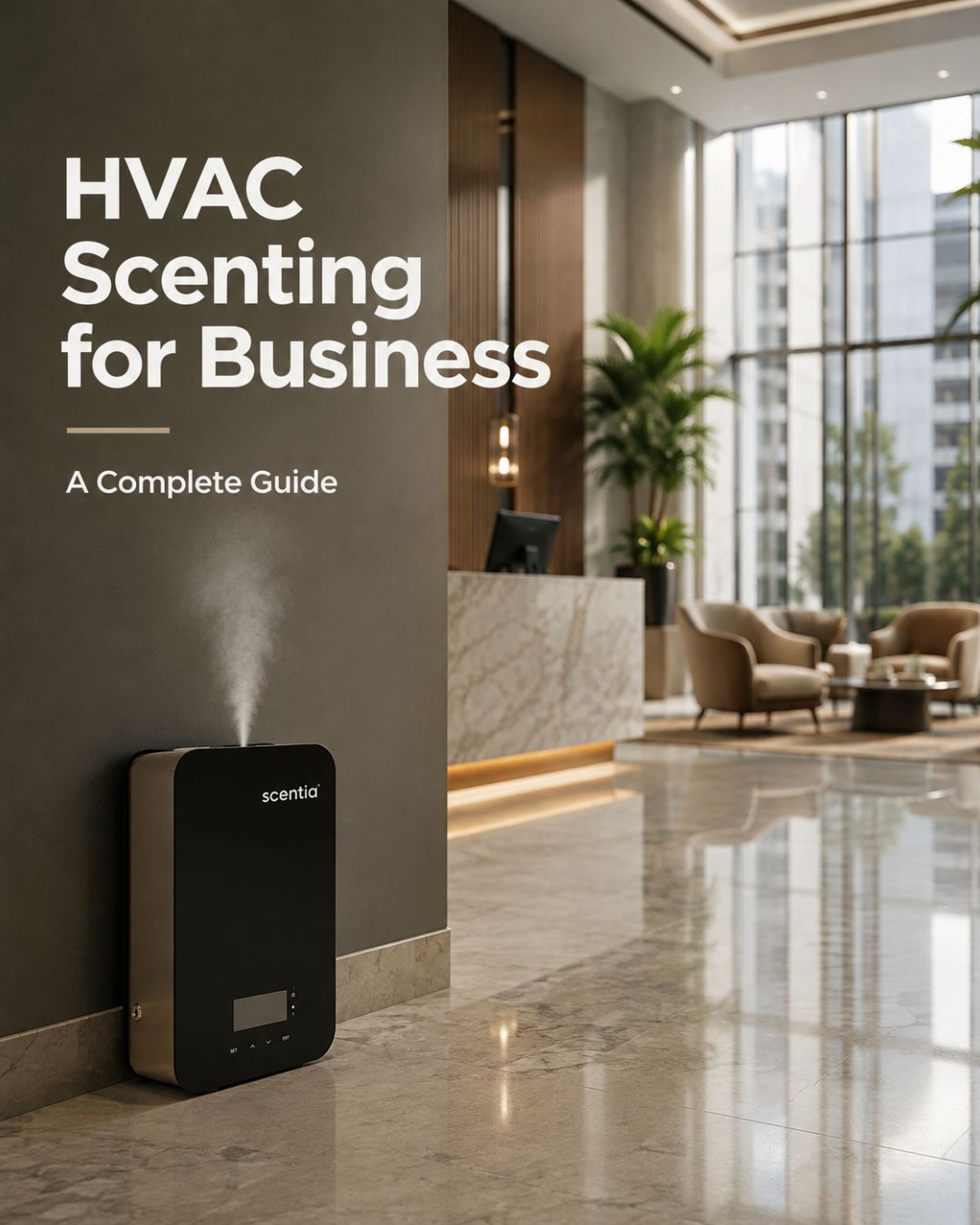
Every hotel lobby that smells consistently good is doing the same thing, and it is not a collection of plug-ins hidden behind furniture. It is one unit connected to the building's air handling, distributing fragrance through ductwork that is already moving air everywhere you want it.
This is the part of commercial scenting that people find surprising: it is an air distribution problem before it is a fragrance problem.
How it works
An HVAC scent unit sits alongside your air handler and injects a dry fragrance micro-mist into the supply duct. Your existing system does the distribution. Wherever the air goes, the scent goes, at the same concentration, at the same time.
The mechanism matters. Cold-air diffusion uses no heat and no water, which is not negotiable in a duct. Water introduces moisture into a system specifically designed to control it, and heat means a hot component inside your air handling. Neither is acceptable in a commercial install, which is why every serious HVAC scenting unit is cold air.
Why not just use standalone units
You can, and for smaller footprints you should. The reason large spaces go ducted comes down to three things.
Consistency. Six standalone units in a 10,000 square foot space produce six pockets of fragrance with dead zones between them. Customers walking through experience the scent turning on and off. Ducted distribution produces one even level.
Labour. Every standalone unit is something a member of staff has to refill, clean and check. One central unit is one maintenance task.
Control. A single unit means a single schedule. You are not relying on someone remembering to switch six things on at opening.
Sizing
Sizing is driven by air volume, not floor area. A retail floor with 9 foot ceilings and a hotel atrium with 30 foot ceilings can have identical square footage and completely different requirements, because the second one has more than three times the air to scent.
The general shape of the decision:
| Space | Approach |
|---|---|
| Single room, one zone | Standalone unit. Ducted is overkill. |
| Several rooms, one air handler | Ducted. This is where it starts paying off. |
| Large open floor, high ceilings | Ducted, sized on volume rather than floor area. |
| Multiple zones or floors | One unit per air handling zone. |
| No central air | Standalone units, placed at entry points and gathering spaces. |
The Scentia Casa HVAC SC-2000 is the ducted unit. For spaces without central air, or single zones, the Scentia Max is the standalone option and covers a substantial area on its own. Our coverage guide for large spaces works through the volume calculation.
Installation
The unit mounts near the air handler and connects to the supply duct. It needs a power source and physical access for refills and servicing.
Practical points that come up on most installs:
- Inject downstream of filtration, not upstream. Otherwise you are filtering out what you just added.
- Mount somewhere a technician can actually reach. Mechanical rooms get tight, and a unit behind three feet of ductwork becomes a unit nobody services.
- Confirm the scent schedule can align with your HVAC run schedule. If the air handler is off, nothing is distributing.
- In multi-tenant buildings, check your lease and your building management rules before connecting anything to shared air handling.
The Casa installation manual has the physical specification. Most installs are straightforward for an HVAC technician and are not a DIY job.
Running cost
Three components: the unit, the fragrance oil, and servicing.
Oil consumption is driven by your run schedule and intensity setting, not by the size of the space directly. A unit running twelve hours a day at moderate intensity in a large lobby may use less oil than one running twenty-four hours at high intensity in a smaller space. The controllable variable is the schedule, and most businesses over-run.
The honest advice is to run at the lowest intensity that achieves what you want, on a schedule matched to when the space is occupied. Scenting an empty building overnight is pure cost.
Choosing the scent
Commercial scent selection is a brand decision more than a taste one. A few principles:
- Go lighter than you think. Staff are in it all day. Customers are in it for twenty minutes. Set the level for the staff.
- Avoid gourmands anywhere near food service. They compete with the kitchen.
- Fresh and woody are the commercial workhorses. Wide appeal, low fatigue, hard to object to.
- Pick one and keep it. The value of commercial scenting is recognition, which requires consistency over years, not seasonal rotation.
The Business Scenting range and the Casa configurations cover the commercial line. If you are working out which fits your space, the sizing conversation is worth having before you choose a scent.
Frequently Asked Questions
How does HVAC scenting work?
A cold-air scent unit connects to your building's supply ductwork and injects a dry fragrance micro-mist. Your existing air handling distributes it, so the scent reaches everywhere the air does at an even concentration.
Is HVAC scenting better than standalone diffusers?
For multiple rooms sharing one air handler, yes. It gives even coverage, one maintenance point and one schedule. For a single room, a standalone unit is simpler and cheaper.
Does an HVAC scent diffuser add moisture to the air?
Not if it uses cold-air diffusion. There is no water and no heat involved, which is why cold air is the only appropriate method for a ducted install.
Can I install an HVAC scent diffuser myself?
It is normally a job for an HVAC technician. The unit connects to supply ductwork downstream of filtration and needs power and service access. In a multi-tenant building, check your lease first.
How do I size a scent diffuser for a commercial space?
Size on air volume rather than floor area. A high-ceilinged space needs considerably more capacity than a low-ceilinged one of identical square footage.
One unit, one schedule, even coverage
The Casa HVAC SC-2000 connects to your existing air handling. Cold air, no water, no heat.
Planning commercial scenting? Visit Business Scenting Solutions or compare commercial HVAC scenting systems.

Leave a comment
All comments are moderated before being published.
This site is protected by hCaptcha and the hCaptcha Privacy Policy and Terms of Service apply.