

Luxury Home Fragrance · Advanced Guide
Fragrance Layering: Building a Custom Signature Scent With Cold-Air Diffusion
You don't have to pick just one oil. Here's how fragrance layering works with cold-air diffusion, and a few combinations worth trying before you buy a fourth bottle.
Updated July 2026
At a Glance
Key Takeaways
Fill Gaps, Don't Fight
Layering works by rounding off an edge or adding depth, not by overpowering one scent with another.
Start at 80/20
Going fifty-fifty right out of the gate usually muddies both scents. Start with a dominant scent and a low-intensity accent.
Give It a Full Day
Some combinations bloom nicely after an hour or two — judge a layered scent the same way you'd judge a new single scent.
How Layering Actually Works
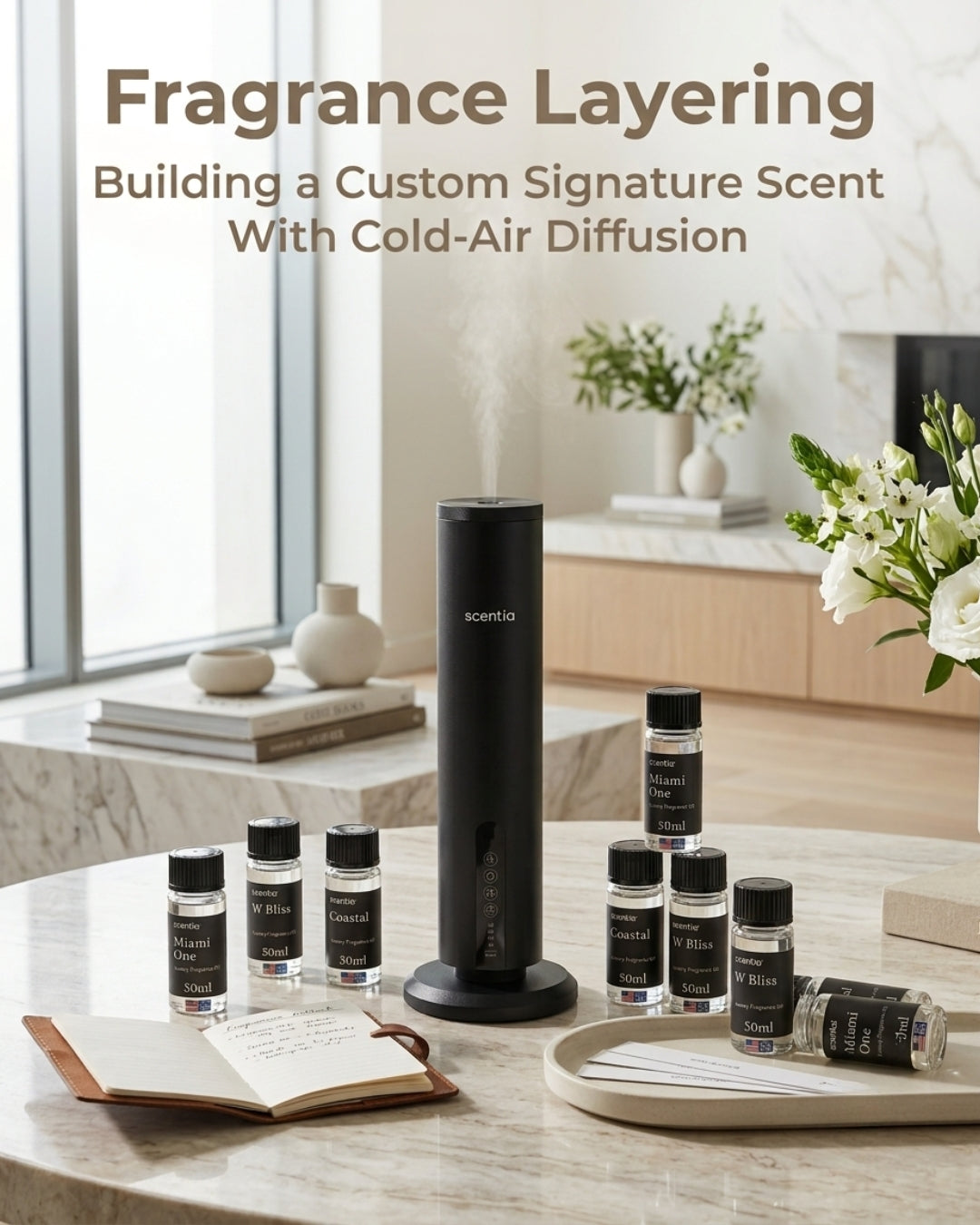
Perfumers have layered fragrance oils to build custom scents for about as long as perfume has existed, and there's no real reason that idea should stop at your wrist. Once you've got a couple of oils you like, mixing them in a diffuser is a genuinely underused way to build something that isn't sitting on a shelf anywhere, without paying for a full custom-blend service.
The basic idea is straightforward: you're not trying to overpower one scent with another, you're trying to fill in a gap or round off an edge. A citrus scent that feels a little thin on its own gets more depth with a small amount of something woody added underneath. A heavier, warmer scent that feels almost too rich by itself softens up nicely with a touch of something bright layered on top. Done well, the two oils read as a single, more complex fragrance rather than "two candles burning in the same room," which is the failure mode most people picture when they hear "layering" and assume it means muddy or confused.
A few pairings that actually work, based on what our customers tend to land on after some trial and error: Coastal with a splash of something warmer underneath gives you that breezy citrus-marine top note with more staying power than Coastal has running solo — the marine brightness fades a bit faster on its own than a warmer base note does, so a small amount of a sandalwood-forward oil mixed in extends how long the scent feels present in a room. You paired with something floral softens the citrus-eucalyptus edge slightly and adds a rounder, more "finished" quality without losing the clean, energizing character that makes it work well for daytime spaces.
The mechanics of actually doing this in a cold-air diffuser are simpler than people expect. Most of our diffusers run off a single oil bottle at a time rather than a built-in blending chamber, so layering usually means one of two approaches: physically combining a small amount of two oils in an empty bottle before loading the diffuser, or running two diffusers in the same space, each with a different oil, at lower individual intensities than you'd use for either alone. The second approach is easier to adjust and undo if a combination isn't working, since you're not committing oil to a permanent blend — just dial one diffuser down or off if the ratio feels wrong.
Recommended
Two Ways to Layer
Blend in a Bottle
Physically combine a small amount of two oils in an empty bottle before loading the diffuser.
Run Two Diffusers
Easier to adjust — dial one down or off if the ratio feels wrong, without committing oil to a permanent blend.
Seasonal Transitions
Layer a small amount of something warmer into a summer scent as the weather cools, instead of swapping entirely.
Getting the Ratio and Timing Right
Start small. The most common mistake with layering is going fifty-fifty right out of the gate, which usually just muddies both scents instead of creating something new. A better ratio to start with is roughly 80/20 — pick a dominant scent you already know you like, and add the second oil at low intensity as an accent rather than an equal partner. You can always add more of the second oil once you've lived with the combination for a day or two. It's much harder to correct an overpowering blend than to build one up gradually.
Give any new combination at least a full day before deciding whether it works, for the same reason a single scent needs time — your nose needs to actually experience how the layered fragrance develops through a normal day, not just the first thirty seconds of a fresh diffuser. Some combinations that seem underwhelming when you first turn the diffuser on actually bloom nicely after an hour or two, once both oils have had time to fill the room.
This is also genuinely useful for seasonal transitions, which is an angle most people don't think about until they're already annoyed at swapping their whole fragrance setup twice a year. Rather than replacing a summer scent with a completely different winter one, layering a small amount of something warmer into your existing summer oil as the weather cools is a cheaper, gentler shift than buying and running an entirely new bottle.
If you're going to experiment, our Sample Kit is the lowest-cost way to test combinations without committing to full-size bottles of oils you might only use as an accent. Worth having a couple of extra profiles on hand just for this even if you've already got a go-to scent you run most days.
Frequently Asked Questions
Can I mix two fragrance oils in one diffuser?
Yes — either by combining a small amount of both oils in an empty bottle before loading the diffuser, or by running two diffusers in the same space at lower individual intensities. The second approach is easier to adjust if a combination isn't working.
What ratio should I use when layering fragrance oils?
Start around 80/20 — a dominant scent you already like, with a second oil added at low intensity as an accent. Going fifty-fifty right away tends to muddy both scents rather than create something new.
How long should I test a layered fragrance combination before deciding?
At least a full day. Some combinations seem underwhelming when a diffuser first turns on but bloom nicely after an hour or two, once both oils have had time to fill the room.
What's a good starter combination for fragrance layering?
A bright citrus-marine scent like Coastal paired with a small amount of something sandalwood-forward underneath extends how long the fragrance feels present, since marine top notes tend to fade faster on their own than a warmer base note does.
Not sure which base scent to start layering from? Start with our mood-based scent guide →
Miami · Luxury Home Fragrance
Build a Scent That Isn't on Any Shelf
Layer Luxury Resort Collection oils to create a fragrance combination that's entirely your own.
Free shipping over $79.99 · Free MiniPod with oil orders over $99 · Use code SCENT10 for 10% off your first order

Leave a comment
All comments are moderated before being published.
This site is protected by hCaptcha and the hCaptcha Privacy Policy and Terms of Service apply.