


Luxury Home Fragrance · Home Scenting Guide
The difference between a house that smells amazing and a house that smells like it's trying too hard usually comes down to two things: how much fragrance you're running, and how you're delivering it.
At a Glance
Key Takeaways
The 30-Second Test
If your entryway smells exactly as strong as a room two doors down, you're overdoing it. Good scenting has a gradient.
Heat Is the Enemy
Candles cook off top notes and intensify the longer they burn. Cold-air diffusion keeps the scent consistent hour to hour.
Clean Families Forgive You
Citrus and marine notes read as fresh even at slightly higher intensity. Sweet, heavy notes read as strong much faster.
Why More Fragrance Usually Backfires
There's a specific kind of home smell that makes people uncomfortable without knowing why. You walk in, and within four seconds your throat is a little tight and you're breathing through your mouth. That's not a nice-smelling house. That's an assault with a vanilla-and-sugar weapon, and it happens more than people think.
The instinct when a house doesn't smell great is to add more. More candles, a stronger plug-in, a spray on top of the plug-in. That's backwards. The houses that actually smell good, the ones where people say "it smells amazing in here" and mean it, are almost always running less fragrance than you'd guess, at a lower intensity, from a cleaner source.
Here's the test I use: stand in your entryway for thirty seconds, then walk to the far end of the house. If the smell is exactly as strong on both ends, you're overdoing it. Good home scenting has a gradient. Strong-ish near the diffuser, present but soft by the time you're two rooms away. If your whole house smells like a single flat wall of scent, guests notice the fragrance before they notice the house, and that's the opposite of what you want.
Candles are the biggest offender here, mostly because of how people use them, not because candles are inherently bad. A candle burning in an enclosed room releases scent through heat, which means it's strongest in a small radius and gets stronger the longer it burns. Leave three candles going during a dinner party and by hour two you've built a scent cloud nobody asked for. Guests' sense of smell fatigues fast, so the host stops noticing while the room keeps intensifying for everyone walking in fresh.
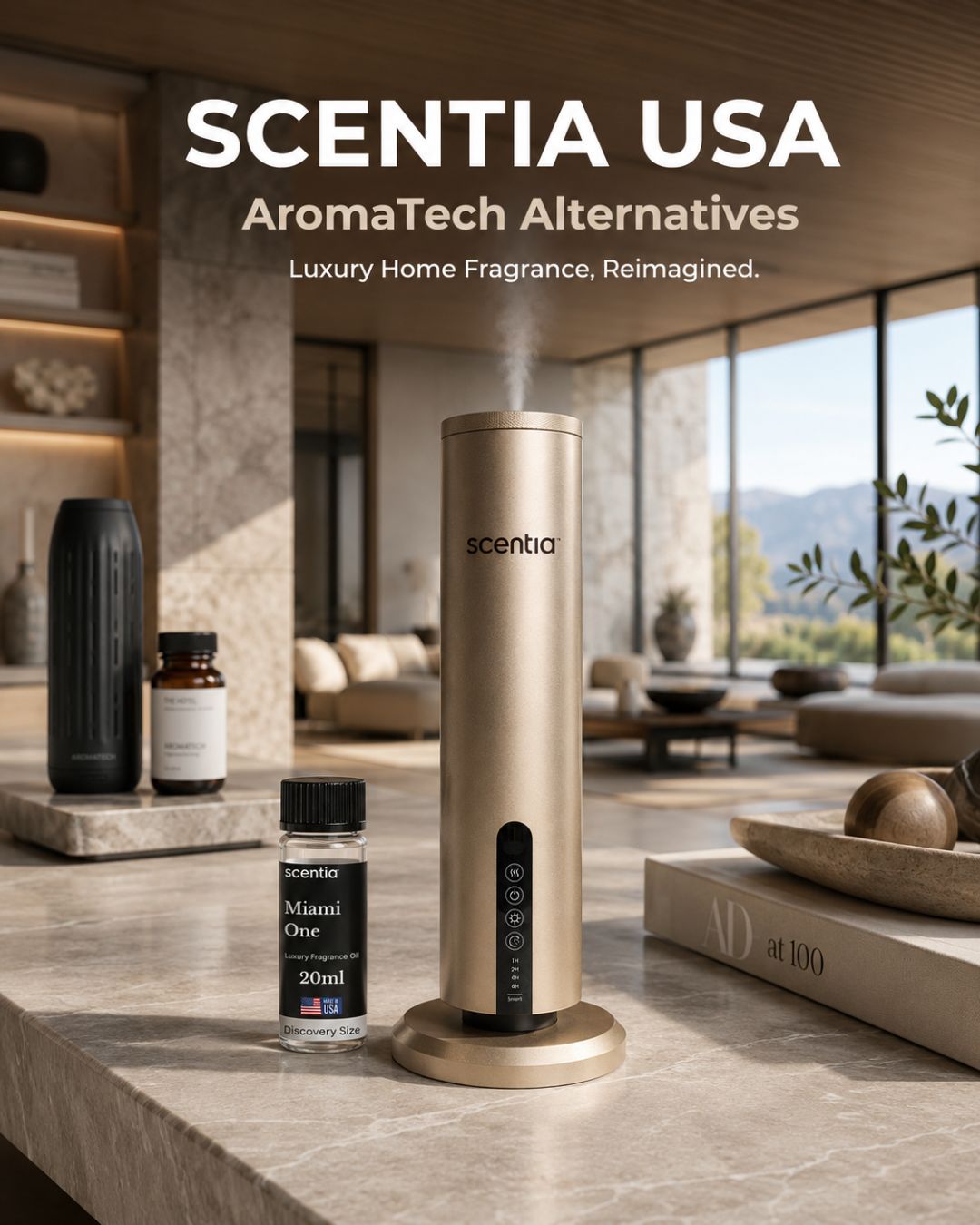
Cold-air diffusion works differently, which is honestly the whole reason we built Scentia around it. There's no heat, so the oil isn't cooking off in a concentrated burst. The diffuser pushes a fine, dry mist into the air on a schedule you set, which means the scent level in the room stays roughly consistent instead of climbing all night. Our Scentia Max runs on a programmable timer, so you can set it to pulse for a few seconds every few minutes rather than running continuously. That's the difference between a house that smells nice and a house that smells like it's trying too hard.
Recommended
Built for Consistent, Room-to-Room Scenting
Scentia Max
Programmable timer lets you pulse fragrance every few minutes instead of running continuously — 1,500 sq ft coverage.
Scentia MiniPod
Portable enough to scent a guest bathroom or entryway without committing a full diffuser to that room. 500 sq ft, wireless.
Luxury Resort Collection
Citrus-forward and ocean-linen profiles that read as clean and fresh rather than heavy, even at moderate-high intensity.
Getting the Delivery Method and Placement Right
Placement matters more than most people account for. A diffuser tucked in a corner behind furniture is going to concentrate scent in that corner and starve the rest of the room. Central, slightly elevated, away from direct airflow from an AC vent — that's the setup that actually distributes evenly. If you've got an open floor plan, one diffuser in the main living space is usually enough. Multiple diffusers running the same or similar scents in adjoining rooms is how you end up with the flat-wall problem.
Intensity is the other lever, and it's the one people ignore because they assume more oil equals a better result. It doesn't. Past a certain point, more oil in a cold-air diffuser doesn't make the scent "nicer," it makes it heavier and less pleasant, the fragrance equivalent of shouting instead of talking. Most of our customers land on a lower intensity setting than they expect to want. Start low, live with it for a day, adjust from there.
Scent choice also plays into this more than people realize. Complex, sweet, multi-note fragrances read as stronger even at the same concentration as a clean single-family scent, because your brain has more to process. If you're worried about overwhelming guests, skip anything heavy on vanilla, amber, or bakery notes and lean toward something in our Luxury Resort Collection — citrus-forward or ocean-and-linen profiles read as fresh and clean rather than heavy, even running at a slightly higher intensity than a sweeter oil would tolerate.
If you want portability — scenting a guest bathroom or an entryway without running a full diffuser there — the MiniPod is built for exactly that. Small footprint, about 500 square feet of coverage, easy to move room to room depending on what's happening that day.
The short version: less is doing more work than you think, cold air beats heat for consistency, and clean scent families forgive you for running a slightly higher intensity than a sweet one would. Get those three things right and you land in the zone where people notice the house smells good without being able to say exactly why.
Frequently Asked Questions
How do I make my house smell good without it being overpowering?
Run less fragrance than feels intuitive, use a cold-air diffuser rather than heat-based candles or plug-ins so the scent stays consistent instead of intensifying over time, and choose a clean scent family like citrus or marine notes, which read as fresh rather than heavy even at a moderate intensity.
Why does my candle smell overwhelming after a few hours but weak at first?
Candles release scent through heat, and the fragrance intensity builds as more of the wax pool melts and the wick burns through built-up wax. This makes candle scent throw inconsistent — weak early, peaking mid-burn, and often muddy by the end.
Where should I place a diffuser for the most even scent?
Central to the room, slightly elevated, and away from direct airflow from an AC vent. A diffuser tucked in a corner behind furniture will concentrate scent in that corner and leave the rest of the room under-scented.
What scent families are least likely to overwhelm guests?
Clean, single-note-forward families like citrus, light florals, and ocean or marine profiles. Heavy, sweet, multi-note scents — vanilla, amber, bakery notes — read as significantly stronger at the same concentration because they require more cognitive processing to parse.
Not sure which diffuser fits your space in the first place? Read our full diffuser buyer's guide →
Miami · Luxury Home Fragrance
Scent That Fills the Room, Not the Guest List
Cold-air diffusion delivers a consistent, room-to-room fragrance without the heat, wax, or guesswork of candles.
Free shipping over $79.99 · Free MiniPod with oil orders over $99 · Use code SCENT10 for 10% off your first order


Leave a comment
All comments are moderated before being published.
This site is protected by hCaptcha and the hCaptcha Privacy Policy and Terms of Service apply.