

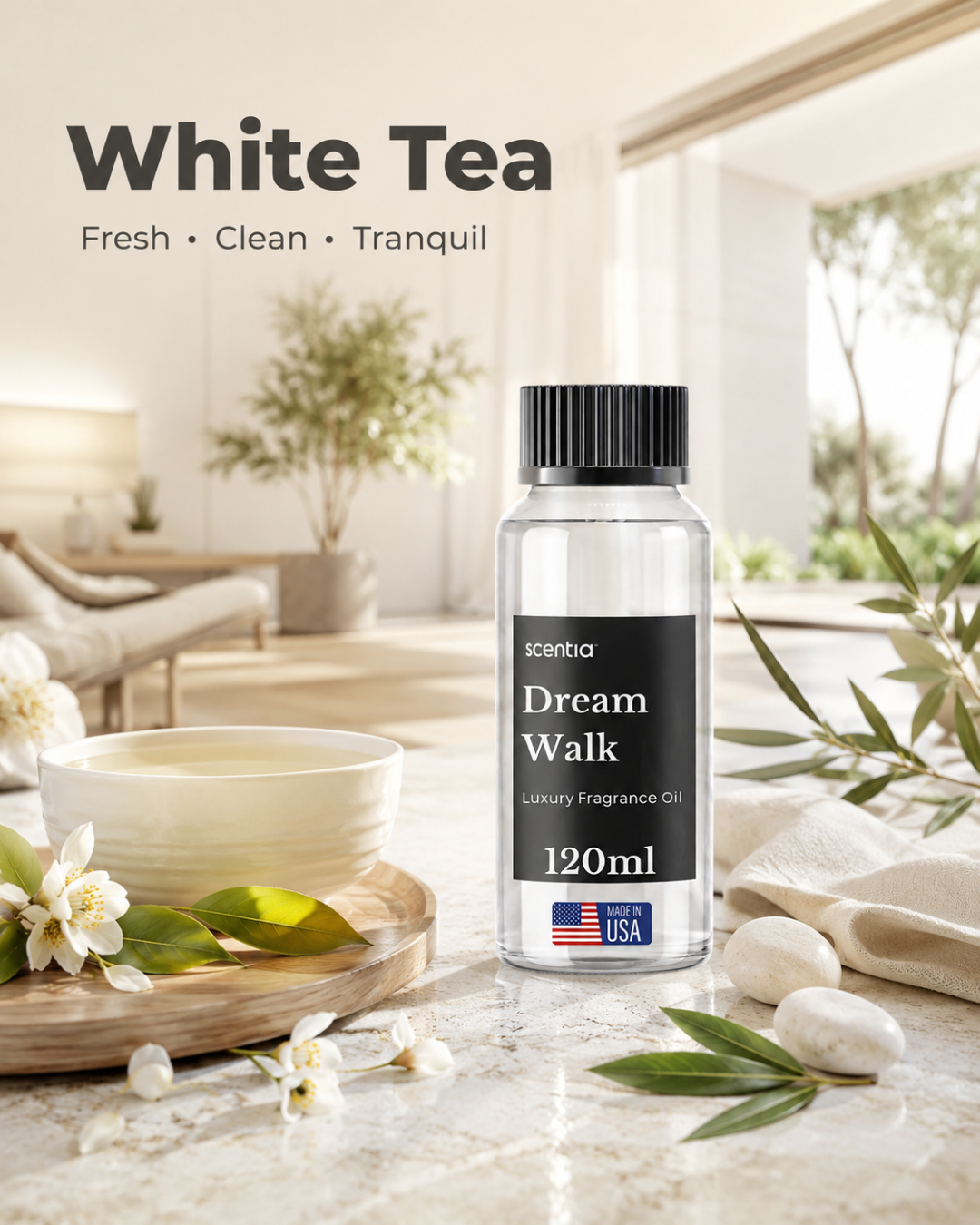
The quietest note in perfumery — built to feel like still water, not fresh leaf.
White tea comes from the same plant as every other tea, Camellia sinensis, but it's picked earliest and processed least — the youngest, silvery buds are harvested before the leaves fully open, then simply withered and air-dried rather than rolled or oxidized. That gentle handling is what gives true white tea its famously pale, delicate character, but it also makes the raw extract faint and notoriously unstable for use in perfumery. So the white tea note that actually reaches a diffuser or a bottle is almost always a built accord — a transparent composition designed to capture the impression of a freshly steeped cup rather than distill the plant directly.
What that impression delivers is a kind of calm that few other notes achieve. Where green tea reads brisk and grassy, white tea is still and pale, more like warm water moving over leaves than the leaves themselves. That quietness is exactly why it's become the signature note of spa and resort-style fragrance — it opens a composition with a sense of quiet freshness without ever raising its voice, then hands off gracefully to whatever warmer notes sit underneath.
What white tea actually smells like
Soft, pale, and faintly sweet — the scent equivalent of afternoon light through a linen curtain. It carries a gentle vegetal quality and a mineral hint of warm water, with none of the sharpness of green tea. It's a note built for calm rather than freshness in the citrusy sense.
Where you'll find it in the Scentia line
White tea opens our most calming, spa-inspired fragrance.
Inspired by Westin® Hotels — white tea, aloe vera, and ginger open into cedarwood and vanilla, settling into a calming base of lily, sandalwood, and musk.
Shop Dream Walk

Leave a comment
All comments are moderated before being published.
This site is protected by hCaptcha and the hCaptcha Privacy Policy and Terms of Service apply.